
Nichollsia
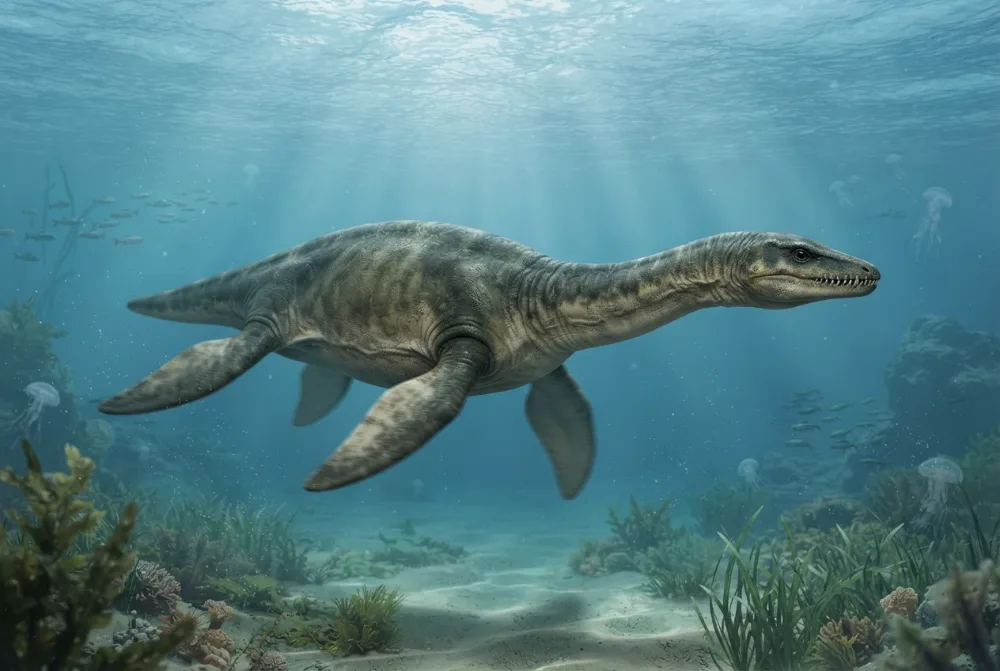
Nichollssaura was a small, fast-swimming marine reptile that lived in the sea that once covered Alberta, Canada. It was a plesiosaur, not a dinosaur, and had a long neck and four flippers for paddling through the water. This creature helps scientists fill in a big 40-million-year gap in the plesiosaur fossil record of North America.1
When did it live?
How big was it?
How big was Nichollsia compared to YOU?
Just maths in your browser. Nothing is saved or sent anywhere.
Fun facts
The fossil was discovered accidentally by giant electric shovel operators in an oilsand mine. The shovel cut off some bones, but the rest of the skeleton was almost complete.1
This plesiosaur was named after Dr. Betsy Nicholls, a famous paleontologist. The first name Nichollsia was already used for a type of isopod, so scientists changed it to Nichollssaura.1
Nichollssaura had 165 gastroliths (stomach stones) inside it. The stones were smooth and round, probably swallowed to help grind food.1
The stomach stones came from rocks that were 8 to 10 million years older than the plesiosaur itself. This suggests Nichollssaura may have swum west to collect pebbles from ancient beaches.1
It lived about 110 million years ago in the Boreal Sea, a warm shallow sea that covered parts of North America.1
The holotype specimen is on display at the Royal Tyrrell Museum in Alberta, Canada.1

Ask Rex about Nichollsia
Rex only answers questions about this page. 3 questions a day.
Rex is an AI and can make mistakes. He runs on servers in the EU and questions are never saved. Never type your name or other personal things.
For dino experts
- Scientific name
- Nichollsia
- Named by
- Druckenmiller and Russell 20082
- Group
- Plesiosaurs
- Family / clade
- Leptocleididae2
- Classification
- Plesiosauria > Sauropterygia2
- Age of the rocks
- 113 to 100 million years (Albian)2
- Fossil records
- 1 in the Paleobiology Database2
- Discovery
- The specimen was found in 1994 by shovel operators Greg Fisher and Lorne Cundal at a Syncrude oilsand mine in Alberta. It was named Nichollsia borealis by Druckenmiller and Russell in 2008, but the name was changed to Nichollssaura in 2009 because Nichollsia was already taken.12
Where the facts come from
- Nichollssaura (en.wikipedia.org)
- Nichollsia in The Paleobiology Database (CC BY 4.0): age, places, rock formations, classification.
Every fact on this page has a number that points to its source. If we got something wrong, sorry, we are dino fans, not a science journal. Tell us at [email protected] and we will fix it.
Rex is hungry! Dino Wiki is a dad's project for his dino-loving son, free with no ads. Grown-ups can feed Rex a snack to help keep it online.Feed Rex Elasmosaurus
 Pliosaurus
 Plesiosaurus
 Cimoliasaurus
 Colymbosaurus
 Trinacromerum
 Stegosaurus
 Iguanodon
 Archaeopteryx
 Giganotosaurus
 Microraptor
 Deinonychus