
Notohypsilophodon
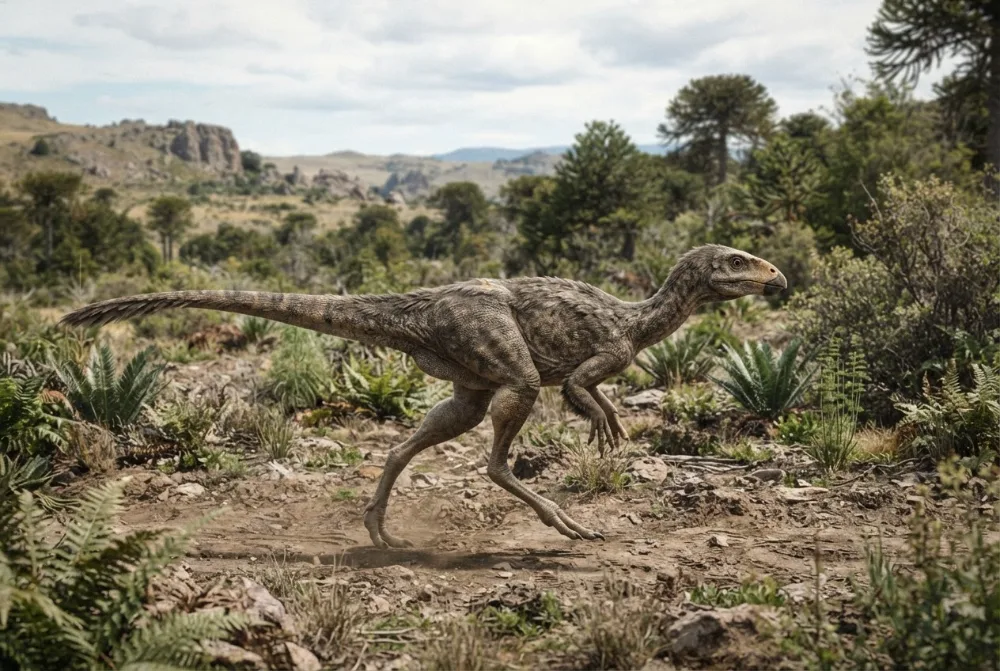
Notohypsilophodon was a small, speedy plant eater that ran on two legs. It lived in what is now Argentina during the Late Cretaceous, about 100 to 90 million years ago. Scientists found a young one, so we are still learning about this little dinosaur.14
When did it live?
How big was it?
How long was it?
How heavy was it?
How big was Notohypsilophodon compared to YOU?
Just maths in your browser. Nothing is saved or sent anywhere.
Fun facts
Notohypsilophodon was the first hypsilophodont dinosaur ever found in South America, which made it very special to scientists.12
The only skeleton we have is from a young dinosaur, because its backbone bones were not fully fused together.12
Its arm bone, the humerus, had no deltopectoral crest, a ridge that many other dinosaurs have for muscle attachment.2
Its shin bone, the tibia, had a bulge on the front and inner side, which is a unique feature of this dinosaur.2
The fibula, a bone in the lower leg, suddenly became narrow near the middle of its shaft, another special trait.2
Its ankle bone, the astragalus, had a top surface with two levels, which is different from many other ornithopods.2
The foot claws, called unguals, had flat undersides, which may have helped it walk or dig.2
Most asked questions about Notohypsilophodon
?How big was Notohypsilophodon?
About 1.3 metres (4.3 ft) long and weighed around 6 kilograms (13 lb), roughly the size of a small dog.1
?What did Notohypsilophodon eat?
It was a herbivore, eating plants. It may have swallowed small stones called gastroliths to help grind up food in its stomach.13
?When did Notohypsilophodon live?
It lived during the Late Cretaceous Period, about 100 to 90 million years ago.1
?Is Notohypsilophodon a dinosaur?
Yes, it is a dinosaur. It is a type of ornithopod, a group of plant-eating, bipedal dinosaurs.1

Ask Rex about Notohypsilophodon
Rex only answers questions about this page. 3 questions a day.
Rex is an AI and can make mistakes. He runs on servers in the EU and questions are never saved. Never type your name or other personal things.
Myth buster
Myth: Some people think Notohypsilophodon was a true hypsilophodont, like Hypsilophodon.
Truth: Scientists now think Hypsilophodontidae is not a real family, and Notohypsilophodon is too incomplete to be sure. It is considered a basal ornithopod, possibly part of a group called Elasmaria.1
For dino experts
- Scientific name
- Notohypsilophodon
- Named by
- Martínez 19984
- Group
- Beaked plant-eaters
- Family / clade
- Elasmaria4
- Classification
- Ornithischia > Ornithopoda > Iguanodontia4
- Age of the rocks
- 100 to 90 million years (Cenomanian / Turonian)4
- Rock formations
- Bajo Barreal4
- Countries
- Argentina4
- Fossil records
- 1 in the Paleobiology Database4
- Discovery
- The skeleton was found in the Bajo Barreal Formation in Argentina during excavations that started in 1985. Rubén D. Martínez named it Notohypsilophodon comodorensis in 1998.12
- Still debated
- Scientists are not sure exactly where Notohypsilophodon belongs in the dinosaur family tree, because the only skeleton is incomplete and from a young animal.1
Where the facts come from
- Notohypsilophodon (en.wikipedia.org)
- The investigation projects “The vertebrates of the Bajo Barreal Formation, Upper Cretaceous of Chubut” and “The vertebrates of the Chubut Group: characteristics and evolution-first stage” have been developed successively by the Laboratorio de Paleovertebrados of the UNPSJB in Comodoro Rivadavia since the year 1985. During their course a rich fauna of vertebrates from the Bajo Barreal Formation has been documented that includes holostean fish, chelonians, crocodiles, abelisaurian and tetanuran theropod dinosaurs, and titanosaur and diplodociform sauropods. To this fauna is added the ornithopod that is the subject of this work. The record of ornithischian dinosaurs in South America has been scarce until recent times, and it includes Pisanosaurus mertii (Casamiquela, 1967) from the Triassic of La Rioja and the Upper Cretaceous hadrosaurs of Patagonia, such as the Chubutian Secernosaurus koerneri (Brett-Surman, 1979) that probably comes from the Bajo Barreal Formation. Recent and important ornithischian discoveries in the region of Comahue, in the north of Patagonia, include the basal iguanodont Gasparinisaura cincosaltensis (Coria and Salgado, 1996) and other ornithopods now in study. Recently, Salgado and Coria (1996) have studied a proximal piece of femur originally classified as belonging to a theropod, Loncosaurus argentinus (Ameghino, 1898) and have considered it an indeterminate ornithopod. This work describes Notohypsilophodon comodorensis, new genus and species, considered (naturalhistory.si.edu)
- A reappraisal of Notohypshilophodon comodorensis (Ornithischia: Ornithopoda) from the Late Cretaceous of Patagonia, Argentina (mapress.com)
- Notohypsilophodon in The Paleobiology Database (CC BY 4.0): age, places, rock formations, classification.
Every fact on this page has a number that points to its source. If we got something wrong, sorry, we are dino fans, not a science journal. Tell us at [email protected] and we will fix it.
 Rex is hungry! Dino Wiki is a dad's project for his dino-loving son, free with no ads. Grown-ups can feed Rex a snack to help keep it online.Feed Rex
 Iguanodon
 Tenontosaurus
 Thescelosaurus
 Zalmoxes
 Camptosaurus
 Rhabdodon
 Tyrannosaurus
 Triceratops
 Velociraptor
 Spinosaurus
 Ankylosaurus
 Parasaurolophus