
Opallionectes
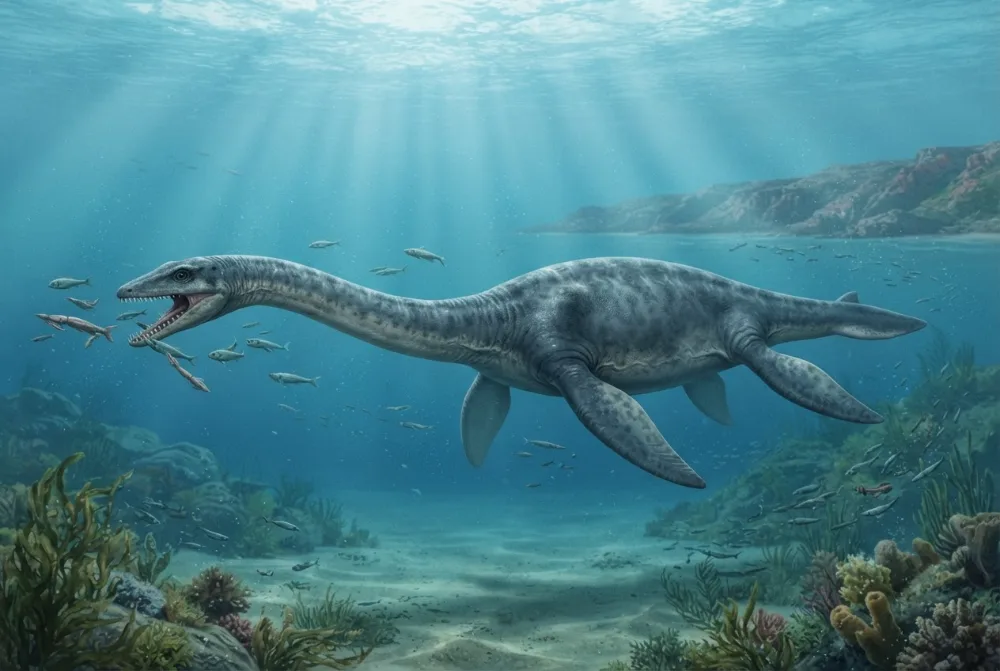
Opallionectes was a plesiosaur, a long-necked marine reptile that swam in the seas near Australia. It had needle-sharp teeth and ate fish and squid. Its bones were turned into opal, a shiny gemstone!1
When did it live?
How big was it?
How big was Opallionectes compared to YOU?
Just maths in your browser. Nothing is saved or sent anywhere.
Fun facts
Opallionectes lived about 115 million years ago in a cold, possibly freezing sea.1
Its skeleton was found in an opal mine and parts of it turned into opal, a precious gemstone.1
It had fine, needle-like teeth that were flattened side to side, similar to ancient nothosaurs.1
Opallionectes is considered a missing link between older plesiosaurs from 165 million years ago and those from 66 million years ago.1
Scientists think it might have migrated to warmer waters or had a high metabolism to survive the cold.1

Ask Rex about Opallionectes
Rex only answers questions about this page. 3 questions a day.
Rex is an AI and can make mistakes. He runs on servers in the EU and questions are never saved. Never type your name or other personal things.
For dino experts
- Scientific name
- Opallionectes
- Named by
- Kear 20063
- Group
- Plesiosaurs
- Family / clade
- Plesiosauroidea3
- Classification
- Plesiosauria > Sauropterygia3
- Age of the rocks
- 120 to 113 million years (Aptian)3
- Rock formations
- Bulldog Shale3
- Countries
- Australia3
- Fossil records
- 1 in the Paleobiology Database3
- Discovery
- The species Opallionectes andamookaensis was named by Benjamin P. Kear in 2006, based on a partial opalized skeleton found in an opal mine at Andamooka, South Australia.13
- Still debated
- Scientists are not sure exactly how Opallionectes adapted to the cold waters it lived in, whether by migrating or by having a higher body temperature.1
Where the facts come from
- Opallionectes (en.wikipedia.org)
- PBDB Taxon (paleobiodb.org)
- Opallionectes in The Paleobiology Database (CC BY 4.0): age, places, rock formations, classification.
Every fact on this page has a number that points to its source. If we got something wrong, sorry, we are dino fans, not a science journal. Tell us at [email protected] and we will fix it.
Rex is hungry! Dino Wiki is a dad's project for his dino-loving son, free with no ads. Grown-ups can feed Rex a snack to help keep it online.Feed Rex Elasmosaurus
 Pliosaurus
 Plesiosaurus
 Cimoliasaurus
 Colymbosaurus
 Trinacromerum
 Stegosaurus
 Iguanodon
 Archaeopteryx
 Giganotosaurus
 Microraptor
 Deinonychus