
Ophthalmothule
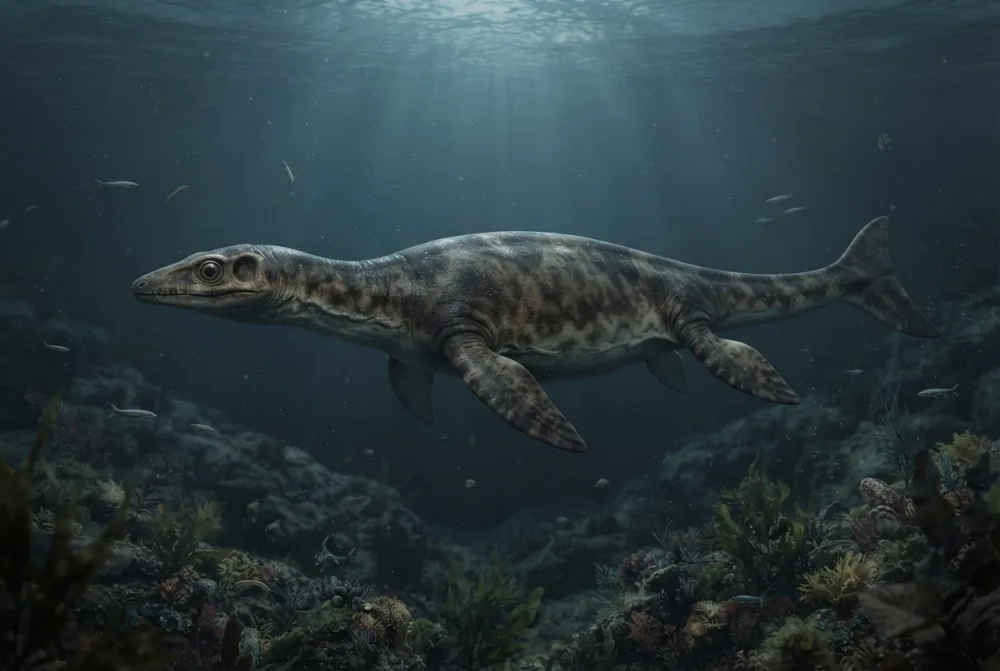
Ophthalmothule was a plesiosaur, a marine reptile that lived in the sea, not a dinosaur. It had huge eye sockets, so it probably hunted in dark or deep water. This medium-sized swimmer was about as long as a car.12
When did it live?
How big was it?
How long was it?
How big was Ophthalmothule compared to YOU?
Just maths in your browser. Nothing is saved or sent anywhere.
Fun facts
Ophthalmothule lived right at the end of the Jurassic and start of the Cretaceous, about 149 to 137 million years ago.3
Its name means 'eye of the north' because it had very large eye sockets and was found in the far north.12
This plesiosaur is one of the youngest cryptoclidids known from the Boreal region, along with Abyssosaurus.12
The holotype specimen includes a nearly complete skull and parts of the body, which is rare for cryptoclidid plesiosaurs.2
Ophthalmothule had a long neck with all its neck bones found still connected, helping scientists study how plesiosaurs moved their necks.2

Ask Rex about Ophthalmothule
Rex only answers questions about this page. 10 questions a month.
Rex is an AI and can make mistakes. He runs on servers in the EU and questions are never saved. Never type your name or other personal things.
For dino experts
- Scientific name
- Ophthalmothule
- Named by
- Roberts et al. 20204
- Group
- Plesiosaurs
- Family / clade
- Cryptoclididae4
- Classification
- Plesiosauria > Sauropterygia4
- Age of the rocks
- 149 to 137 million years (Tithonian / Berriasian)4
- Rock formations
- Agardhfjellet4
- Countries
- Norway4
- Fossil records
- 1 in the Paleobiology Database4
- Discovery
- Ophthalmothule was named in 2020 by Roberts and colleagues. The fossil was dug up in 2012 from Mount Wiman on Spitsbergen, Norway, from rocks that span the Jurassic-Cretaceous boundary.23
- Still debated
- Scientists are not sure whether the Ophthalmothule fossil comes from the very end of the Jurassic or the very beginning of the Cretaceous, because the rock layers are very compressed.2
Where the facts come from
- Ophthalmothule (en.wikipedia.org)
- PeerJ A new plesiosaurian from the Jurassic, Cretaceous transitional interval of the Slottsmøya Member (Volgian), with insights into the cranial anatomy of cryptoclidids using computed tomography (peerj.com)
- PBDB Taxon (paleobiodb.org)
- Ophthalmothule in The Paleobiology Database (CC BY 4.0): age, places, rock formations, classification.
Every fact on this page has a number that points to its source. If we got something wrong, sorry, we are dino fans, not a science journal. Tell us at [email protected] and we will fix it.
 Rex is hungry! Dino Wiki is a dad's project for his dino-loving son, free with no ads. Grown-ups can feed Rex a snack to help keep it online.Feed Rex
 Elasmosaurus
 Pliosaurus
 Plesiosaurus
 Cimoliasaurus
 Colymbosaurus
 Trinacromerum
 Stegosaurus
 Iguanodon
 Archaeopteryx
 Giganotosaurus
 Microraptor
 Deinonychus