 Home
 All dinos
 Dino groups
 Explore
 Dinos by country
 Dino vs dino
 How big were they?
 Dinos A to Z
 Who ate what?
 What dino are you? Quiz
 Dino games
 Dino battle
 Dino race
 Dino mini-games
 Sticker album
 Dino TOP lists
 Timeline
 Surprise me!
 Language: English

Oxalaia
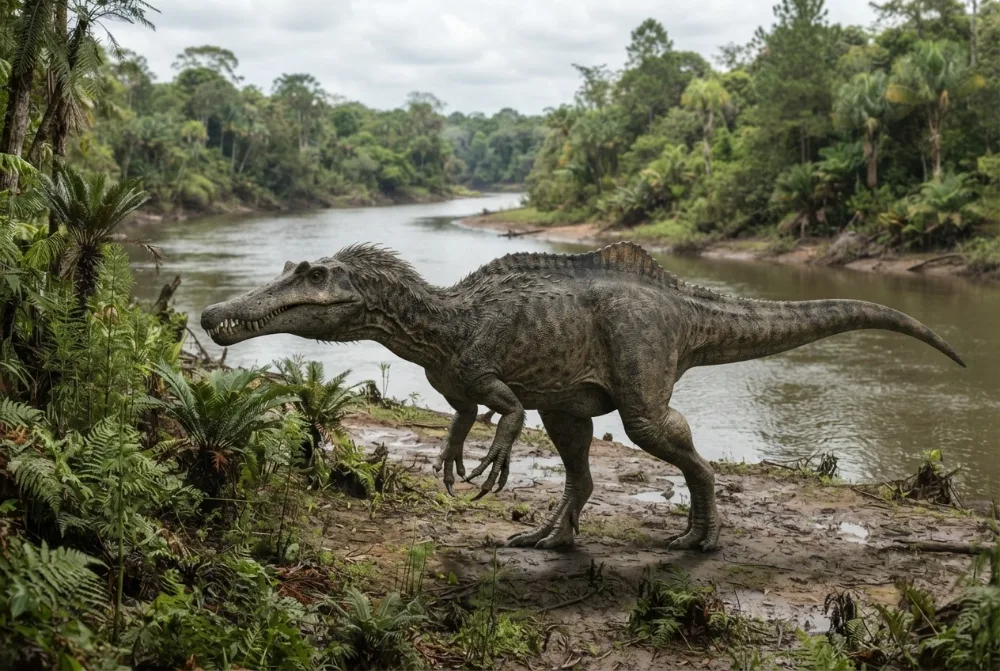
Oxalaia was a huge, meat-eating dinosaur with a long snout like a crocodile. It lived in what is now Brazil and was one of the biggest predators of its time.1
 Brazil
When did it live?
Oxalaia: 100 to 94 million years ago
How big was it?
How long was it?
How tall was it?
estimate
How heavy was it?
 as long as 3 cars parked in a row🍌as long as 78 bananas end to end
 about as heavy as an elephant🍉as heavy as 1400 watermelons🎒as heavy as 9 whole school classes of kids🐻❄️as heavy as 16 polar bears🏢tall enough to peek into a window on floor 2🏃could run 100 metres in 20 seconds (the fastest human needs 9.6)
How big was Oxalaia compared to YOU?
Just maths in your browser. Nothing is saved or sent anywhere.
How fast was it?


Fun facts
Oxalaia is the largest meat-eating dinosaur ever found in Brazil.1
Its teeth had no serrations, unlike many other spinosaurids such as Suchomimus.1
Oxalaia had one functional tooth followed by two replacement teeth, a feature not seen in other theropod dinosaurs.1
The front part of its snout was very expanded and rounded, different from Spinosaurus.1
Oxalaia lived about 100 to 94 million years ago during the Late Cretaceous period.3
Its fossils were found on Cajual Island, a place where descendants of escaped slaves (quilombolas) live.1
Most asked questions about Oxalaia
?How big was Oxalaia?
Oxalaia was about 12 to 14 metres long and weighed 5 to 7 tonnes. That makes it the largest meat eating dinosaur found in Brazil.12
?What did Oxalaia eat?
Oxalaia was a spinosaurid, so it mostly ate fish, like a crocodile. It may also have eaten small dinosaurs and pterosaurs.2
?When did Oxalaia live?
Oxalaia lived during the Late Cretaceous period, about 100.5 to 93.9 million years ago.2
?Where was Oxalaia found?
Oxalaia's fossils were found on Cajual Island in Maranhão, northeastern Brazil, in the Alcântara Formation.2
?Is Oxalaia a dinosaur?
Yes, Oxalaia is a dinosaur. It is a spinosaurid theropod, which means it was a meat-eating dinosaur.2
?Did Oxalaia have feathers?
Nobody knows for sure. No feathers have been found with Oxalaia fossils, and spinosaurids are not known to have feathers, but some related dinosaurs may have had them.2
?Was Oxalaia bigger than T. rex?
Oxalaia was about 12 to 14 metres long, similar in length to T. rex, but T. rex was heavier, weighing about 8 tonnes compared to Oxalaia's 5 to 7 tonnes.12
?Could Oxalaia swim?
It is possible. Spinosaurids like Oxalaia had long snouts and conical teeth like fish-eaters, and some scientists think they could swim, but there is no direct evidence for Oxalaia.2
For dino experts
- Scientific name
- Oxalaia
- Named by
- Kellner et al. 20113
- Group
- Spinosaurs
- Family / clade
- Spinosauridae3
- Classification
- Theropoda > Spinosauridae3
- Age of the rocks
- 100 to 94 million years (Cenomanian)3
- Rock formations
- Alcântara3
- Countries
- Brazil3
- Fossil records
- 1 in the Paleobiology Database3
- Discovery
- Oxalaia was named in 2011 by Alexander Kellner and his team based on a snout and a jaw fragment found at Laje do Coringa in Brazil.31
- Still debated
- Scientists are not sure if Oxalaia is a separate species or the same as Spinosaurus, because only a few bones have been found.1
Where the facts come from
- A new dinosaur (Theropoda, Spinosauridae) from the Cretaceous (Cenomanian) Alcântara Formation, Cajual Island, Brazil (scielo.br)
- Oxalaia (en.wikipedia.org)
- Oxalaia in The Paleobiology Database (CC BY 4.0): age, places, rock formations, classification.
Every fact on this page has a number that points to its source. If we got something wrong, sorry, we are dino fans, not a science journal. Tell us at hello@dinowiki.app and we will fix it.
 Rex is hungry! Dino Wiki is a dad's project for his dino-loving son, free with no ads and no cookies. Grown-ups can feed Rex a snack to help keep it online.Feed Rex
 Spinosaurus
 Baryonyx
 Suchomimus
 Angaturama
 Camarillasaurus
 Ceratosuchops
 Tyrannosaurus
 Triceratops
 Velociraptor
 Ankylosaurus
 Parasaurolophus
 Pteranodon