
Piksi
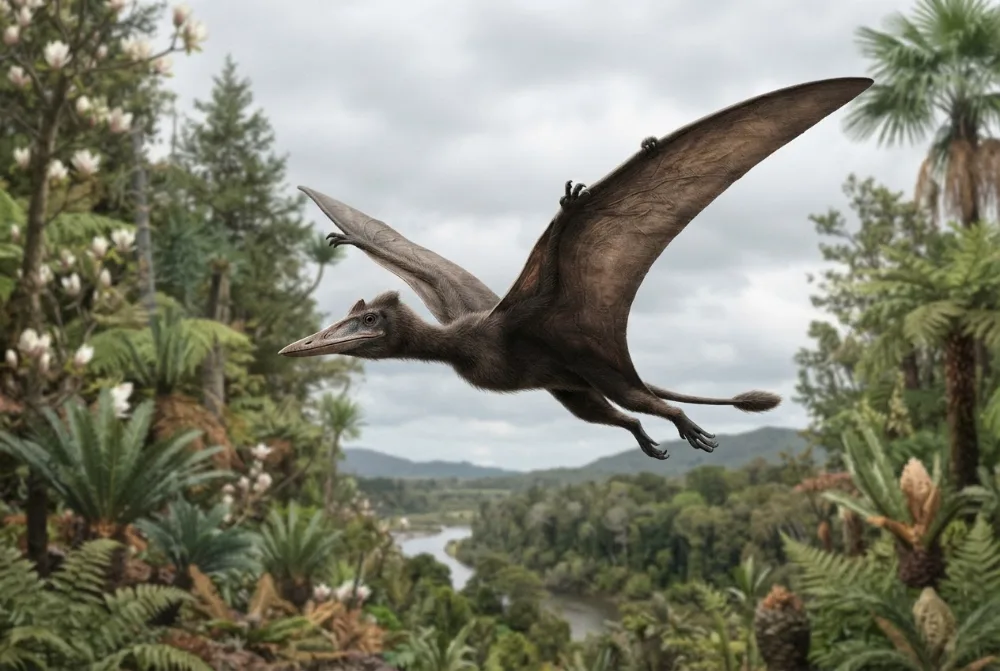
Piksi was a small flying reptile that lived about 75 million years ago. It had a wingspan of about 1 meter (3.3 feet), which is as wide as a big bird's wings. Piksi used its wings to fly over ancient Montana, USA.12
When did it live?
How big was it?
How wide were its wings?
How big was Piksi compared to YOU?
Just maths in your browser. Nothing is saved or sent anywhere.
How fast was it?
Fun facts
Piksi was first thought to be a bird, but scientists later realized it was a pterosaur, a flying reptile.21
The only known fossils of Piksi are parts of its right wing: the humerus, ulna, and radius bones.31
Piksi belongs to a group of pterosaurs called Ornithocheiroidea, which had teeth and were common in the Early Cretaceous.2
The fossils were found in 1991 by Gloria Jean Siebrecht on the Blackfeet Indian Reservation in Montana.1
Most asked questions about Piksi

Ask Rex about Piksi
Rex only answers questions about this page. 10 questions a month.
Rex is an AI and can make mistakes. He runs on servers in the EU and questions are never saved. Never type your name or other personal things.
For dino experts
- Scientific name
- Piksi
- Named by
- Varricchio 20023
- Group
- Flying reptiles
- Family / clade
- Ornithocheiroidea3
- Classification
- Pterosauria > Pterodactyloidea3
- Age of the rocks
- 84 to 72 million years (Campanian)3
- Rock formations
- Two Medicine3
- Countries
- USA3
- Fossil records
- 1 in the Paleobiology Database3
- Discovery
- Piksi was named in 2002 by paleontologist David J. Varricchio. The fossils were found in 1991 by Gloria Jean Siebrecht at Bob's Vacation Site in Montana, USA.31
- Still debated
- Scientists are still debating whether Piksi is definitely a pterosaur or might be something else, because the fossils are very fragmentary.1
Where the facts come from
- Piksi (en.wikipedia.org)
- Systematic reinterpretation of Piksi barbarulna Varricchio, 2002 from the Two Medicine Formation (Upper Cretaceous) of Western USA (Montana) as a pterosaur rather than a bird (sciencepress.mnhn.fr)
- Piksi in The Paleobiology Database (CC BY 4.0): age, places, rock formations, classification.
Every fact on this page has a number that points to its source. If we got something wrong, sorry, we are dino fans, not a science journal. Tell us at [email protected] and we will fix it.
 Rex is hungry! Dino Wiki is a dad's project for his dino-loving son, free with no ads. Grown-ups can feed Rex a snack to help keep it online.Feed Rex
 Pteranodon
 Quetzalcoatlus
 Dorygnathus
 Rhamphorhynchus
 Anhanguera
 Pterodactylus
 Tyrannosaurus
 Triceratops
 Velociraptor
 Spinosaurus
 Ankylosaurus
 Parasaurolophus