
Plioplatecarpus
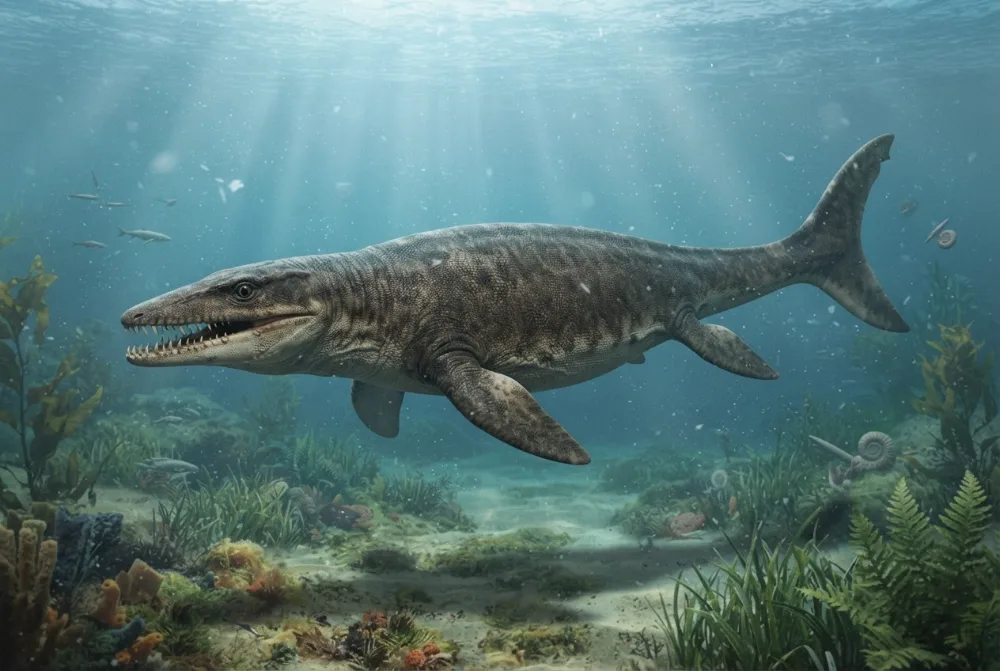
Plioplatecarpus was a medium-sized mosasaur, a giant marine lizard that lived in the late Cretaceous seas. It had big eyes and fewer, sharply curved teeth than other mosasaurs, perfect for grabbing small, slippery prey. Fossils of this ocean hunter have been found all over the world, from North America to Europe and even Antarctica.14
When did it live?
How big was it?
How long was it?
 as long as 6 dogs nose to tail🍌as long as 33 bananas end to end🏊could swim the length of a big swimming pool (50 m) in 4.7 seconds
How big was Plioplatecarpus compared to YOU?
Just maths in your browser. Nothing is saved or sent anywhere.
How fast was it?


Fun facts
Plioplatecarpus had bigger eyes than most other mosasaurs, which may have helped it see in dark, deep water.1
Its teeth were fewer but strongly curved backward, so it could grab small prey very precisely.1
Some scientists think Plioplatecarpus could swim into rivers and estuaries, not just the open ocean.1
Plioplatecarpus used its front flippers for underwater flight, like a bird flaps its wings, to move through weedy or coral reef areas.2
The first Plioplatecarpus fossil was found in Belgium and named by Louis Dollo in 1882.1
Plioplatecarpus lived about 82 to 66 million years ago, during the late Cretaceous period.1
Most asked questions about Plioplatecarpus
?How big was Plioplatecarpus?
About 5.5 to 6 metres long, depending on the species.1
?What did Plioplatecarpus eat?
It ate small, slippery prey like fish and squid, grabbing them with its sharply curved teeth.13
?Could Plioplatecarpus swim in freshwater?
Some scientists think it could, because a fossil was found in a non-marine deposit, suggesting it entered rivers and estuaries.1
?When did Plioplatecarpus live?
It lived in the late Cretaceous period, about 82 to 68 million years ago.1

Ask Rex about Plioplatecarpus
Rex only answers questions about this page. 10 questions a month.
Rex is an AI and can make mistakes. He runs on servers in the EU and questions are never saved. Never type your name or other personal things.
Myth buster
Myth: Plioplatecarpus was a dinosaur.
Truth: Plioplatecarpus was a mosasaur, a type of marine lizard that lived in the sea, not a dinosaur.1
For dino experts
- Scientific name
- Plioplatecarpus
- Named by
- Dollo 18824
- Group
- Mosasaurs
- Family / clade
- Mosasauridae4
- Classification
- Mosasauroidea4
- Age of the rocks
- 100 to 62 million years (Cenomanian / Danian)4
- Rock formations
- Bearpaw Shale, Pierre Shale, Fox Hills4
- Countries
- USA, Canada, Antarctica, Sweden, Denmark, Russia4
- Fossil records
- 28 in the Paleobiology Database4
- Discovery
- The first Plioplatecarpus fossil was found in Belgium and named by paleontologist Louis Dollo in 1882. Later, fossils from North America that were first called Mosasaurus were reclassified as Plioplatecarpus.1
- Still debated
- Scientists still debate whether some North American Plioplatecarpus fossils belong to separate species or are just variations of the same species found in Europe.2
Where the facts come from
- Plioplatecarpus (en.wikipedia.org)
- Plioplatecarpus (Reptilia, Mosasauridae) from the Upper (biblio.naturalsciences.be)
- Plioplatecarpus (prehistoric-wildlife.com)
- Plioplatecarpus in The Paleobiology Database (CC BY 4.0): age, places, rock formations, classification.
Every fact on this page has a number that points to its source. If we got something wrong, sorry, we are dino fans, not a science journal. Tell us at [email protected] and we will fix it.
 Rex is hungry! Dino Wiki is a dad's project for his dino-loving son, free with no ads. Grown-ups can feed Rex a snack to help keep it online.Feed Rex
 Mosasaurus
 Prognathodon
 Tylosaurus
 Platecarpus
 Clidastes
 Globidens
 Tyrannosaurus
 Triceratops
 Velociraptor
 Spinosaurus
 Ankylosaurus
 Parasaurolophus