
Rhinorex
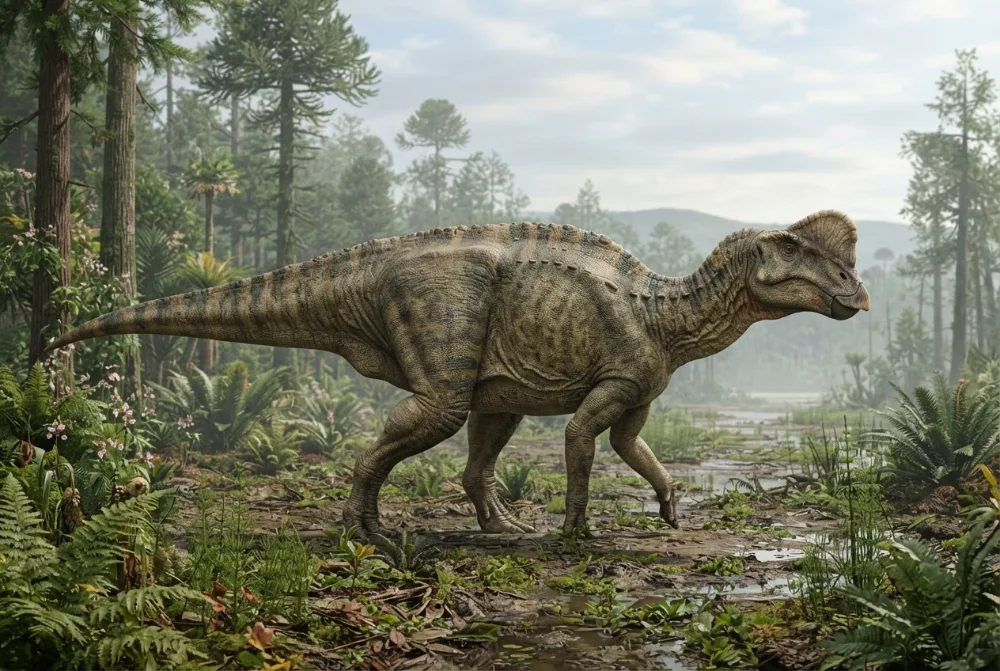
Rhinorex was a duck-billed dinosaur with a huge, bony nose that made it look like a giant bulldog. It lived in swampy forests near the coast of ancient Utah about 75 million years ago. This gentle plant-eater used its big nose to impress friends or smash plants, but scientists are still sniffing out the real reason!12
When did it live?
How big was it?
How long was it?
How heavy was it?
How big was Rhinorex compared to YOU?
Just maths in your browser. Nothing is saved or sent anywhere.
Fun facts
Rhinorex's fossil was first dug up in the 1990s, but it sat in storage for years because scientists were more interested in its well-preserved skin impressions than its bones.1
Unlike many other duck-billed dinosaurs, Rhinorex did not have a crest on top of its head. Instead, it had a huge, bony nose that gave it a very unique face.1
Rhinorex lived in an estuary, a swampy area where a river meets the sea, about 50 miles from the coast. This is different from its relative Gryposaurus, which lived further inland.1
Scientists are not sure why Rhinorex had such a big nose. It might have been used to attract mates, to recognize other members of its species, or as a base for a strong, plant-smashing beak.1
Rhinorex is the only complete hadrosaur fossil ever found in the Neslen Formation, making it a very important discovery for understanding Utah's ancient environments.1
Most asked questions about Rhinorex
?How big was Rhinorex?
About 9 metres (30 feet) long and weighed over 3,850 kilograms (8,500 lbs).1
?Why did Rhinorex have a big nose?
Scientists are not sure yet. It might have been used to attract mates, recognize its own species, or as a base for a strong beak to smash plants.1
?Is Rhinorex a dinosaur?
Yes, it is a duck-billed dinosaur called a hadrosaur.4
Ask Rex about Rhinorex
Rex only answers questions about this page. 3 questions a day.
Rex is an AI and can make mistakes. He runs on servers in the EU and questions are never saved. Never type your name or other personal things.
Myth buster
Myth: Rhinorex was a fierce predator with a horn on its nose.
Truth: Rhinorex was a gentle plant-eating hadrosaur, not a predator. Its 'nose' was a bony bump, not a horn, and it used its beak to eat plants.2
For dino experts
- Scientific name
- Rhinorex
- Named by
- Gates and Scheetz 20145
- Group
- Duck-bills
- Family / clade
- Hadrosauridae5
- Classification
- Ornithischia > Ornithopoda > Iguanodontia > Hadrosauridae5
- Age of the rocks
- 84 to 72 million years (Campanian)5
- Rock formations
- Nelsen5
- Countries
- USA5
- Fossil records
- 1 in the Paleobiology Database5
- Discovery
- Rhinorex was discovered by two geology students from the University of California, Riverside in 1992 while they were mapping the Book Cliffs in eastern Utah. It was later named and described by paleontologists Terry Gates and Rodney Scheetz in 2014 after they found the fossil in storage at Brigham Young University.12
- Still debated
- Scientists are still debating whether Rhinorex lived at exactly the same time as its close relative Gryposaurus, or if it lived a bit later. This would change whether they shared the same habitat or if Rhinorex evolved from Gryposaurus.2
Where the facts come from
- New Hadrosaur Noses into Spotlight | NC State News (news.ncsu.edu)
- New Dinosaur Rhinorex Raises Cretaceous Quandary (nationalgeographic.com)
- New dinosaur species with giant nose discovered in Utah - Utah Geological Survey (geology.utah.gov)
- Rhinorex (en.wikipedia.org)
- Rhinorex in The Paleobiology Database (CC BY 4.0): age, places, rock formations, classification.
Every fact on this page has a number that points to its source. If we got something wrong, sorry, we are dino fans, not a science journal. Tell us at [email protected] and we will fix it.
 Rex is hungry! Dino Wiki is a dad's project for his dino-loving son, free with no ads. Grown-ups can feed Rex a snack to help keep it online.Feed Rex
 Parasaurolophus
 Edmontosaurus
 Saurolophus
 Hypacrosaurus
 Corythosaurus
 Kritosaurus
 Tyrannosaurus
 Triceratops
 Velociraptor
 Spinosaurus
 Ankylosaurus
 Pteranodon