
Shantungosaurus
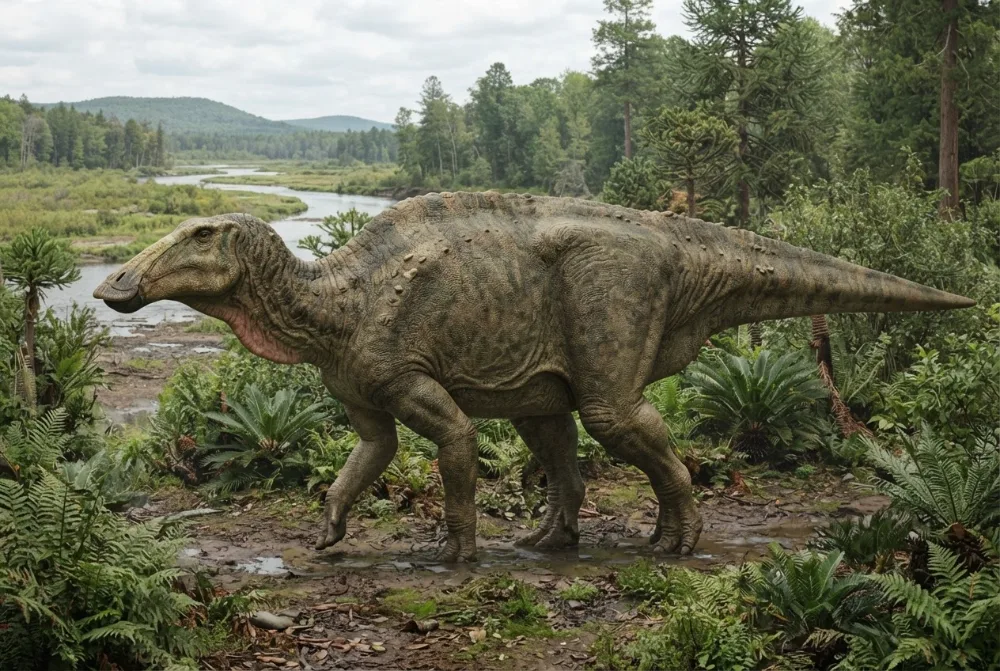
Shantungosaurus was a giant duck-billed dinosaur that lived in China during the Late Cretaceous. It was one of the biggest plant-eaters of its time, with a long snout shaped like a duck's bill and hundreds of tiny teeth.21
When did it live?
How big was it?
How big was Shantungosaurus compared to YOU?
Just maths in your browser. Nothing is saved or sent anywhere.
Fun facts
Shantungosaurus is the largest known duck-billed dinosaur, even bigger than other hadrosaurs like Edmontosaurus.2
Its skull alone was about 1.63 metres (5.3 feet) long, which is longer than a tall adult human.2
It had around 1,500 tiny teeth in its jaws, which it used to chew tough plants.2
A big hole near its nostrils might have been covered by a loose flap of skin that could puff up to make sounds.2
Most asked questions about Shantungosaurus
?How big was Shantungosaurus?
It was about 15 to 17 metres long and weighed around 13 to 16 metric tons. Some scientists think it was a bit smaller, about 15 metres and 13 metric tons.21
?What did Shantungosaurus eat?
It was a plant-eater, eating tough, low-growing plants like pine branches and flowering plants. It used its 1,500 tiny teeth to chew them up.32
?When did Shantungosaurus live?
It lived during the Late Cretaceous Period, about 78 to 74 million years ago. Some sources say 77 to 71 million years ago.12
?Where was Shantungosaurus found?
Its fossils were found in the Shandong Peninsula in China. It was first described by paleontologist Hu Chengzhi in 1973.32
?Was Shantungosaurus bigger than T. rex?
Shantungosaurus was longer than T. rex, but T. rex was a meat eater and Shantungosaurus was a plant eater. Shantungosaurus could be up to 17 metres long, while T. rex was about 12 metres long.2
?Did Shantungosaurus have feathers?
No, scientists have not found any evidence of feathers on Shantungosaurus. It was a duck-billed dinosaur with scaly skin, and its hands were webbed.3
?Could Shantungosaurus swim?
It probably could swim, because it often browsed along the shores of lakes and other bodies of water. Its webbed hands might have helped it paddle.3

Ask Rex about Shantungosaurus
Rex only answers questions about this page. 3 questions a day.
Rex is an AI and can make mistakes. He runs on servers in the EU and questions are never saved. Never type your name or other personal things.
For dino experts
- Scientific name
- Shantungosaurus
- Named by
- Hu 19734
- Group
- Duck-bills
- Family / clade
- Hadrosauridae4
- Classification
- Ornithischia > Ornithopoda > Iguanodontia > Hadrosauridae4
- Age of the rocks
- 100 to 66 million years (Cenomanian / Maastrichtian)4
- Rock formations
- Hongtuya, Huiquanpu, Shanyang/Hongtuling4
- Countries
- China4
- Fossil records
- 5 in the Paleobiology Database4
- Also known as
- Huaxiaosaurus, Zhuchengosaurus (older names now counted as the same animal)4
- Discovery
- Shantungosaurus was first described by Chinese scientist C.-C. Hu in 1973, based on fossils dug up between 1964 and 1968 in Shandong, China.24
- Still debated
- Scientists still debate its exact maximum size, with some estimates up to 17 metres long and others closer to 15 metres.2
Where the facts come from
- Shantungosaurus | Natural History Museum (nhm.ac.uk)
- Shantungosaurus (en.wikipedia.org)
- Shantungosaurus - Students | Britannica Kids | Homework Help (kids.britannica.com)
- Shantungosaurus in The Paleobiology Database (CC BY 4.0): age, places, rock formations, classification.
Every fact on this page has a number that points to its source. If we got something wrong, sorry, we are dino fans, not a science journal. Tell us at [email protected] and we will fix it.
Rex is hungry! Dino Wiki is a dad's project for his dino-loving son, free with no ads. Grown-ups can feed Rex a snack to help keep it online.Feed Rex Parasaurolophus
 Edmontosaurus
 Saurolophus
 Hypacrosaurus
 Corythosaurus
 Kritosaurus
 Triceratops
 Velociraptor
 Spinosaurus
 Ankylosaurus
 Pteranodon