
Tsagantegia
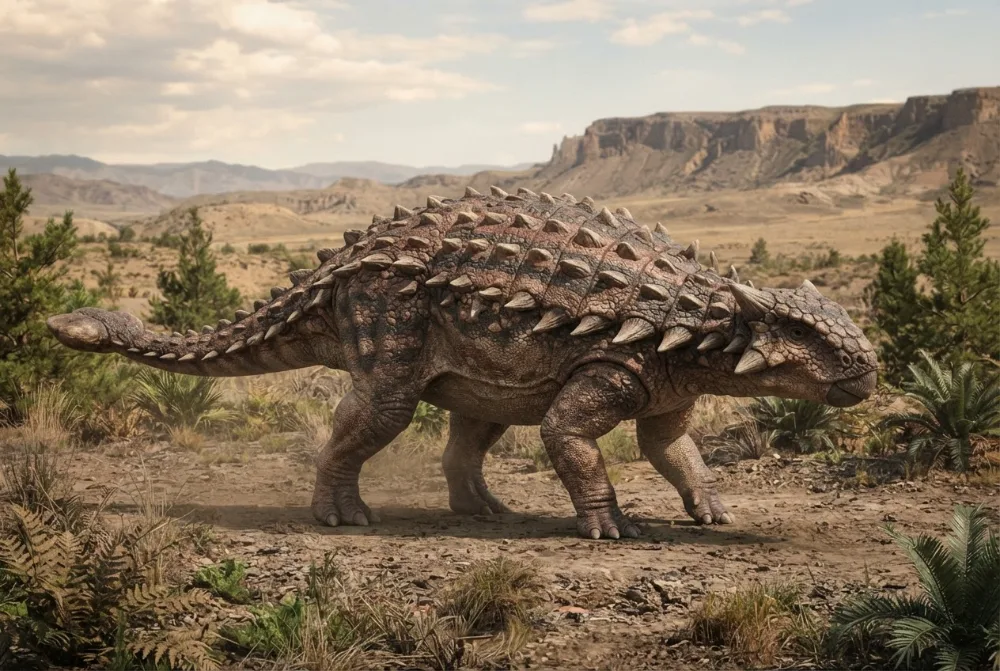
Tsagantegia was a medium-sized armoured dinosaur that lived in what is now Mongolia. It had a long, flat snout and flat bony plates on its head, which made it look different from other ankylosaurs.1
When did it live?
How big was it?
How big was Tsagantegia compared to YOU?
Just maths in your browser. Nothing is saved or sent anywhere.
Fun facts
Tsagantegia is known only from a single skull, about 38 cm long. No other bones have been found.1
The skull of Tsagantegia is longer than it is wide, unlike many other ankylosaurs.1
The bony plates on its head were flat and not arranged in a mosaic pattern like in other ankylosaurs.1
Tsagantegia lived about 92 to 86 million years ago, during the Late Cretaceous period.1
It shared its habitat with the theropod Achillobator and the long-necked sauropod Erketu.1
Tsagantegia had a U-shaped beak, which may have helped it eat different plants than its relative Talarurus.1
Most asked questions about Tsagantegia
?How big was Tsagantegia?
Tsagantegia was about 3 to 4 metres (10 to 13 feet) long and weighed roughly 1 to 2 tonnes (2,200 to 4,400 pounds).1
?What did Tsagantegia eat?
Tsagantegia was a herbivore, meaning it ate plants. It had a shovel-like snout that helped it browse on plants, unlike its relative Talarurus which grazed.13
?When did Tsagantegia live?
Tsagantegia lived during the Late Cretaceous period, about 92 to 86 million years ago.1

Ask Rex about Tsagantegia
Rex only answers questions about this page. 3 questions a day.
Rex is an AI and can make mistakes. He runs on servers in the EU and questions are never saved. Never type your name or other personal things.
For dino experts
- Scientific name
- Tsagantegia
- Named by
- Tumanova 19933
- Group
- Armoured dinos
- Family / clade
- Ankylosauridae3
- Classification
- Ornithischia > Ankylosauria > Ankylosauridae > Thyreophora3
- Age of the rocks
- 100 to 84 million years (Cenomanian / Santonian)3
- Rock formations
- Baynshire3
- Countries
- Mongolia3
- Fossil records
- 2 in the Paleobiology Database3
- Discovery
- The only Tsagantegia skull was found in 1983 by a joint Soviet-Mongolian expedition. Russian paleontologist Tatiana Tumanova named it in 1993.1
- Still debated
- Scientists are not sure what the rest of Tsagantegia's body looked like, because only its skull has been found.1
Where the facts come from
- Tsagantegia (en.wikipedia.org)
- Tsagantegia | Natural History Museum (nhm.ac.uk)
- Tsagantegia in The Paleobiology Database (CC BY 4.0): age, places, rock formations, classification.
Every fact on this page has a number that points to its source. If we got something wrong, sorry, we are dino fans, not a science journal. Tell us at [email protected] and we will fix it.
Rex is hungry! Dino Wiki is a dad's project for his dino-loving son, free with no ads. Grown-ups can feed Rex a snack to help keep it online.Feed Rex Ankylosaurus
 Sauropelta
 Pinacosaurus
 Scutellosaurus
 Struthiosaurus
 Euoplocephalus
 Triceratops
 Velociraptor
 Spinosaurus
 Parasaurolophus
 Pteranodon