
Vallibonavenatrix
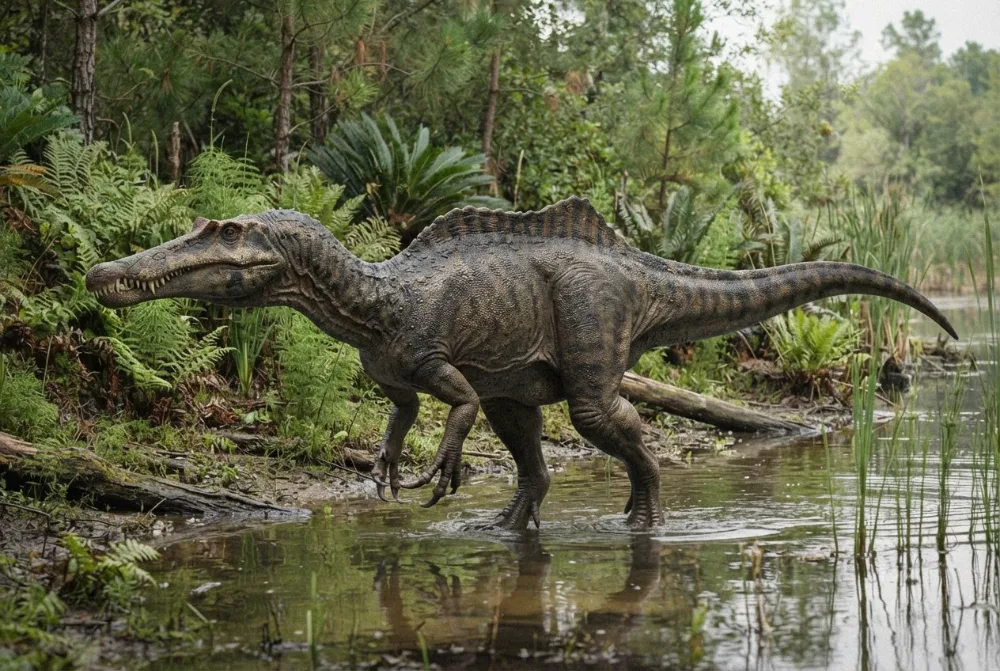
Vallibonavenatrix was a medium-sized spinosaurid dinosaur that lived in what is now Spain during the Early Cretaceous. It had a long, crocodile-like snout and probably ate fish, just like its bigger cousin Spinosaurus. This dinosaur is the most complete spinosaur ever found in the Iberian Peninsula.1
When did it live?
How big was it?
How long was it?
How tall was it?
at the hips
How heavy was it?
How big was Vallibonavenatrix compared to YOU?
Just maths in your browser. Nothing is saved or sent anywhere.
How fast was it?
Fun facts
Vallibonavenatrix had a sail on its back made of tall, fan-shaped spines, similar to the dinosaur Ichthyovenator.1
Its bones were full of air pockets, making its skeleton lighter. This is called being pneumatic.1
The first fossils were found by amateur fossil collector Juan Cano Forner in the 1980s and 1990s.1
Vallibonavenatrix lived about 129 to 125 million years ago, during the Barremian stage of the Early Cretaceous.1
It shared its home with other dinosaurs like Iguanodon and the spinosaurid Protathlitis.1
Most asked questions about Vallibonavenatrix
?How big was Vallibonavenatrix?
It was a medium-sized spinosaurid, but scientists do not know its exact length or weight because only a partial skeleton has been found.1
?What did Vallibonavenatrix eat?
It probably ate fish, just like its bigger cousin Spinosaurus, because it had a long, crocodile-like snout.1
?Did Vallibonavenatrix have a sail?
Yes, it likely had a sail on its back made of tall, fan-shaped spines, similar to the dinosaur Ichthyovenator.1
?When did Vallibonavenatrix live?
It lived about 129 to 125 million years ago, during the Barremian stage of the Early Cretaceous.1
?Where was Vallibonavenatrix found?
Its fossils were found in the Arcillas de Morella Formation near Vallibona, Castellón, Spain.12
?Is Vallibonavenatrix a dinosaur?
Yes, it is a spinosaurid dinosaur, a type of theropod dinosaur.1

Ask Rex about Vallibonavenatrix
Rex only answers questions about this page. 10 questions a month.
Rex is an AI and can make mistakes. He runs on servers in the EU and questions are never saved. Never type your name or other personal things.
Myth buster
Myth: Vallibonavenatrix was a close relative of Baryonyx from Europe.
Truth: Scientists disagree. Some studies place it closer to spinosaurines from Africa and South America, like Spinosaurus and Irritator.1
For dino experts
- Scientific name
- Vallibonavenatrix
- Named by
- Malafaia et al. 20192
- Group
- Spinosaurs
- Family / clade
- Spinosauridae2
- Classification
- Theropoda > Spinosauridae2
- Age of the rocks
- 126 to 121 million years (Barremian)2
- Rock formations
- Arcillas de Morella2
- Countries
- Spain2
- Fossil records
- 1 in the Paleobiology Database2
- Discovery
- Vallibonavenatrix was named in 2019 by Elisabete Malafaia and colleagues. The species name cani honors Juan Cano Forner, who discovered the fossils.1
- Still debated
- Scientists are not sure whether Vallibonavenatrix belongs to the Spinosaurinae or Baryonychinae group, or if it is a more primitive spinosaurid.1
Where the facts come from
- Vallibonavenatrix (en.wikipedia.org)
- Vallibonavenatrix in The Paleobiology Database (CC BY 4.0): age, places, rock formations, classification.
Every fact on this page has a number that points to its source. If we got something wrong, sorry, we are dino fans, not a science journal. Tell us at [email protected] and we will fix it.
 Rex is hungry! Dino Wiki is a dad's project for his dino-loving son, free with no ads. Grown-ups can feed Rex a snack to help keep it online.Feed Rex
 Spinosaurus
 Baryonyx
 Suchomimus
 Angaturama
 Camarillasaurus
 Ceratosuchops
 Stegosaurus
 Iguanodon
 Archaeopteryx
 Giganotosaurus
 Microraptor
 Deinonychus