
Xericeps
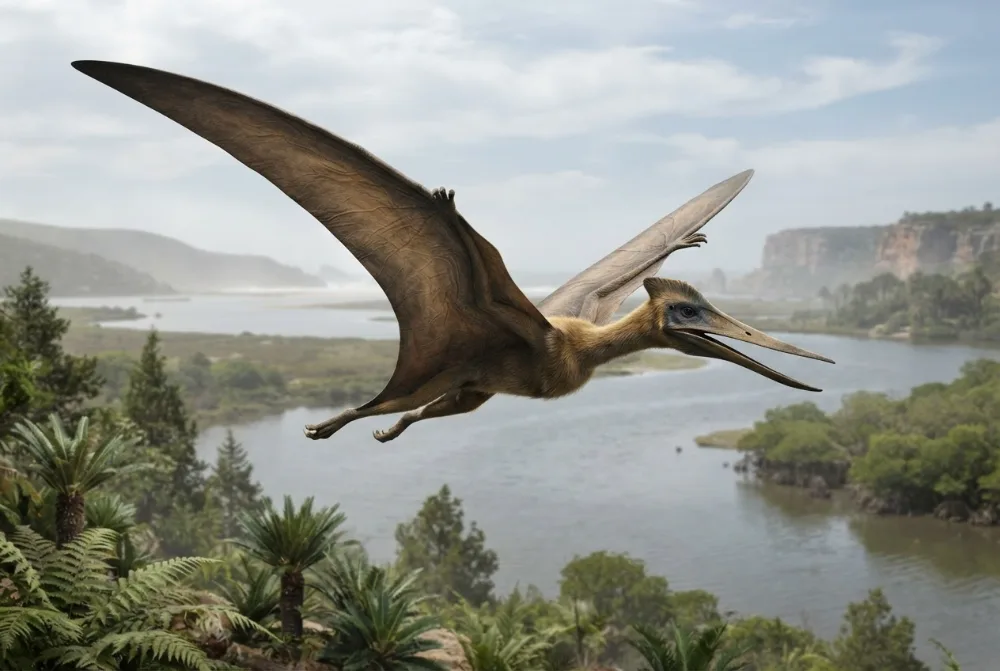
Xericeps was a flying reptile that lived in what is now the Sahara Desert in Morocco. It had a long, toothless beak that curved upward like a pair of tweezers. It probably used its beak to snatch fish from rivers and lakes.13
When did it live?
How big was it?
How wide were its wings?
How big was Xericeps compared to YOU?
Just maths in your browser. Nothing is saved or sent anywhere.
How fast was it?
Fun facts
Xericeps is known only from a piece of its lower jaw. No other bones have been found yet.1
Its beak was curved upward, which is why its species name 'curvirostris' means 'curved snout'.1
Xericeps is one of only three named pterosaurs from the Kem Kem beds of Morocco. This area was once a river system full of dinosaurs and flying reptiles.2
Scientists think Xericeps was a medium-sized pterosaur, with a wingspan likely between 3 and 8 metres (10 to 26 feet).1
Most asked questions about Xericeps
?Is Xericeps a dinosaur?
No, Xericeps is a pterosaur, which is a flying reptile that lived alongside dinosaurs but is not a dinosaur itself.1
?How big was Xericeps?
It was medium sized for a pterosaur, with a wingspan estimated between 3 and 8 metres (10 to 26 feet). Scientists think it was likely closer to the lower end of that range.12
?What did Xericeps eat?
Xericeps probably used its long, curved, toothless beak to snatch fish from rivers and lakes.1
?Why did Xericeps have a curved beak?
Scientists think the upward curve helped it catch food, like fish, from water. The species name 'curvirostris' even means 'curved snout'.1

Ask Rex about Xericeps
Rex only answers questions about this page. 10 questions a month.
Rex is an AI and can make mistakes. He runs on servers in the EU and questions are never saved. Never type your name or other personal things.
For dino experts
- Scientific name
- Xericeps
- Named by
- Martill et al. 20183
- Group
- Flying reptiles
- Family / clade
- Neoazhdarchia3
- Classification
- Pterosauria > Pterodactyloidea3
- Age of the rocks
- 100 to 94 million years (Cenomanian)3
- Countries
- Morocco3
- Fossil records
- 1 in the Paleobiology Database3
- Discovery
- The only known fossil of Xericeps was found by local mine workers at Aferdou N'Chaft in Morocco. British paleontologist David M. Martill bought it at the mine site in January 2017. He and his colleagues named it in 2018.12
- Still debated
- Scientists are not sure exactly which group of pterosaurs Xericeps belongs to. Some studies place it with the alanqids, others with the chaoyangopterids.1
Where the facts come from
- Xericeps (en.wikipedia.org)
- A new edentulous pterosaur from the Cretaceous Kem Kem beds of south eastern Morocco (sciencedirect.com)
- Xericeps in The Paleobiology Database (CC BY 4.0): age, places, rock formations, classification.
Every fact on this page has a number that points to its source. If we got something wrong, sorry, we are dino fans, not a science journal. Tell us at [email protected] and we will fix it.
 Rex is hungry! Dino Wiki is a dad's project for his dino-loving son, free with no ads. Grown-ups can feed Rex a snack to help keep it online.Feed Rex
 Pteranodon
 Quetzalcoatlus
 Dorygnathus
 Rhamphorhynchus
 Anhanguera
 Pterodactylus
 Tyrannosaurus
 Triceratops
 Velociraptor
 Spinosaurus
 Ankylosaurus
 Parasaurolophus