
Zaraapelta
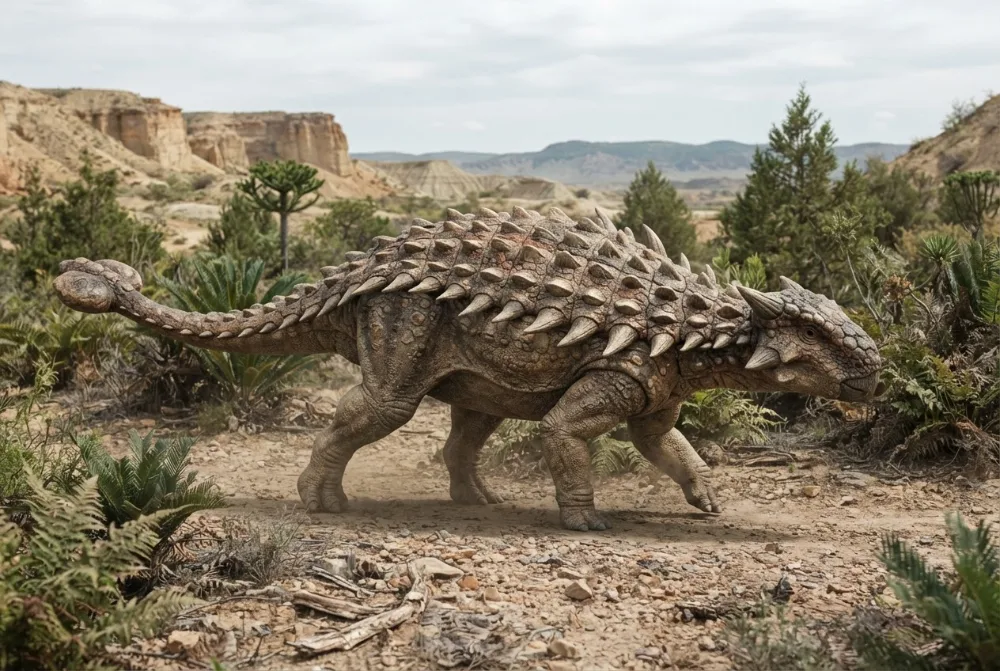
Zaraapelta was an armoured dinosaur that walked on four legs and munched on plants. It had a bumpy, spiky skull with fancy horns, making it look like a walking tank. It lived in the Gobi Desert during the Late Cretaceous, about 75 million years ago.12
When did it live?
How fast was it?
Fun facts
Zaraapelta's skull was covered in bumpy armour plates called osteoderms, and it had an especially fancy pattern of bumps and grooves behind its eye.12
The horns on the back of its skull had a smooth ridge on top, which is different from any other ankylosaur.13
Scientists think the fancy skull ornaments might have been used to attract mates, like a peacock's tail feathers.2
The only known fossil is a skull missing the snout tip, and it probably belonged to a young adult.1
Most asked questions about Zaraapelta
?How big was Zaraapelta?
The only known skull is about 40 centimetres long, so Zaraapelta was a medium-sized ankylosaur.1
?What did Zaraapelta eat?
It was a herbivore, eating plants.1
?Who discovered Zaraapelta?
It was discovered in 2000 by a team led by Phil Currie, and named in 2014 by Victoria Arbour.12
?What was Zaraapelta's closest relative?
Its closest known relative is Tarchia, another ankylosaur from Mongolia.1

Ask Rex about Zaraapelta
Rex only answers questions about this page. 10 questions a month.
Rex is an AI and can make mistakes. He runs on servers in the EU and questions are never saved. Never type your name or other personal things.
Myth buster
Myth: Some people think all armoured dinosaurs had tail clubs.
Truth: Zaraapelta is known only from a skull, so scientists don't know if it had a tail club. Many ankylosaurs did, but not all.1
For dino experts
- Scientific name
- Zaraapelta
- Named by
- Arbour et al. 20144
- Group
- Armoured dinos
- Family / clade
- Ankylosauridae4
- Classification
- Ornithischia > Ankylosauria > Ankylosauridae > Thyreophora4
- Age of the rocks
- 100 to 84 million years (Cenomanian / Santonian)4
- Rock formations
- Baynshire4
- Countries
- Mongolia4
- Fossil records
- 1 in the Paleobiology Database4
- Discovery
- The skull was found in 2000 by a team led by Phil Currie in the Gobi Desert. In 2014, Victoria Arbour, Philip Currie, and Demchig Badamgarav named it Zaraapelta nomadis.12
- Still debated
- Scientists are still debating exactly how Zaraapelta is related to other ankylosaurs, and whether its fancy head ornaments were for protection or for showing off.12
Where the facts come from
- Zaraapelta (en.wikipedia.org)
- UAlberta paleontologists name new armoured dinosaur (ualberta.ca)
- PBDB Taxon (paleobiodb.org)
- Zaraapelta in The Paleobiology Database (CC BY 4.0): age, places, rock formations, classification.
Every fact on this page has a number that points to its source. If we got something wrong, sorry, we are dino fans, not a science journal. Tell us at [email protected] and we will fix it.
 Rex is hungry! Dino Wiki is a dad's project for his dino-loving son, free with no ads. Grown-ups can feed Rex a snack to help keep it online.Feed Rex
 Ankylosaurus
 Sauropelta
 Pinacosaurus
 Scutellosaurus
 Struthiosaurus
 Euoplocephalus
 Tyrannosaurus
 Triceratops
 Velociraptor
 Spinosaurus
 Parasaurolophus
 Pteranodon