 Home
 All dinos
 Dino groups
 Explore
 Dinos by country
 Dino vs dino
 How big were they?
 Dinos A to Z
 Who ate what?
 What dino are you? Quiz
 Dino games
 Dino battle
 Dino race
 Dino mini-games
 Sticker album
 Dino TOP lists
 Timeline
 Surprise me!
 Language: English
 USA
When did it live?
Ziapelta: 84 to 72 million years ago

How fast was it?


Fun facts
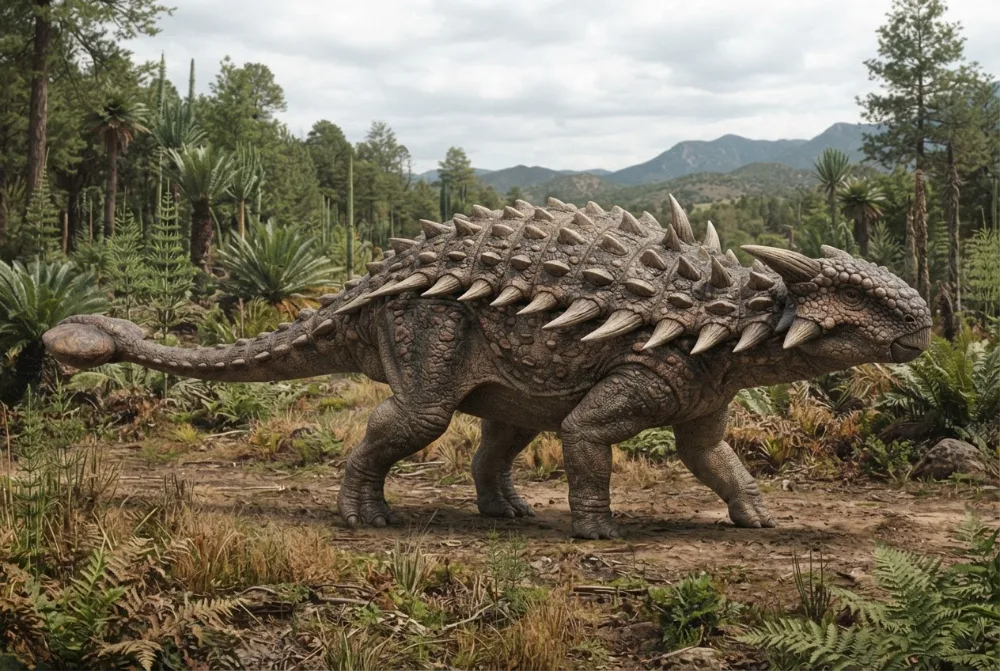
Ziapelta's skull was covered in bony plates called caputegulae, and it had a large, triangular plate on its snout.2
Its squamosal horns were deep and curved forward, measuring about 10.2 centimetres (4 inches) from base to tip.1
The back of Ziapelta's skull had three deep grooves, a feature not seen in other ankylosaurs.2
Ziapelta lived about 73 million years ago, during the Late Cretaceous period.1
Its fossils were found in the Kirtland Formation of New Mexico, in the Bisti/De-Na-Zin Wilderness.1
The first Ziapelta skull was discovered in 2011 by a team led by Robert Michael Sullivan.1
Ziapelta's name comes from the Zia sun symbol on the New Mexico state flag, plus the Latin word for shield.1
Most asked questions about Ziapelta
?What did Ziapelta eat?
Ziapelta was a plant-eater. Its small teeth and wide beak helped it chew tough plants.1
?How big was Ziapelta?
Nobody knows for sure because only the skull and neck armor have been found. The skull was about 30 centimetres (12 inches) long, so the whole dinosaur was probably around 5 metres (16 feet) long.12
?Did Ziapelta have a tail club?
Yes, like most ankylosaurids, Ziapelta probably had a big bony club at the end of its tail, but no tail bones have been found yet.1
For dino experts
- Scientific name
- Ziapelta
- Named by
- Arbour et al. 20143
- Group
- Armoured dinos
- Family / clade
- Ankylosauridae3
- Classification
- Ornithischia > Ankylosauria > Ankylosauridae > Thyreophora3
- Age of the rocks
- 84 to 72 million years (Campanian)3
- Rock formations
- Kirtland3
- Countries
- USA3
- Fossil records
- 1 in the Paleobiology Database3
- Discovery
- Ziapelta was named in 2014 by Victoria Arbour and colleagues, based on a complete skull and neck armour found in New Mexico.13
- Still debated
- Scientists are not sure whether Ziapelta was more closely related to Scolosaurus or to Nodocephalosaurus.1
Where the facts come from
- Ziapelta (en.wikipedia.org)
- A New Ankylosaurid Dinosaur from the Upper Cretaceous (Kirtlandian) of New Mexico with Implications for Ankylosaurid Diversity in the Upper Cretaceous of Western North America (pmc.ncbi.nlm.nih.gov)
- Ziapelta in The Paleobiology Database (CC BY 4.0): age, places, rock formations, classification.
Every fact on this page has a number that points to its source. If we got something wrong, sorry, we are dino fans, not a science journal. Tell us at hello@dinowiki.app and we will fix it.
 Rex is hungry! Dino Wiki is a dad's project for his dino-loving son, free with no ads and no cookies. Grown-ups can feed Rex a snack to help keep it online.Feed Rex
 Ankylosaurus
 Sauropelta
 Pinacosaurus
 Scutellosaurus
 Struthiosaurus
 Euoplocephalus
 Tyrannosaurus
 Triceratops
 Velociraptor
 Spinosaurus
 Parasaurolophus
 Pteranodon