 Ozali dino nini? Kwizi
 Etumba ya badino
 Mbangu ya badino
 Masano mike ya badino
 Albumu ya bastika
 Bilisti TOP ya badino
 Kamwisa ngai!
Gobihadros
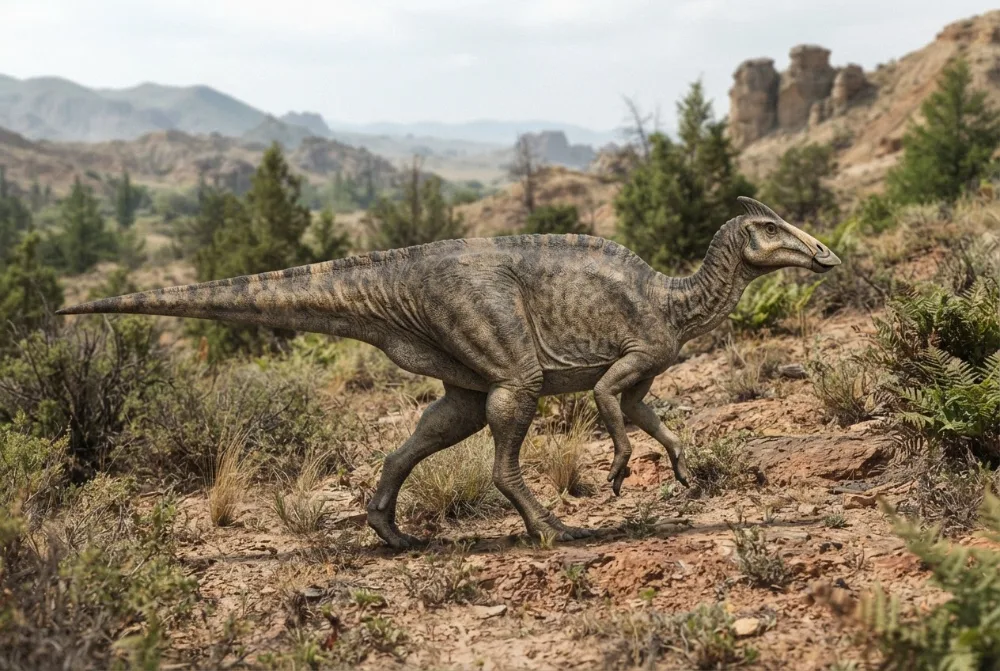
Gobihadros was a small, plant-eating dinosaur that lived in what is now Mongolia. It had a beak like a duck and could walk on two legs or all fours. Scientists found a nearly complete skeleton, so we know a lot about its body.1
Azalaki na bomoi ntango nini?
Azalaki monene boni?
Azalaki molai boni?
Azalaki molai boni na likolo?
kokanisa
 molai lokola bambwa 8 zolo kino mokila🍌molai lokola matoko 42 oyo balandani🏃akokaki kopota metele 100 na sekonde 12 (moto oyo aleki mbangu asalelaka 9,6)
Gobihadros azalaki monene boni soki tokokanisi na YO?
Kaka matematiki na navigatere na yo. Eloko moko te ebombami to etindami esika moko.
Azalaki na mbangu boni?


Makambo ya kosepelisa
Gobihadros is the first non-hadrosaurid hadrosauroid from the Late Cretaceous of central Asia known from a complete, articulated skull and skeleton.1
It had up to three functional teeth in each tooth position in its lower jaw, which is unusual for a hadrosauroid.1
The upper jaw of Gobihadros had a 'double-layer' oral margin, a feature also seen in later hadrosaurids.1
Its ilium (hip bone) had a sigmoidal (S-shaped) upper outline and a fan-shaped rear process, which helped scientists identify it as a new species.1
Gobihadros had a spike-like thumb claw on its hand, which it may have used for defense or digging.1
The fossils were collected by a joint Mongolian-Japanese expedition between 1993 and 2004.1
Mituna oyo batunaka mingi na ntina na Gobihadros
?How big was Gobihadros?
About 7.5 metres (25 feet) long for the largest fully grown individuals, though some specimens were smaller, like 3 metres (9.8 feet) for an immature one.3
?What did Gobihadros eat?
It was a plant-eater. It had a beak like a duck and up to three functional teeth in each spot in its lower jaw to chew plants.3
?Did Gobihadros have a thumb spike?
Yes, it had a conical, spike-like claw on its first finger, which it may have used for defense or digging.3
?When did Gobihadros live?
It lived during the Late Cretaceous period, about 100 to 84 million years ago (Cenomanian to Santonian stages).3
Mpo na bayebi ya badino
- Nkombo ya siansi
- Gobihadros
- Nkombo epesamaki na
- Tsogtbaatar et al. 20194
- Lisanga
- Badino ya monoko ya ndeke
- Libota / klade
- Hadrosauroidea4
- Klasifikasio
- Ornithischia > Ornithopoda > Iguanodontia4
- Mbula ya mabanga
- mbula milio 100 kino 84 (Cenomanian / Santonian)4
- Milongo ya mabanga
- Baynshire4
- Bikolo
- Mongoli4
- Bafosile oyo ekomami
- 6 na The Paleobiology Database4
- Ntango bamonaki yango
- Gobihadros was named in 2019 by Khishigjav Tsogtbaatar, David B. Weishampel, David C. Evans, and Mahito Watabe. The type specimen, a nearly complete skeleton, was found at Bayshin Tsav in the Gobi Desert, Mongolia.41
- Naino bazali kowelana
- Scientists are not sure whether Gobihadros was a direct ancestor of later hadrosaurids or just a close cousin.1
Esika makambo euti
- journals.plos.org (journals.plos.org)
- PBDB Taxon (paleobiodb.org)
- Gobihadros (en.wikipedia.org)
- Gobihadros in The Paleobiology Database (CC BY 4.0): mbula, bisika, milongo ya mabanga, klasifikasio.
Likambo nyonso na lokasa oyo ezali na nimero oyo elakisi liziba na yango. Soki tosali libunga, limbisa biso, tozali bato balingaka badino, zulunalo ya siansi te. Yebisa biso na [email protected] mpe tokobongisa yango.
 Rex azali na nzala! Dino Wiki ezali mosala ya tata moko mpo na mwana na ye ya mobali oyo alingaka badino, ofele, piblisite te mpe batrakere te. Bato bakolo bakoki kopesa Rex biskwi mpo na kosalisa ete etikala na internet.Leisa Rex
 Iguanodon
 Tenontosaurus
 Thescelosaurus
 Zalmoxes
 Camptosaurus
 Rhabdodon
 Tyrannosaurus
 Triceratops
 Velociraptor
 Spinosaurus
 Ankylosaurus
 Parasaurolophus