 Kwizi ya Ndiwe dino uti?
 Nkhondo ya madino
 Mpikisano wa madino
 Masewera ang'onoang'ono a madino
 Chimbale cha zomata
 Mindandanda ya TOP ya madino
 Ndidabwitse!
Anzu
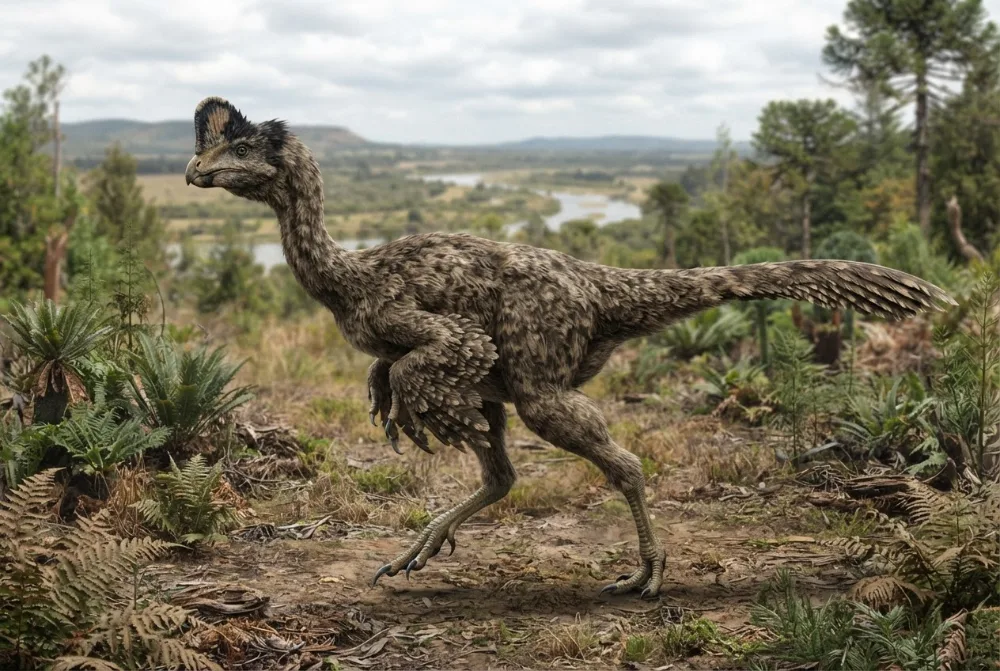
Anzu was a bird-like dinosaur that lived about 68 to 66 million years ago. It had feathers, a toothless beak, and a tall crest on its head. Scientists nicknamed it the 'chicken from hell' because it looked like a giant, scary chicken!1
Ankakhala liti?
Anali wamkulu bwanji?
Anali wautali bwanji?
Msinkhu wake unali wautali bwanji?
Ankalemera bwanji?
 wautali ngati agalu 3 otsatizana mphuno ndi mchira🍌wautali ngati nthochi 19 zotsatizana🍉wolemera ngati mavwende 60🧸wolemera ngati ana a sukulu ya mkaka 16🎒wolemera ngati ana a sukulu 9🏃akanatha kuthamanga mamita 100 m'masekondi 8 (munthu waliwiro kwambiri amafunika 9.6)
Anzu anali wamkulu bwanji poyerekeza ndi IWEYO?
Ndi masamu chabe mu msakatuli wako. Palibe chimene chimasungidwa kapena kutumizidwa kwina kulikonse.
Anali ndi liwiro lotani?


Mfundo zosangalatsa
Anzu had feathers on its arms and tail, making it look like a big flightless bird.1
Its forelimbs ended in large, sharp claws, unlike modern birds.1
Two of the Anzu skeletons show injuries: one had a broken and healed rib, and another had an arthritic toe bone.1
Anzu lived at the same time as Tyrannosaurus rex and Triceratops.1
The fossils were found in the Hell Creek Formation, which is famous for many dinosaur fossils.1
Anzu belongs to a group called oviraptorosaurs, which are closely related to birds.1
Mafunso ofunsidwa kwambiri okhudza Anzu
?How big was Anzu?
Anzu was about 3.5 to 3.75 metres (11.5 to 12.3 feet) long, up to 1.5 metres (4.9 feet) tall at the hip, and weighed 200 to 300 kilograms (440 to 660 pounds).21
?What did Anzu eat?
Anzu was probably an omnivore or herbivore, eating plants, small animals, and possibly eggs. Its beak was toothless but not as strong as in some Asian relatives.2
Kwa akatswiri a madino
- Dzina la sayansi
- Anzu
- Anapatsidwa dzina ndi
- Lamanna et al. 20144
- Gulu
- Madino a nthenga achilendo
- Banja / kladi
- Caenagnathidae4
- Magawidwe a sayansi
- Theropoda > Oviraptorosauria4
- Zaka za miyala
- zaka 72 mpaka 66 miliyoni (Maastrichtian)4
- Mapangidwe a miyala
- Hell Creek4
- Mayiko
- Amereka4
- Zolemba za mafosili
- 6 mu The Paleobiology Database4
- Kupezeka
- Anzu was named in 2014 by a team led by Matthew Lamanna. The fossils were found by private collectors and scientists in North and South Dakota. The species name wyliei honors the grandson of two museum supporters.14
- Akukambiranabe
- Scientists are not sure exactly what Anzu ate, but its skull suggests it was an omnivore.1
Kumene mfundo zimachokera
- Feathered Dinosaur, Anzu wyliei | Smithsonian Institution (si.edu)
- Anzu wyliei (en.wikipedia.org)
- Constraining the body mass range of Anzu wyliei using volumetric and extant-scaling methods | Vertebrate Anatomy Morphology Palaeontology (journals.library.ualberta.ca)
- Anzu in The Paleobiology Database (CC BY 4.0): zaka, malo, mapangidwe a miyala, magawidwe a sayansi.
Mfundo iliyonse patsamba lino ili ndi nambala yosonyeza kumene yachokera. Ngati talakwitsa kanthu, pepa, ndife okonda madino, osati magazini ya sayansi. Tiuze pa [email protected] ndipo tikonza.
 Rex ali ndi njala! Dino Wiki ndi ntchito ya bambo kwa mwana wawo wamwamuna wokonda madainoso, yaulere popanda zotsatsa ndi zokazonda. Akuluakulu angadyetse Rex zokhwasula-khwasula kuti tsambali lipitirize kupezeka pa intaneti.Dyetsa Rex
 Therizinosaurus
 Oviraptor
 Chirostenotes
 Citipes
 Leptorhynchos
 Avimimus
 Tyrannosaurus
 Triceratops
 Velociraptor
 Spinosaurus
 Ankylosaurus
 Parasaurolophus