 Kwizi ya Ndiwe dino uti?
 Nkhondo ya madino
 Mpikisano wa madino
 Masewera ang'onoang'ono a madino
 Chimbale cha zomata
 Mindandanda ya TOP ya madino
 Ndidabwitse!
Gobihadros
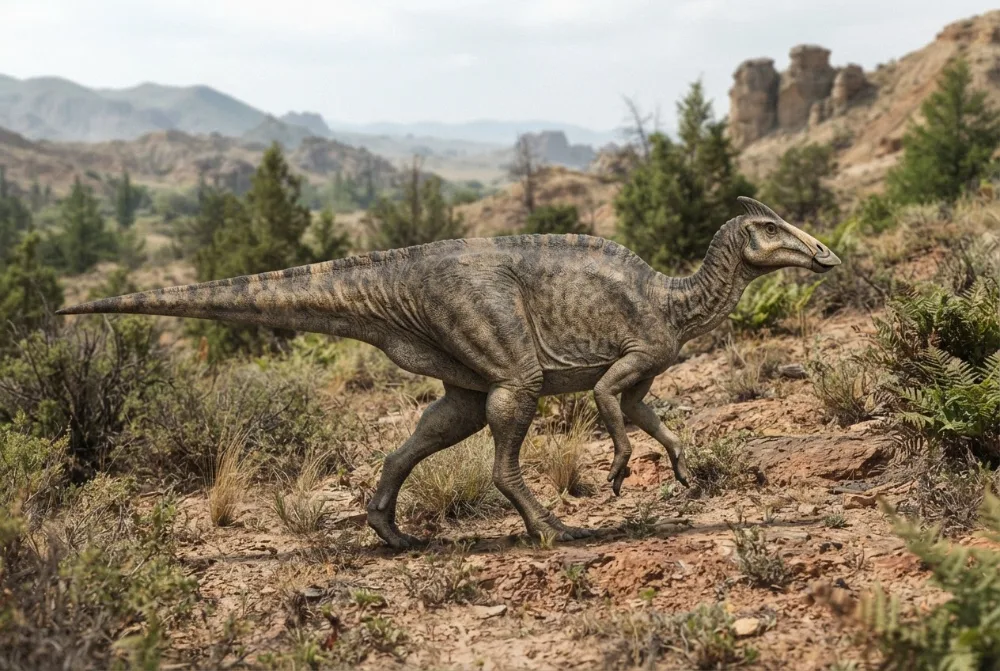
Gobihadros was a small, plant-eating dinosaur that lived in what is now Mongolia. It had a beak like a duck and could walk on two legs or all fours. Scientists found a nearly complete skeleton, so we know a lot about its body.1
Ankakhala liti?
Anali wamkulu bwanji?
Anali wautali bwanji?
Msinkhu wake unali wautali bwanji?
kuyerekeza
 wautali ngati agalu 8 otsatizana mphuno ndi mchira🍌wautali ngati nthochi 42 zotsatizana🏃akanatha kuthamanga mamita 100 m'masekondi 12 (munthu waliwiro kwambiri amafunika 9.6)
Gobihadros anali wamkulu bwanji poyerekeza ndi IWEYO?
Ndi masamu chabe mu msakatuli wako. Palibe chimene chimasungidwa kapena kutumizidwa kwina kulikonse.
Anali ndi liwiro lotani?


Mfundo zosangalatsa
Gobihadros is the first non-hadrosaurid hadrosauroid from the Late Cretaceous of central Asia known from a complete, articulated skull and skeleton.1
It had up to three functional teeth in each tooth position in its lower jaw, which is unusual for a hadrosauroid.1
The upper jaw of Gobihadros had a 'double-layer' oral margin, a feature also seen in later hadrosaurids.1
Its ilium (hip bone) had a sigmoidal (S-shaped) upper outline and a fan-shaped rear process, which helped scientists identify it as a new species.1
Gobihadros had a spike-like thumb claw on its hand, which it may have used for defense or digging.1
The fossils were collected by a joint Mongolian-Japanese expedition between 1993 and 2004.1
Mafunso ofunsidwa kwambiri okhudza Gobihadros
?How big was Gobihadros?
About 7.5 metres (25 feet) long for the largest fully grown individuals, though some specimens were smaller, like 3 metres (9.8 feet) for an immature one.3
?What did Gobihadros eat?
It was a plant-eater. It had a beak like a duck and up to three functional teeth in each spot in its lower jaw to chew plants.3
?Did Gobihadros have a thumb spike?
Yes, it had a conical, spike-like claw on its first finger, which it may have used for defense or digging.3
?When did Gobihadros live?
It lived during the Late Cretaceous period, about 100 to 84 million years ago (Cenomanian to Santonian stages).3
Kwa akatswiri a madino
- Dzina la sayansi
- Gobihadros
- Anapatsidwa dzina ndi
- Tsogtbaatar et al. 20194
- Gulu
- Odya zomera a milomo
- Banja / kladi
- Hadrosauroidea4
- Magawidwe a sayansi
- Ornithischia > Ornithopoda > Iguanodontia4
- Zaka za miyala
- zaka 100 mpaka 84 miliyoni (Cenomanian / Santonian)4
- Mapangidwe a miyala
- Baynshire4
- Mayiko
- Mongoliya4
- Zolemba za mafosili
- 6 mu The Paleobiology Database4
- Kupezeka
- Gobihadros was named in 2019 by Khishigjav Tsogtbaatar, David B. Weishampel, David C. Evans, and Mahito Watabe. The type specimen, a nearly complete skeleton, was found at Bayshin Tsav in the Gobi Desert, Mongolia.41
- Akukambiranabe
- Scientists are not sure whether Gobihadros was a direct ancestor of later hadrosaurids or just a close cousin.1
Kumene mfundo zimachokera
- journals.plos.org (journals.plos.org)
- PBDB Taxon (paleobiodb.org)
- Gobihadros (en.wikipedia.org)
- Gobihadros in The Paleobiology Database (CC BY 4.0): zaka, malo, mapangidwe a miyala, magawidwe a sayansi.
Mfundo iliyonse patsamba lino ili ndi nambala yosonyeza kumene yachokera. Ngati talakwitsa kanthu, pepa, ndife okonda madino, osati magazini ya sayansi. Tiuze pa [email protected] ndipo tikonza.
 Rex ali ndi njala! Dino Wiki ndi ntchito ya bambo kwa mwana wawo wamwamuna wokonda madainoso, yaulere popanda zotsatsa ndi zokazonda. Akuluakulu angadyetse Rex zokhwasula-khwasula kuti tsambali lipitirize kupezeka pa intaneti.Dyetsa Rex
 Iguanodon
 Tenontosaurus
 Thescelosaurus
 Zalmoxes
 Camptosaurus
 Rhabdodon
 Tyrannosaurus
 Triceratops
 Velociraptor
 Spinosaurus
 Ankylosaurus
 Parasaurolophus