 Kwizi ya Ndiwe dino uti?
 Nkhondo ya madino
 Mpikisano wa madino
 Masewera ang'onoang'ono a madino
 Chimbale cha zomata
 Mindandanda ya TOP ya madino
 Ndidabwitse!
Ankakhala liti?

Anali wamkulu bwanji?
Anali wautali bwanji?
Msinkhu wake unali wautali bwanji?
kuyerekeza
Ankalemera bwanji?
 wautali ngati agalu 6 otsatizana mphuno ndi mchira🍌wautali ngati nthochi 33 zotsatizana🍉wolemera ngati mavwende 74🧸wolemera ngati ana a sukulu ya mkaka 19🎒wolemera ngati ana a sukulu 12🏃akanatha kuthamanga mamita 100 m'masekondi 9 (munthu waliwiro kwambiri amafunika 9.6)
Jeyawati anali wamkulu bwanji poyerekeza ndi IWEYO?
Ndi masamu chabe mu msakatuli wako. Palibe chimene chimasungidwa kapena kutumizidwa kwina kulikonse.
Anali ndi liwiro lotani?


Mfundo zosangalatsa
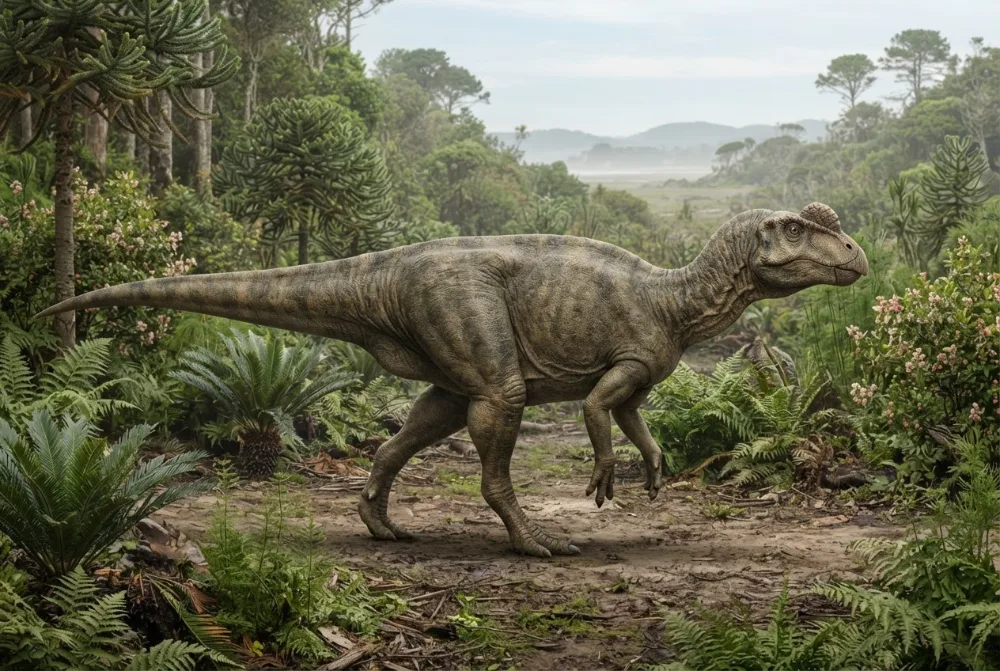
Jeyawati's full scientific name is Jeyawati rugoculus, which means 'wrinkle eye' because of the rough texture on its skull bone near the eye.12
It was a hadrosauroid, a cousin of the duck-billed dinosaurs, but it lived earlier than most of them.1
The only known fossil of Jeyawati was found in rocks that are about 90 million years old, from the Turonian stage of the Late Cretaceous.51
Jeyawati was more advanced than some early hadrosauroids like Eolambia, but not as advanced as later ones like Bactrosaurus.1
The name Jeyawati comes from the Zuni language, spoken by Native American people in New Mexico.1
Mafunso ofunsidwa kwambiri okhudza Jeyawati
?How big was Jeyawati?
Nobody knows for sure because only a partial skeleton has been found. Based on its relatives, it was probably a medium-sized dinosaur, but no exact length or weight is given in the sources.14
?What did Jeyawati eat?
Jeyawati was a plant-eater. It likely ate ferns and conifer trees that grew in its swampy forest home 91 million years ago.4
?Could Jeyawati walk on two legs?
Yes, scientists think it could. It probably walked on all fours but was also able to rear up on its hind legs.4
Kwa akatswiri a madino
- Dzina la sayansi
- Jeyawati
- Anapatsidwa dzina ndi
- McDonald et al. 20105
- Gulu
- Odya zomera a milomo
- Banja / kladi
- Hadrosauroidea5
- Magawidwe a sayansi
- Ornithischia > Ornithopoda > Iguanodontia5
- Zaka za miyala
- zaka 94 mpaka 90 miliyoni (Turonian)5
- Mapangidwe a miyala
- Moreno Hill5
- Mayiko
- Amereka5
- Zolemba za mafosili
- 1 mu The Paleobiology Database5
- Kupezeka
- Jeyawati was named in 2010 by Andrew T. McDonald, Douglas G. Wolfe, and James I. Kirkland. The fossil was found in the Moreno Hill Formation in New Mexico.15
- Akukambiranabe
- Scientists are still debating exactly where Jeyawati fits on the family tree of hadrosauroids, with some studies placing it close to Eolambia and others near Eotrachodon.1
Kumene mfundo zimachokera
- Jeyawati (en.wikipedia.org)
- Holdings: A New Basal Hadrosauroid (Dinosauria: Ornithopoda) from the Turonian of New Mexico :: Descubridor de recursos de la Universidad Veracruzana (ebusca.uv.mx)
- Jeyawati rugoculus | Dinosaur Database by DinoAnimals.com (dinoanimals.com)
- “Grinding Mouth, Wrinkle Eye”: Penn Graduate Student Describes New Species of Plant-Eating Dinosaur (penntoday.upenn.edu)
- Jeyawati in The Paleobiology Database (CC BY 4.0): zaka, malo, mapangidwe a miyala, magawidwe a sayansi.
Mfundo iliyonse patsamba lino ili ndi nambala yosonyeza kumene yachokera. Ngati talakwitsa kanthu, pepa, ndife okonda madino, osati magazini ya sayansi. Tiuze pa [email protected] ndipo tikonza.
 Rex ali ndi njala! Dino Wiki ndi ntchito ya bambo kwa mwana wawo wamwamuna wokonda madainoso, yaulere popanda zotsatsa ndi zokazonda. Akuluakulu angadyetse Rex zokhwasula-khwasula kuti tsambali lipitirize kupezeka pa intaneti.Dyetsa Rex
 Iguanodon
 Tenontosaurus
 Thescelosaurus
 Zalmoxes
 Camptosaurus
 Rhabdodon
 Tyrannosaurus
 Triceratops
 Velociraptor
 Spinosaurus
 Ankylosaurus
 Parasaurolophus