 Kwizi ya Ndiwe dino uti?
 Nkhondo ya madino
 Mpikisano wa madino
 Masewera ang'onoang'ono a madino
 Chimbale cha zomata
 Mindandanda ya TOP ya madino
 Ndidabwitse!
Ankakhala liti?

Anali wamkulu bwanji?
Anali wautali bwanji?
Msinkhu wake unali wautali bwanji?
kuyerekeza
Ankalemera bwanji?
Manidens anali wamkulu bwanji poyerekeza ndi IWEYO?
Ndi masamu chabe mu msakatuli wako. Palibe chimene chimasungidwa kapena kutumizidwa kwina kulikonse.
Anali ndi liwiro lotani?


Mfundo zosangalatsa
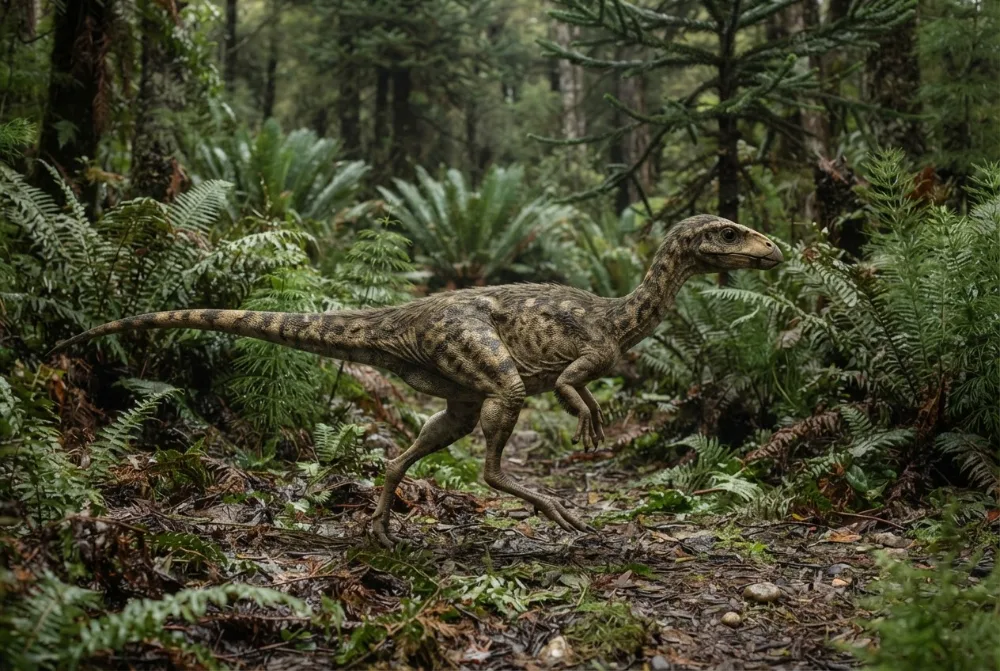
Manidens lived during the Middle Jurassic, about 171 to 167 million years ago, in a time when South America had many lakes and forests.1
Its name comes from the Latin words for 'hand' and 'tooth' because its last tooth looked like a tiny hand with fingers.1
Manidens is a heterodontosaurid, a group of small ornithischian dinosaurs that often had different types of teeth for different jobs.1
The only known skeleton of Manidens includes parts of the skull, jaws, backbone, shoulder, and hips, but not the tail or legs.1
Scientists think Manidens shows an intermediate step in the evolution of plant-eating: it had high tooth crowns but not the heavy wear facets that later relatives had.1
Manidens was one of the few ornithischian dinosaurs known from the Jurassic of South America, making it a rare find.1
Mafunso ofunsidwa kwambiri okhudza Manidens
?How big was Manidens?
Manidens was about 60 cm (2.0 ft) long and weighed around 500 g (1.1 lb), smaller than later heterodontosaurids.2
?What did Manidens eat?
Manidens was a plant-eater. It had high-crowned teeth for chewing plants, but it lacked the heavy wear facets seen in more advanced relatives.21
?When did Manidens live?
Manidens lived during the Early Jurassic, about 179 to 178 million years ago, in what is now Argentina.2
?Did Manidens have feathers?
Scientists think it might have. A close relative called Tianyulong had filamentous structures, so Manidens may have had them too.2
Kwa akatswiri a madino
- Dzina la sayansi
- Manidens
- Anapatsidwa dzina ndi
- Pol et al. 20113
- Gulu
- Odya zomera a milomo
- Banja / kladi
- Heterodontosauridae3
- Magawidwe a sayansi
- Ornithischia > Heterodontosauridae3
- Zaka za miyala
- zaka 184 mpaka 171 miliyoni (Toarcian / Aalenian)3
- Mapangidwe a miyala
- Cañadón Asfalto3
- Mayiko
- Argentina3
- Zolemba za mafosili
- 2 mu The Paleobiology Database3
- Kupezeka
- Manidens was named in 2011 by Diego Pol, Oliver Rauhut, and Marcos Becerra. The fossils were found at the Queso Rallado site near Cerro Cóndor, Argentina, in the Cañadón Asfalto Formation.13
- Akukambiranabe
- Scientists are still debating exactly how Manidens chewed its food, since its teeth were high and close together but lacked the heavy wear seen in more advanced plant-eaters.1
Kumene mfundo zimachokera
- A Middle Jurassic heterodontosaurid dinosaur from Patagonia and the evolution of heterodontosaurids (staff.mef.org.ar)
- Manidens (en.wikipedia.org)
- Manidens in The Paleobiology Database (CC BY 4.0): zaka, malo, mapangidwe a miyala, magawidwe a sayansi.
Mfundo iliyonse patsamba lino ili ndi nambala yosonyeza kumene yachokera. Ngati talakwitsa kanthu, pepa, ndife okonda madino, osati magazini ya sayansi. Tiuze pa [email protected] ndipo tikonza.
 Rex ali ndi njala! Dino Wiki ndi ntchito ya bambo kwa mwana wawo wamwamuna wokonda madainoso, yaulere popanda zotsatsa ndi zokazonda. Akuluakulu angadyetse Rex zokhwasula-khwasula kuti tsambali lipitirize kupezeka pa intaneti.Dyetsa Rex
 Iguanodon
 Tenontosaurus
 Thescelosaurus
 Zalmoxes
 Camptosaurus
 Rhabdodon
 Dilophosaurus
 Stenopterygius
 Dorygnathus
 Lufengosaurus
 Scutellosaurus
 Yunnanosaurus