 Kwizi ya Ndiwe dino uti?
 Nkhondo ya madino
 Mpikisano wa madino
 Masewera ang'onoang'ono a madino
 Chimbale cha zomata
 Mindandanda ya TOP ya madino
 Ndidabwitse!
Ankakhala liti?

Anali wamkulu bwanji?
Anali wautali bwanji?
Msinkhu wake unali wautali bwanji?
kuyerekeza
Ankalemera bwanji?
 wautali ngati agalu 5 otsatizana mphuno ndi mchira🍌wautali ngati nthochi 29 zotsatizana🍉wolemera ngati mavwende 240🧸wolemera ngati ana a sukulu ya mkaka 63🎒wolemera ngati ana a sukulu 38🐻❄️wolemera ngati zimbalangondo zoyera 2.5🏃akanatha kuthamanga mamita 100 m'masekondi 16 (munthu waliwiro kwambiri amafunika 9.6)
Nothronychus anali wamkulu bwanji poyerekeza ndi IWEYO?
Ndi masamu chabe mu msakatuli wako. Palibe chimene chimasungidwa kapena kutumizidwa kwina kulikonse.
Anali ndi liwiro lotani?


Mfundo zosangalatsa
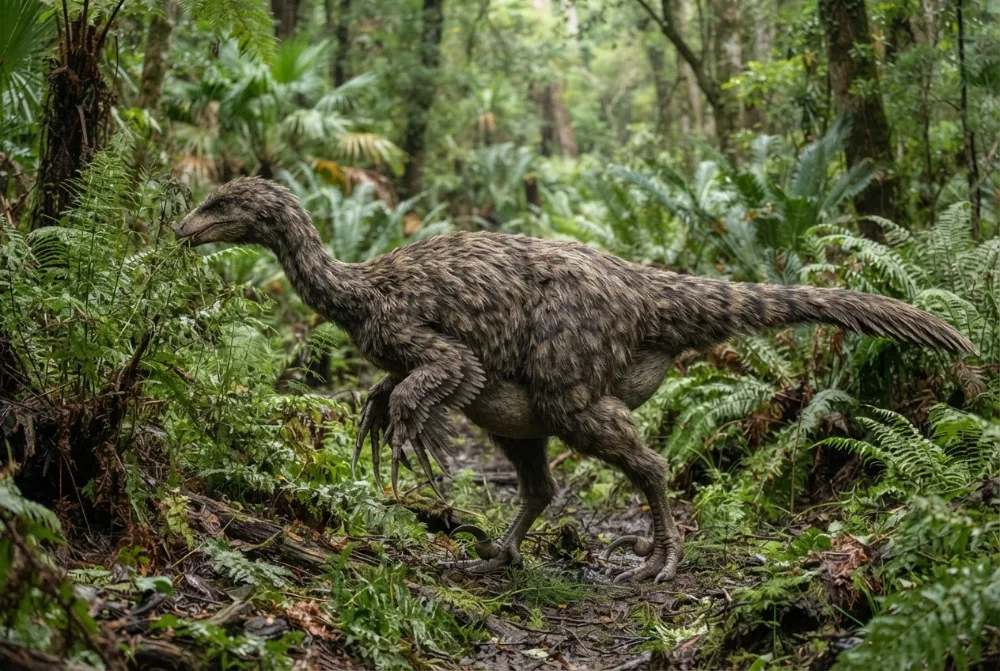
Nothronychus was the first therizinosaur ever found in the Americas. All earlier therizinosaur fossils came from China and Mongolia.1
Its claws were up to 30 centimeters (12 inches) long and curved like hooks. Scientists think it used them to pull down branches to eat.1
Nothronychus had four forward-facing toes on each foot, which helped it walk slowly and steadily.1
One species, Nothronychus graffami, was found in rocks that were once under a shallow sea called the Western Interior Seaway. The dinosaur's bones were mixed with marine reptile fossils.1
The first Nothronychus bone was mistaken for part of a horned dinosaur's skull. Only later did scientists realize it was a hip bone from a therizinosaur.1
Mafunso ofunsidwa kwambiri okhudza Nothronychus
?How big was Nothronychus?
It was about 4.2 to 5.3 metres (14 to 17 feet) long and weighed 800 to 1,200 kilograms (1,800 to 2,600 pounds).1
?What did Nothronychus eat?
It ate plants. Even though it was a theropod dinosaur, it was a herbivore.12
?Did Nothronychus have feathers?
No feather fossils have been found, but its relatives had feathers, so scientists think it probably did too.3
?When did Nothronychus live?
It lived during the Late Cretaceous period, about 94 to 89 million years ago.2
?Why did Nothronychus have long claws?
It used its long, curved claws to pull down branches so it could eat leaves.1
Kwa akatswiri a madino
- Dzina la sayansi
- Nothronychus
- Anapatsidwa dzina ndi
- Kirkland and Wolfe 20014
- Gulu
- Madino a nthenga achilendo
- Banja / kladi
- Therizinosauridae4
- Magawidwe a sayansi
- Theropoda > Therizinosauria4
- Zaka za miyala
- zaka 94 mpaka 90 miliyoni (Turonian)4
- Mapangidwe a miyala
- Moreno Hill, Tropic Shale4
- Mayiko
- Amereka4
- Zolemba za mafosili
- 2 mu The Paleobiology Database4
- Kupezeka
- Nothronychus was named in 2001 by paleontologists James Kirkland and Douglas Wolfe. The first fossils were found in New Mexico on land owned by rancher Bobby McKinley, who the species N. mckinleyi is named after.1
- Akukambiranabe
- Scientists are not sure if Nothronychus had feathers. Since it is a theropod closely related to birds, it might have had feathers, but no direct fossil evidence has been found yet.1
Kumene mfundo zimachokera
- Nothronychus (en.wikipedia.org)
- Nothronychus | Natural History Museum (nhm.ac.uk)
- Nothronychus Fact Sheet - Enchanted Learning (enchantedlearning.com)
- Nothronychus in The Paleobiology Database (CC BY 4.0): zaka, malo, mapangidwe a miyala, magawidwe a sayansi.
Mfundo iliyonse patsamba lino ili ndi nambala yosonyeza kumene yachokera. Ngati talakwitsa kanthu, pepa, ndife okonda madino, osati magazini ya sayansi. Tiuze pa [email protected] ndipo tikonza.
 Rex ali ndi njala! Dino Wiki ndi ntchito ya bambo kwa mwana wawo wamwamuna wokonda madainoso, yaulere popanda zotsatsa ndi zokazonda. Akuluakulu angadyetse Rex zokhwasula-khwasula kuti tsambali lipitirize kupezeka pa intaneti.Dyetsa Rex
 Therizinosaurus
 Oviraptor
 Chirostenotes
 Citipes
 Leptorhynchos
 Avimimus
 Tyrannosaurus
 Triceratops
 Velociraptor
 Spinosaurus
 Ankylosaurus
 Parasaurolophus