 Kwizi ya Ndiwe dino uti?
 Nkhondo ya madino
 Mpikisano wa madino
 Masewera ang'onoang'ono a madino
 Chimbale cha zomata
 Mindandanda ya TOP ya madino
 Ndidabwitse!
Ankakhala liti?

Anali wamkulu bwanji?
Anali wautali bwanji?
Msinkhu wake unali wautali bwanji?
kuyerekeza
Ankalemera bwanji?
 wautali ngati agalu 2.5 otsatizana mphuno ndi mchira🍌wautali ngati nthochi 14 zotsatizana
 wolemera ngati amphaka a pakhomo 12🍉wolemera ngati mavwende 10🧸wolemera ngati ana a sukulu ya mkaka 2.5🎒wolemera ngati ana a sukulu 1.5🏃akanatha kuthamanga mamita 100 m'masekondi 8 (munthu waliwiro kwambiri amafunika 9.6)
Orodromeus anali wamkulu bwanji poyerekeza ndi IWEYO?
Ndi masamu chabe mu msakatuli wako. Palibe chimene chimasungidwa kapena kutumizidwa kwina kulikonse.
Anali ndi liwiro lotani?


Mfundo zosangalatsa
Orodromeus was discovered at a site called Egg Mountain, which was a nesting colony of the much larger dinosaur Maiasaura.1
The first fossils were found by Robert Makela, and the dinosaur was named after him: Orodromeus makelai.1
Some eggs once thought to belong to Orodromeus are now believed to be from a troodontid dinosaur, like Stenonychosaurus.1
Orodromeus embryos had well-developed bones and teeth, suggesting the babies could walk and feed themselves soon after hatching.1
This dinosaur may have dug burrows, like its relative Oryctodromeus, because its bones have been found in places where they would not normally be scattered.1
Orodromeus lived alongside predators like Daspletosaurus and the horned dinosaur Einiosaurus.1
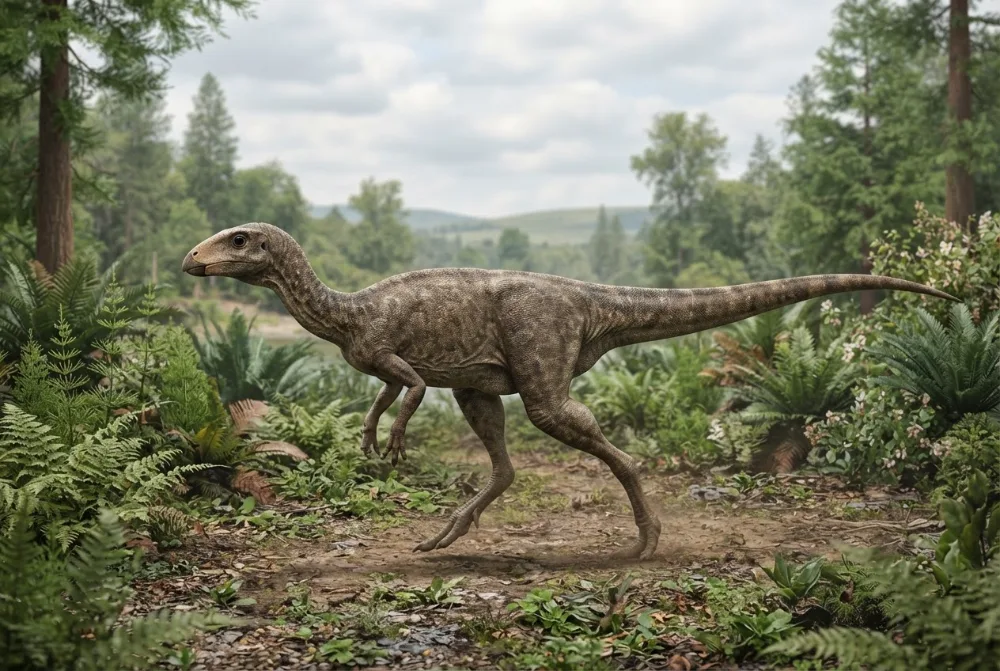
Mafunso ofunsidwa kwambiri okhudza Orodromeus
?How big was Orodromeus?
About 2.5 metres (8.2 feet) long. That is roughly the size of a large dog.12
?What did Orodromeus eat?
It was a plant-eater. It used its horny beak and grinding cheek teeth to eat tough plant material, and it probably fed on plants no higher than 1 metre (3.3 feet) off the ground.12
?When did Orodromeus live?
It lived during the Late Cretaceous Period, about 75 million years ago, in what is now Montana, USA.12
?How fast could Orodromeus run?
Nobody knows for sure, but its name means 'mountain runner' and it was built for running on two legs. It was probably very quick.12
?Did Orodromeus dig burrows?
Maybe. Scientists think it may have dug burrows like its relative Oryctodromeus, because its bones are sometimes found packed together in ways that suggest burrowing.1
Kwa akatswiri a madino
- Dzina la sayansi
- Orodromeus
- Anapatsidwa dzina ndi
- Horner and Weishampel 19883
- Gulu
- Odya zomera a milomo
- Banja / kladi
- Thescelosauridae3
- Magawidwe a sayansi
- Ornithischia3
- Zaka za miyala
- zaka 84 mpaka 66 miliyoni (Campanian / Maastrichtian)3
- Mapangidwe a miyala
- Two Medicine, Hell Creek, Judith River3
- Mayiko
- Amereka3
- Zolemba za mafosili
- 9 mu The Paleobiology Database3
- Kupezeka
- Orodromeus was named by Jack Horner and David Weishampel in 1988. The first fossils were found by Robert Makela in Teton County, Montana, during an excavation of the Egg Mountain site.1
- Akukambiranabe
- Scientists are not sure if Orodromeus really dug burrows, because the evidence is not yet strong.1
Kumene mfundo zimachokera
- Orodromeus (en.wikipedia.org)
- Orodromeus (nhm.ac.uk)
- Orodromeus in The Paleobiology Database (CC BY 4.0): zaka, malo, mapangidwe a miyala, magawidwe a sayansi.
Mfundo iliyonse patsamba lino ili ndi nambala yosonyeza kumene yachokera. Ngati talakwitsa kanthu, pepa, ndife okonda madino, osati magazini ya sayansi. Tiuze pa [email protected] ndipo tikonza.
 Rex ali ndi njala! Dino Wiki ndi ntchito ya bambo kwa mwana wawo wamwamuna wokonda madainoso, yaulere popanda zotsatsa ndi zokazonda. Akuluakulu angadyetse Rex zokhwasula-khwasula kuti tsambali lipitirize kupezeka pa intaneti.Dyetsa Rex
 Iguanodon
 Tenontosaurus
 Thescelosaurus
 Zalmoxes
 Camptosaurus
 Rhabdodon
 Tyrannosaurus
 Triceratops
 Velociraptor
 Spinosaurus
 Ankylosaurus
 Parasaurolophus