 Kwizi ya Ndiwe dino uti?
 Nkhondo ya madino
 Mpikisano wa madino
 Masewera ang'onoang'ono a madino
 Chimbale cha zomata
 Mindandanda ya TOP ya madino
 Ndidabwitse!
Oryctodromeus
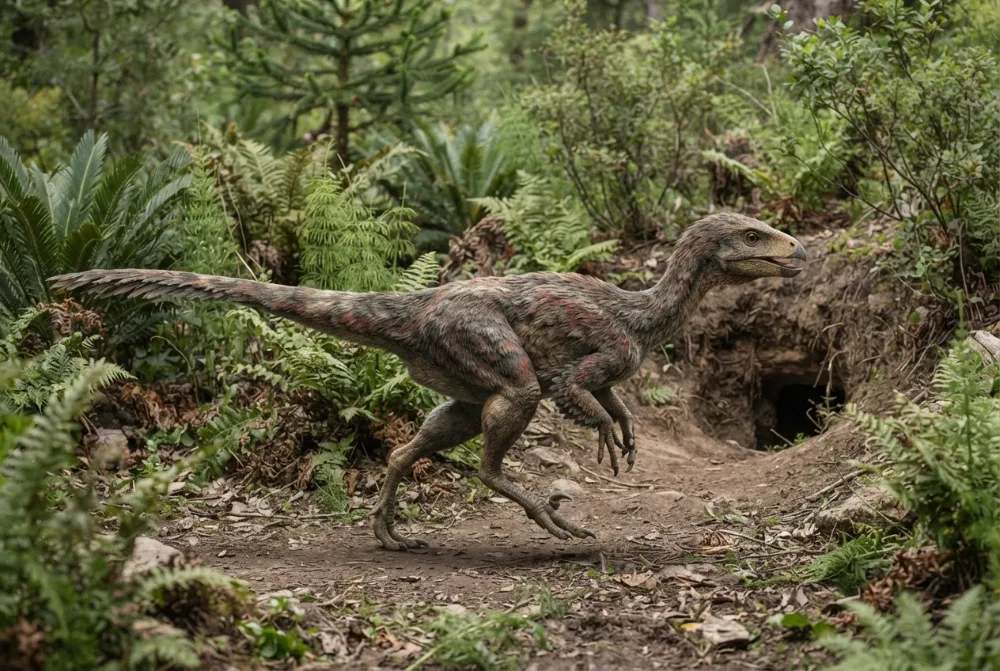
Oryctodromeus was a small, fast dinosaur that dug burrows to live in. It is the first non-bird dinosaur ever found with proof that it lived underground. An adult, two babies, and their burrow were all fossilized together.1
Ankakhala liti?
Anali wamkulu bwanji?
Anali wautali bwanji?
Msinkhu wake unali wautali bwanji?
kuyerekeza
Ankalemera bwanji?
 wautali ngati amphaka a pakhomo 4 otsatizana mphuno ndi mchira🍌wautali ngati nthochi 12 zotsatizana🍉wolemera ngati mavwende 6🏃akanatha kuthamanga mamita 100 m'masekondi 8.8 (munthu waliwiro kwambiri amafunika 9.6)
Oryctodromeus anali wamkulu bwanji poyerekeza ndi IWEYO?
Ndi masamu chabe mu msakatuli wako. Palibe chimene chimasungidwa kapena kutumizidwa kwina kulikonse.
Anali ndi liwiro lotani?


Mfundo zosangalatsa
Oryctodromeus means 'digging runner' because it could both dig burrows and run fast on two legs.1
Its burrow was about 2 meters (6.6 feet) long and 70 centimeters (2.3 feet) wide, with two turns.1
The adult Oryctodromeus was about 2.1 meters (6.9 feet) long and weighed between 22 and 32 kilograms (50 to 70 pounds).1
Two baby Oryctodromeus were found with the adult, showing that parents cared for their young in the burrow.1
Its strong shoulders and arms helped it dig, but it was not as specialized for digging as a mole or wombat.1
Oryctodromeus was named the state dinosaur of Idaho in 2023.1
The burrow was filled with sand and turned into sandstone, which preserved the bones inside.1
Mafunso ofunsidwa kwambiri okhudza Oryctodromeus
?How did Oryctodromeus dig?
It used its strong shoulders, arms, and broad snout to scratch and move soil. It was not as specialized for digging as a mole or wombat, but more like a rabbit or hyena.13
?What did Oryctodromeus eat?
It was a plant-eater, or herbivore.2
?When did Oryctodromeus live?
It lived during the mid-Cretaceous Period, about 105 to 96 million years ago.1
Kwa akatswiri a madino
- Dzina la sayansi
- Oryctodromeus
- Anapatsidwa dzina ndi
- Varricchio et al. 20074
- Gulu
- Odya zomera a milomo
- Banja / kladi
- Thescelosauridae4
- Magawidwe a sayansi
- Ornithischia4
- Zaka za miyala
- zaka 106 mpaka 94 miliyoni (Albian / Cenomanian)4
- Mapangidwe a miyala
- Wayan, Blackleaf4
- Mayiko
- Amereka4
- Zolemba za mafosili
- 9 mu The Paleobiology Database4
- Kupezeka
- Oryctodromeus was named in 2007 by David Varricchio, Anthony Martin, and Yoshihiro Katsura. They found an adult and two juveniles inside a fossilized burrow in Montana.14
- Akukambiranabe
- Scientists are not sure if its close relatives Orodromeus and Zephyrosaurus also dug burrows, though they have similar features.1
Kumene mfundo zimachokera
- Oryctodromeus (en.wikipedia.org)
- Oryctodromeus | Natural History Museum (nhm.ac.uk)
- First trace and body fossil evidence of a burrowing, denning dinosaur (pmc.ncbi.nlm.nih.gov)
- Oryctodromeus in The Paleobiology Database (CC BY 4.0): zaka, malo, mapangidwe a miyala, magawidwe a sayansi.
Mfundo iliyonse patsamba lino ili ndi nambala yosonyeza kumene yachokera. Ngati talakwitsa kanthu, pepa, ndife okonda madino, osati magazini ya sayansi. Tiuze pa [email protected] ndipo tikonza.
 Rex ali ndi njala! Dino Wiki ndi ntchito ya bambo kwa mwana wawo wamwamuna wokonda madainoso, yaulere popanda zotsatsa ndi zokazonda. Akuluakulu angadyetse Rex zokhwasula-khwasula kuti tsambali lipitirize kupezeka pa intaneti.Dyetsa Rex
 Iguanodon
 Tenontosaurus
 Thescelosaurus
 Zalmoxes
 Camptosaurus
 Rhabdodon
 Tyrannosaurus
 Triceratops
 Velociraptor
 Spinosaurus
 Ankylosaurus
 Parasaurolophus