 Kwizi ya Ndiwe dino uti?
 Nkhondo ya madino
 Mpikisano wa madino
 Masewera ang'onoang'ono a madino
 Chimbale cha zomata
 Mindandanda ya TOP ya madino
 Ndidabwitse!
Ankakhala liti?

Anali wamkulu bwanji?
Anali wautali bwanji?
Msinkhu wake unali wautali bwanji?
Ankalemera bwanji?
 wolemera pafupifupi ngati mphaka wa pakhomo🍌wolemera ngati nthochi 29🪑wamng'ono moti angayende pansi pa mpando🏃akanatha kuthamanga mamita 100 m'masekondi 12 (munthu waliwiro kwambiri amafunika 9.6)
Shuvuuia anali wamkulu bwanji poyerekeza ndi IWEYO?
Ndi masamu chabe mu msakatuli wako. Palibe chimene chimasungidwa kapena kutumizidwa kwina kulikonse.
Anali ndi liwiro lotani?


Mfundo zosangalatsa
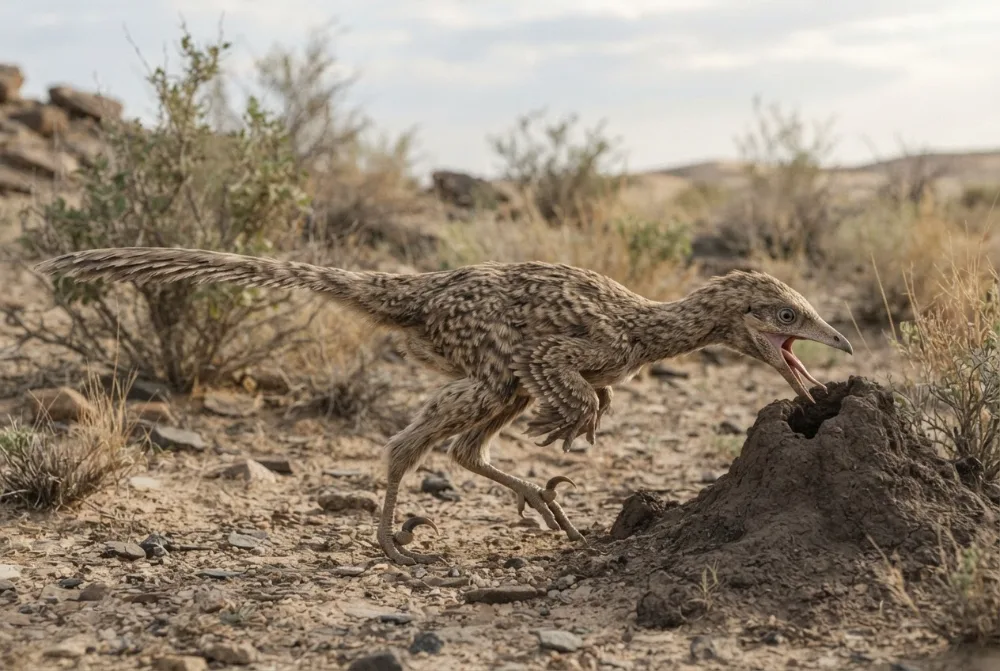
Shuvuuia is known from two beautifully preserved skulls, which are the first skulls ever found for its group, the Alvarezsauridae.2
Its lower jaw was not locked to the skull, so its mouth could open very wide to catch larger prey.1
Shuvuuia lived in the Late Cretaceous period, about 75 to 81 million years ago, in what is now the Gobi Desert of Mongolia.1
Scientists think Shuvuuia may have eaten termites, because its skull and jaw look like those of modern animals that eat insects.1
The name Shuvuuia means 'bird' in Mongolian, because its skull shows features that link it to birds.1
Mafunso ofunsidwa kwambiri okhudza Shuvuuia
?How big was Shuvuuia?
Shuvuuia was very small, about 1 metre (3.3 feet) long and weighed around 3.5 kilograms (7.7 pounds). It is one of the smallest known non-avian dinosaurs.4
?Did Shuvuuia have feathers?
Yes, scientists think Shuvuuia had a coat of feathers. Fossils show tiny tube-like structures that contain the same proteins found in modern bird feathers.4
?What did Shuvuuia eat?
Shuvuuia probably ate insects and small animals. It may have used its strong arms to dig into insect nests and its flexible jaw to catch prey like termites or small mammals.41
?Could Shuvuuia see in the dark?
Some scientists think Shuvuuia had excellent night vision and hearing, like an owl, and could hunt in complete darkness. However, a 2025 study disagreed and said its hearing was more like a chicken's.4
Kwa akatswiri a madino
- Dzina la sayansi
- Shuvuuia
- Anapatsidwa dzina ndi
- Chiappe et al. 19985
- Gulu
- Madino a nthenga achilendo
- Banja / kladi
- Alvarezsauridae5
- Magawidwe a sayansi
- Theropoda > Alvarezsauridae5
- Zaka za miyala
- zaka 84 mpaka 72 miliyoni (Campanian)5
- Mapangidwe a miyala
- Djadokhta5
- Mayiko
- Mongoliya5
- Zolemba za mafosili
- 3 mu The Paleobiology Database5
- Kupezeka
- Shuvuuia was named by Luis Chiappe, Mark Norell, and James Clark in 1998. The first fossils were found at Ukhaa Tolgod in Mongolia.25
- Akukambiranabe
- Scientists are still debating whether Shuvuuia was more closely related to birds or to other dinosaurs like therizinosaurs and oviraptorosaurs.2
Kumene mfundo zimachokera
- Shuvuuia | Natural History Museum (nhm.ac.uk)
- The skull of a relative of the stem-group bird Mononykus | Nature (nature.com)
- Shuvuuia Fact Sheet - Enchanted Learning (enchantedlearning.com)
- Shuvuuia (en.wikipedia.org)
- Shuvuuia in The Paleobiology Database (CC BY 4.0): zaka, malo, mapangidwe a miyala, magawidwe a sayansi.
Mfundo iliyonse patsamba lino ili ndi nambala yosonyeza kumene yachokera. Ngati talakwitsa kanthu, pepa, ndife okonda madino, osati magazini ya sayansi. Tiuze pa [email protected] ndipo tikonza.
 Rex ali ndi njala! Dino Wiki ndi ntchito ya bambo kwa mwana wawo wamwamuna wokonda madainoso, yaulere popanda zotsatsa ndi zokazonda. Akuluakulu angadyetse Rex zokhwasula-khwasula kuti tsambali lipitirize kupezeka pa intaneti.Dyetsa Rex
 Therizinosaurus
 Oviraptor
 Chirostenotes
 Citipes
 Leptorhynchos
 Avimimus
 Tyrannosaurus
 Triceratops
 Velociraptor
 Spinosaurus
 Ankylosaurus
 Parasaurolophus