 Kwizi ya Ndiwe dino uti?
 Nkhondo ya madino
 Mpikisano wa madino
 Masewera ang'onoang'ono a madino
 Chimbale cha zomata
 Mindandanda ya TOP ya madino
 Ndidabwitse!
Ankakhala liti?

Anali wamkulu bwanji?
Anali wautali bwanji?
Msinkhu wake unali wautali bwanji?
Ankalemera bwanji?
 wautali ngati agalu 4 otsatizana mphuno ndi mchira🍌wautali ngati nthochi 25 zotsatizana🍉wolemera ngati mavwende 120🧸wolemera ngati ana a sukulu ya mkaka 31🎒wolemera ngati ana a sukulu 18🏃akanatha kuthamanga mamita 100 m'masekondi 9.2 (munthu waliwiro kwambiri amafunika 9.6)
Tethyshadros anali wamkulu bwanji poyerekeza ndi IWEYO?
Ndi masamu chabe mu msakatuli wako. Palibe chimene chimasungidwa kapena kutumizidwa kwina kulikonse.
Anali ndi liwiro lotani?


Mfundo zosangalatsa
Tethyshadros lived on a large island in the ancient Tethys Ocean, which is why it was named after that sea.1
The first skeleton, nicknamed Antonio, was found in a vertical rockface and took years to dig out.1
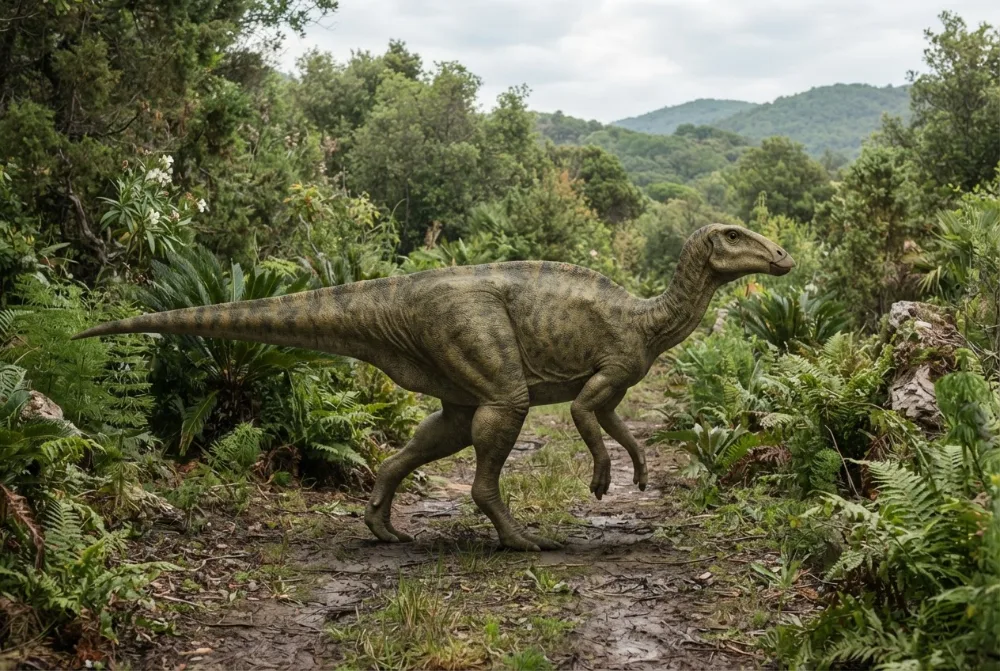
Tethyshadros had a mix of old-fashioned features, like a short neck and a skull like Iguanodon, and advanced features, like teeth arranged in batteries like true hadrosaurs.1
Scientists once thought Tethyshadros was a dwarf dinosaur, but later bone studies showed the main skeleton was from a teenager, not a full-grown adult.1
A second skeleton, nicknamed Bruno, is bigger and more complete, with a full skull and many bones.1
Tethyshadros is one of the latest surviving non-hadrosaurid hadrosauromorphs, meaning it lived just before true hadrosaurs became common.1
Mafunso ofunsidwa kwambiri okhudza Tethyshadros
?How big was Tethyshadros?
About 4.5 metres (15 feet) long, though some scientists think that estimate might be too high. The adult skeleton Bruno was 15 to 20% larger than the subadult Antonio.1
?What did Tethyshadros eat?
It was a plant-eater. Its beak and teeth were adapted for eating plants, and it may have used its strange serrated beak to bite specific food items.13
?Why did Tethyshadros have a strange beak?
Nobody knows for sure. It might have helped it bite certain plants, or been used for grooming or display.3
?Was Tethyshadros a dwarf dinosaur?
It was originally thought to be a dwarf, but later bone studies showed the main skeleton (Antonio) was a teenager, not a full-grown adult. The adult Bruno was larger.1
?When did Tethyshadros live?
It lived during the Late Cretaceous, about 81.5 to 80.5 million years ago.1
?Where was Tethyshadros found?
In an abandoned quarry at Villaggio del Pescatore, near Trieste, Italy. It lived on a large island in the ancient Tethys Ocean.1
Wothetsa nthano zabodza
Nthano: Tethyshadros was a dwarf dinosaur.
Zoona: The first skeleton was a subadult, not a full-grown adult, so it was not a dwarf species.1
Kwa akatswiri a madino
- Dzina la sayansi
- Tethyshadros
- Anapatsidwa dzina ndi
- Dalla Vecchia 20094
- Gulu
- Odya zomera a milomo
- Banja / kladi
- Telmatosauridae4
- Magawidwe a sayansi
- Ornithischia > Ornithopoda > Iguanodontia4
- Zaka za miyala
- zaka 84 mpaka 72 miliyoni (Campanian)4
- Mapangidwe a miyala
- Aurisina4
- Mayiko
- Italiya4
- Zolemba za mafosili
- 1 mu The Paleobiology Database4
- Kupezeka
- Fossil fragments were found in the 1980s by Alceo Tarlao and Giorgio Rimoli. A nearly complete skeleton was discovered in 1994 and excavated by 1999. The dinosaur was named Tethyshadros insularis by Fabio Dalla Vecchia in 2009.1
- Akukambiranabe
- Scientists still debate the exact total length of Tethyshadros, because the tail of the first skeleton was missing and its length had to be estimated.1
Kumene mfundo zimachokera
- Tethyshadros (en.wikipedia.org)
- Friuli-Venezia Giulia - Fossili Regionali (fossiliregionali.it)
- The “Duck-billed” Dinosaur That Wasn’t (smithsonianmag.com)
- Tethyshadros in The Paleobiology Database (CC BY 4.0): zaka, malo, mapangidwe a miyala, magawidwe a sayansi.
Mfundo iliyonse patsamba lino ili ndi nambala yosonyeza kumene yachokera. Ngati talakwitsa kanthu, pepa, ndife okonda madino, osati magazini ya sayansi. Tiuze pa [email protected] ndipo tikonza.
 Rex ali ndi njala! Dino Wiki ndi ntchito ya bambo kwa mwana wawo wamwamuna wokonda madainoso, yaulere popanda zotsatsa ndi zokazonda. Akuluakulu angadyetse Rex zokhwasula-khwasula kuti tsambali lipitirize kupezeka pa intaneti.Dyetsa Rex
 Iguanodon
 Tenontosaurus
 Thescelosaurus
 Zalmoxes
 Camptosaurus
 Rhabdodon
 Tyrannosaurus
 Triceratops
 Velociraptor
 Spinosaurus
 Ankylosaurus
 Parasaurolophus