 Kwizi ya Ndiwe dino uti?
 Nkhondo ya madino
 Mpikisano wa madino
 Masewera ang'onoang'ono a madino
 Chimbale cha zomata
 Mindandanda ya TOP ya madino
 Ndidabwitse!
Ankakhala liti?

Anali wamkulu bwanji?
Anali wautali bwanji?
Msinkhu wake unali wautali bwanji?
kuyerekeza
 wautali ngati amphaka a pakhomo 4 otsatizana mphuno ndi mchira🍌wautali ngati nthochi 11 zotsatizana🏃akanatha kuthamanga mamita 100 m'masekondi 8.8 (munthu waliwiro kwambiri amafunika 9.6)
Weewarrasaurus anali wamkulu bwanji poyerekeza ndi IWEYO?
Ndi masamu chabe mu msakatuli wako. Palibe chimene chimasungidwa kapena kutumizidwa kwina kulikonse.
Anali ndi liwiro lotani?


Mfundo zosangalatsa
Weewarrasaurus is known from a jawbone preserved in precious opal, giving it a colorful, gem-like appearance.1
It lived about 100 to 94 million years ago during the Cretaceous Period.4
The name Weewarrasaurus comes from the Wee Warra locality where its fossil was found.1
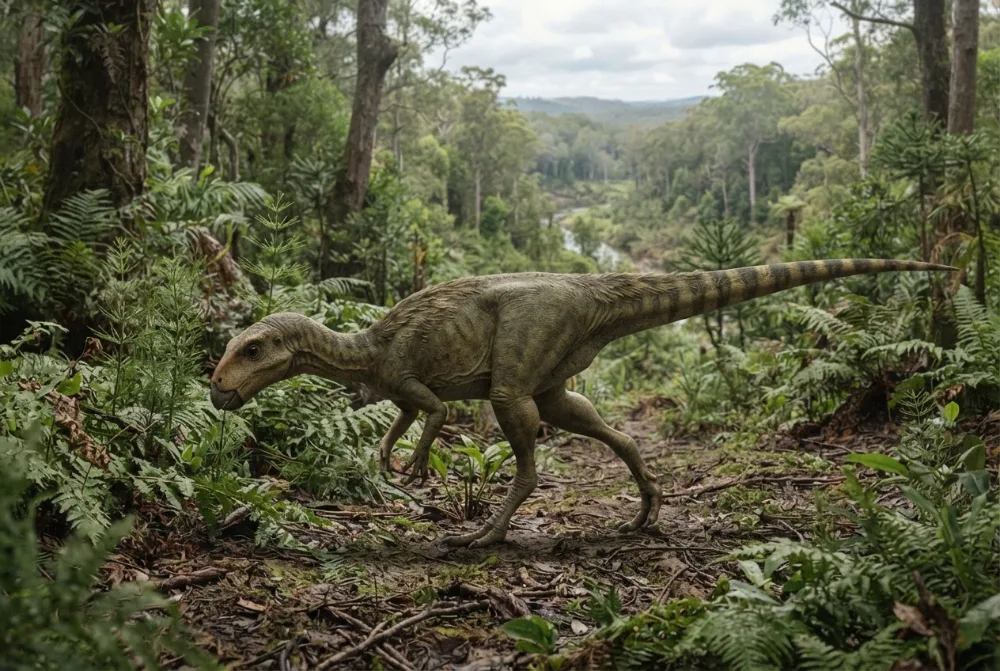
This dinosaur was a small ornithopod, about the size of a large dog.1
Weewarrasaurus shared its home with other ornithopods of different sizes, including a larger iguanodontian.1
Mafunso ofunsidwa kwambiri okhudza Weewarrasaurus
?How big was Weewarrasaurus?
About the size of a Labrador retriever, or a large dog. It walked on its hind legs.3
?What did Weewarrasaurus eat?
It was a plant-eater. It had a beak and teeth for nibbling vegetation like ferns.3
?Why is Weewarrasaurus preserved in opal?
The fossil was preserved in opal because silica-rich solutions underground turned into the gemstone over millions of years. This happened in the Lightning Ridge area of Australia.3
Kwa akatswiri a madino
- Dzina la sayansi
- Weewarrasaurus
- Anapatsidwa dzina ndi
- Bell et al. 20184
- Gulu
- Odya zomera a milomo
- Banja / kladi
- Elasmaria4
- Magawidwe a sayansi
- Ornithischia > Ornithopoda > Iguanodontia4
- Zaka za miyala
- zaka 100 mpaka 94 miliyoni (Cenomanian)4
- Mapangidwe a miyala
- Griman Creek4
- Mayiko
- Australia4
- Zolemba za mafosili
- 2 mu The Paleobiology Database4
- Kupezeka
- Weewarrasaurus was named in 2018 by Phil Bell and colleagues based on a jawbone found by opal miner Mike Poben near Lightning Ridge, Australia.12
- Akukambiranabe
- Scientists are not sure exactly how big Weewarrasaurus grew, because only jawbones have been found so far.1
Kumene mfundo zimachokera
- Ornithopod diversity in the Griman Creek Formation (Cenomanian), New South Wales, Australia (pmc.ncbi.nlm.nih.gov)
- Weewarrasaurus (en.wikipedia.org)
- Exclusive: Sparkly, opal-filled fossils reveal new dinosaur species | National Geographic (nationalgeographic.com)
- Weewarrasaurus in The Paleobiology Database (CC BY 4.0): zaka, malo, mapangidwe a miyala, magawidwe a sayansi.
Mfundo iliyonse patsamba lino ili ndi nambala yosonyeza kumene yachokera. Ngati talakwitsa kanthu, pepa, ndife okonda madino, osati magazini ya sayansi. Tiuze pa [email protected] ndipo tikonza.
 Rex ali ndi njala! Dino Wiki ndi ntchito ya bambo kwa mwana wawo wamwamuna wokonda madainoso, yaulere popanda zotsatsa ndi zokazonda. Akuluakulu angadyetse Rex zokhwasula-khwasula kuti tsambali lipitirize kupezeka pa intaneti.Dyetsa Rex
 Iguanodon
 Tenontosaurus
 Thescelosaurus
 Zalmoxes
 Camptosaurus
 Rhabdodon
 Tyrannosaurus
 Triceratops
 Velociraptor
 Spinosaurus
 Ankylosaurus
 Parasaurolophus