 Ati daayinoo kami? Qormaata
 Lola daayinoo
 Dorgommii daayinoo
 Taphoota daayinoo xixiqqoo
 Albamii istiikarii
 Tarreewwan TOP daayinoo
 Na dinqisiisi!
Maiaspondylus
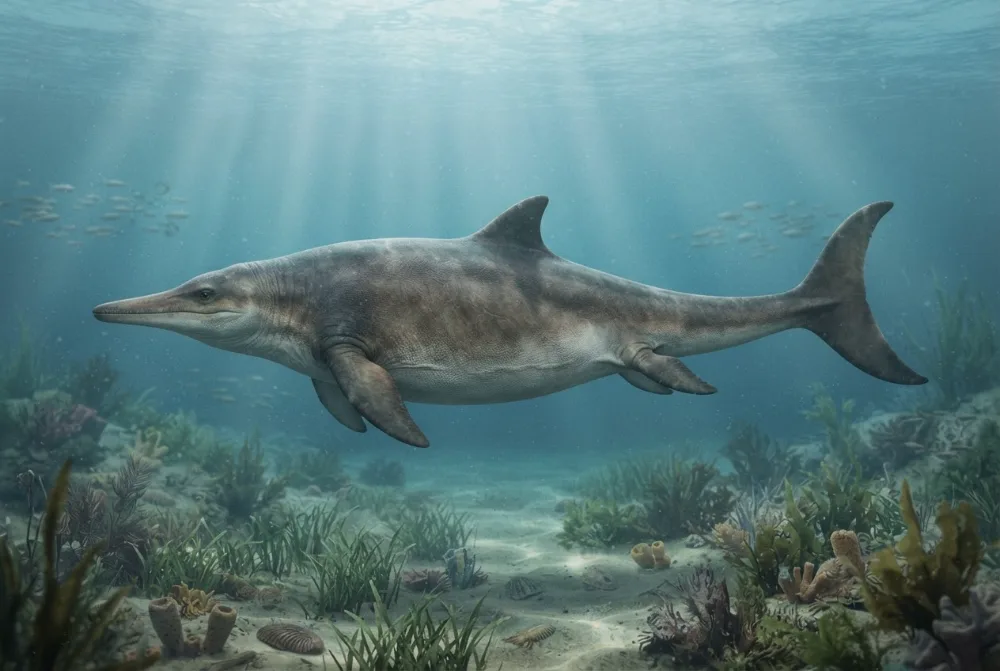
Maiaspondylus was a marine reptile that lived in the sea, not a dinosaur. It was an ichthyosaur, a fast-swimming predator with a long snout and sharp teeth. Fossils show that it gave birth to live babies, just like whales and dolphins do today.1
Yoom jiraate?
Hammam guddaa ture?
Hammam dheeraa ture?
 akka saree 4 funyaan hanga eegeetti dheeraa🍌akka muuzii 22 walitti hiriiran dheeraa🏊dheerina bishaan daakaa guddaa (50 m) sekondii 3.8 keessatti daakuu danda'a
SI wajjin yoo wal bira qabamu, Maiaspondylus hammam guddaa ture?
Herrega qofa barbaadduu kee keessatti. Wanti tokkollee hin olkaa'amu, eessayyuu hin ergamu.
Hammam saffisaa ture?


Odeeffannoowwan bashannansiisoo
Maiaspondylus means 'caring mother vertebra' because a fossil was found with two embryos inside an adult, showing it gave live birth.1
The embryos found inside the adult are the smallest and youngest ichthyosaur embryos ever discovered.1
Maiaspondylus lived about 110 million years ago during the Early Cretaceous period.1
Its fossils were first found in the Loon River Formation in Canada's Northwest Territories.1
Maiaspondylus had a special skull bone arrangement: the jugal and maxilla overlapped a lot, which helped scientists tell it apart from other ichthyosaurs.2
Its teeth had smooth crowns and fluted cementum (the root covering), and they curved inward toward the tongue.2
The arm bone (humerus) of Maiaspondylus had three knobs at the end for muscles, with the middle knob smaller than the outer ones.2
Gaaffiiwwan waa'ee Maiaspondylus baay'ee gaafataman
?How big was Maiaspondylus?
No one knows for sure because no complete skeleton has been found. The known fossils include a nearly complete skeleton and vertebrae from adults, but scientists have not estimated its total length.1
?Did Maiaspondylus give live birth?
Yes. A fossil of an adult Maiaspondylus was found with two embryos inside, proving it gave birth to live babies, just like whales and dolphins.13
?Where was Maiaspondylus found?
Its fossils were first found in the Loon River Formation in Canada's Northwest Territories. Later, fossils were also found in England and Russia.1
Ogeeyyii daayinootiif
- Maqaa saayinsii
- Maiaspondylus
- Kan maqaa baase
- Maxwell and Caldwell 20064
- Garee
- Ikteyoosaroota
- Maatii / kilaadii
- Ophthalmosauridae4
- Ramaddii
- Ichthyosauria > Ichthyosauromorpha4
- Umurii dhagaawwanii
- waggaa miliyoona 110 hanga 106 (Albian)4
- Caasaawwan dhagaa
- Loon River4
- Biyyoota
- Kanaadaa4
- Galmee fosilii
- 1 The Paleobiology Database keessa4
- Argannoo
- Maiaspondylus was named by scientists Erin Maxwell and Michael Caldwell in 2006. The fossils were found by technician Allan Lindoe, who collected and prepared them.1
- Ammallee falmisiisaa
- Scientists are still debating exactly how Maiaspondylus is related to other ichthyosaurs, especially the genus Platypterygius.1
Odeeffannoon eessaa dhufa
- Maiaspondylus (en.wikipedia.org)
- A NEW GENUS OF ICHTHYOSAUR FROM THE LOWER CRETACEOUS OF WESTERN CANADA (onlinelibrary.wiley.com)
- Pregnant prehistoric fossil offers clues to past | EurekAlert! (eurekalert.org)
- Maiaspondylus in The Paleobiology Database (CC BY 4.0): umurii, bakkeewwan, caasaawwan dhagaa, ramaddii.
Odeeffannoon fuula kana irra jiru hundi lakkoofsa madda isaa agarsiisu qaba. Yoo waa dogoggorre, dhiifama, nuti jaallattoota daayinoo malee joornaalii saayinsii miti. [email protected] irratti nutti himi, nus ni sirreessina.
 Rex beela'eera! Dino Wiki pirojektii abbaa tokkoo kan ilma isaa daayinoo jaallatuuf hojjetame, bilisa, beeksisa malee fi hordoftuu malee. Ga'eessonni akka inni interneetii irra turuuf Rexiif nyaata xiqqoo kennuu danda'u.Rex soori
 Ichthyosaurus
 Platypterygius
 Stenopterygius
 Khudiakovia
 Ophthalmosaurus
 Chonespondylus
 Stegosaurus
 Iguanodon
 Archaeopteryx
 Giganotosaurus
 Microraptor
 Deinonychus