 Ati daayinoo kami? Qormaata
 Lola daayinoo
 Dorgommii daayinoo
 Taphoota daayinoo xixiqqoo
 Albamii istiikarii
 Tarreewwan TOP daayinoo
 Na dinqisiisi!
Megapterygius
Megapterygius was a huge marine lizard that swam in the seas around Japan 72 million years ago. It had enormous flippers that were longer than its head, and scientists think it even had a dorsal fin like a shark!12
Yoom jiraate?
Hammam guddaa ture?
Hammam dheeraa ture?
Hammam ulfaataa ture?
 akka saree 6 funyaan hanga eegeetti dheeraa🍌akka muuzii 33 walitti hiriiran dheeraa🍉akka habxuu 90 ulfaata🧸akka ijoollee KG 24 ulfaata🎒akka ijoollee mana barumsaa 14 ulfaata🏊dheerina bishaan daakaa guddaa (50 m) sekondii 4.7 keessatti daakuu danda'a
SI wajjin yoo wal bira qabamu, Megapterygius hammam guddaa ture?
Herrega qofa barbaadduu kee keessatti. Wanti tokkollee hin olkaa'amu, eessayyuu hin ergamu.
Hammam saffisaa ture?


Odeeffannoowwan bashannansiisoo
Megapterygius had rear flippers that were even longer than its front flippers, a feature only seen in one other mosasaur, Tylosaurus.1
Its flippers were longer than its skull, which is unique among mosasaurs with paddle-like limbs.1
The shape of its backbone suggests it had a dorsal fin, like a dolphin or shark, which would have helped it turn quickly in the water.12
Its skull was slightly wide around the eye sockets, giving it binocular vision that helped it hunt prey. This is only the second mosasaur known to have this ability.1
The fossil was found in 2006 by Akihiro Misaki, who was actually looking for ammonite fossils when he spotted a vertebra.12
More than 100 shark teeth were found around the Megapterygius skeleton, suggesting that sharks scavenged its body after it died.1
Megapterygius is the most complete mosasaur skeleton ever found in Japan or the northwestern Pacific.2
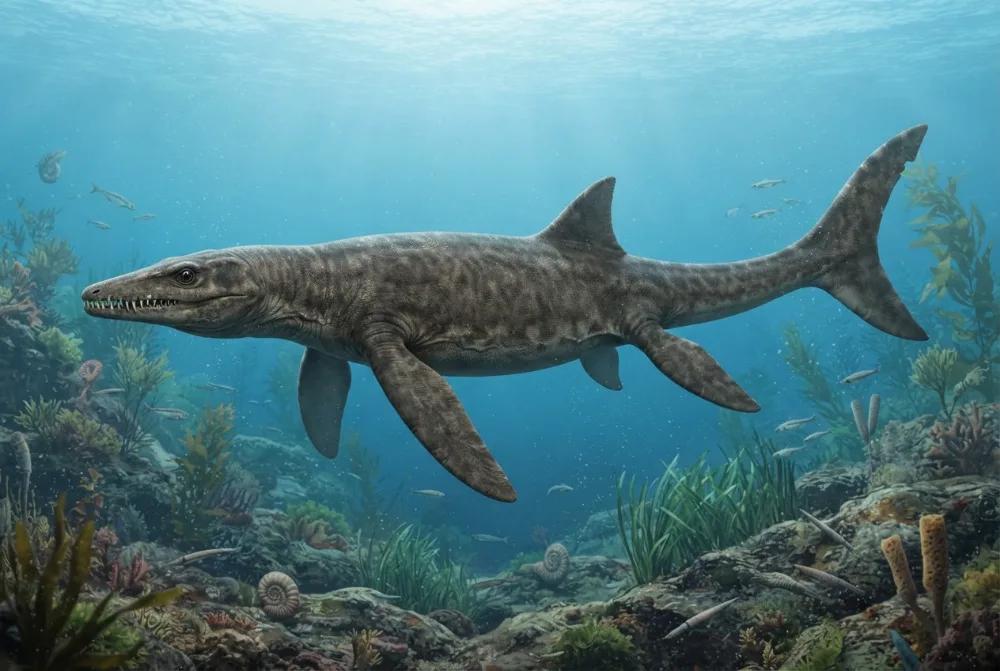
Gaaffiiwwan waa'ee Megapterygius baay'ee gaafataman
?How big was Megapterygius?
Megapterygius was about 6 metres long, with a skull about 0.8 metres long. That is roughly the size of a large great white shark.12
?Did Megapterygius have a dorsal fin?
Scientists think it did. The shape of its backbone is like that of dolphins and porpoises, which have dorsal fins, and this would have helped it turn quickly in the water. It's the first mosasaur with evidence of a dorsal fin.12
?What did Megapterygius eat?
Scientists think it hunted large groups of small prey, like schools of fish. Its binocular vision and big flippers would have helped it catch them.1
Ogeeyyii daayinootiif
- Maqaa saayinsii
- Megapterygius
- Kan maqaa baase
- Konishi et al. 20234
- Garee
- Moosaasaroota
- Maatii / kilaadii
- Mosasauridae4
- Ramaddii
- Mosasauroidea4
- Umurii dhagaawwanii
- waggaa miliyoona 84 hanga 66 (Campanian / Maastrichtian)4
- Caasaawwan dhagaa
- Toyajo4
- Biyyoota
- Jaappaan4
- Galmee fosilii
- 1 The Paleobiology Database keessa4
- Argannoo
- The fossil was discovered in 2006 by Akihiro Misaki in Wakayama Prefecture, Japan. It was named Megapterygius wakayamaensis by Takuya Konishi and colleagues in 2023.12
- Ammallee falmisiisaa
- Scientists are still debating how Megapterygius used its four large flippers and tail fin together for swimming, since no modern animal has a similar body shape.2
Odeeffannoon eessaa dhufa
- Megapterygius (en.wikipedia.org)
- UC paleontologist describes Wakayama 'blue dragon' that ruled prehistoric waters off Japan - University of Cincinnati: Founder of Co-op, Leader in Co-op | University of Cincinnati (uc.edu)
- Megapterygius | Dino Encyclopedia (dinosaurmuseum.jp)
- Megapterygius in The Paleobiology Database (CC BY 4.0): umurii, bakkeewwan, caasaawwan dhagaa, ramaddii.
Odeeffannoon fuula kana irra jiru hundi lakkoofsa madda isaa agarsiisu qaba. Yoo waa dogoggorre, dhiifama, nuti jaallattoota daayinoo malee joornaalii saayinsii miti. [email protected] irratti nutti himi, nus ni sirreessina.
 Rex beela'eera! Dino Wiki pirojektii abbaa tokkoo kan ilma isaa daayinoo jaallatuuf hojjetame, bilisa, beeksisa malee fi hordoftuu malee. Ga'eessonni akka inni interneetii irra turuuf Rexiif nyaata xiqqoo kennuu danda'u.Rex soori
 Mosasaurus
 Prognathodon
 Tylosaurus
 Platecarpus
 Clidastes
 Globidens
 Tyrannosaurus
 Triceratops
 Velociraptor
 Spinosaurus
 Ankylosaurus
 Parasaurolophus