 Ati daayinoo kami? Qormaata
 Lola daayinoo
 Dorgommii daayinoo
 Taphoota daayinoo xixiqqoo
 Albamii istiikarii
 Tarreewwan TOP daayinoo
 Na dinqisiisi!
Sauroplites
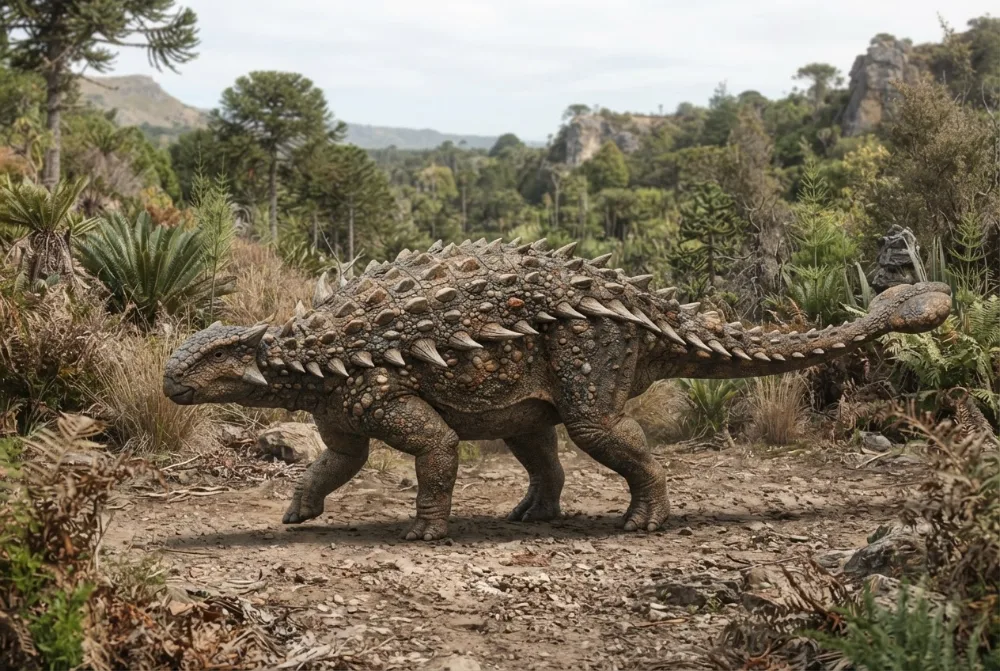
Sauroplites was an armoured dinosaur that walked on four legs and ate plants. Its back and hips were covered with a shield made of bony plates, like a suit of armour. It lived in what is now Inner Mongolia, China, during the Early Cretaceous period.14
Yoom jiraate?
Hammam guddaa ture?
Hammam dheeraa ture?
Hammam ol-dheeraa ture?
 akka saree 6 funyaan hanga eegeetti dheeraa🍌akka muuzii 31 walitti hiriiran dheeraa🏃meetira 100 sekondii 22 keessatti fiiguu danda'a (namni hunda caalaa saffisaan 9.6 barbaada)
SI wajjin yoo wal bira qabamu, Sauroplites hammam guddaa ture?
Herrega qofa barbaadduu kee keessatti. Wanti tokkollee hin olkaa'amu, eessayyuu hin ergamu.
Hammam saffisaa ture?


Odeeffannoowwan bashannansiisoo
Sauroplites had a special shield on its hips made of fused rosettes. Each rosette had one large central bony plate surrounded by a single ring of smaller plates. No other armoured dinosaur had this exact pattern.12
The largest bony plates on its back could be up to 40 centimetres (about 16 inches) long. The plates on its sides were about 30 centimetres (12 inches) across.1
The fossils of Sauroplites were discovered in 1930 by Swedish paleontologist Anders Birger Bohlin during an expedition in Inner Mongolia. The dinosaur was named and described by Bohlin in 1953.1
The original fossil bones of Sauroplites are lost today, but some casts (copies) are kept at the American Museum of Natural History in New York.1
For a long time, scientists thought Sauroplites might be a doubtful name because the fossils were so fragmentary. But in 2014, researcher Victoria Megan Arbour found a unique feature on the hip shield that proved it was a real, valid dinosaur.1
Gaaffiiwwan waa'ee Sauroplites baay'ee gaafataman
?How big was Sauroplites?
Nobody knows for sure because the fossils are very fragmentary. The largest bony plates on its back could be up to 40 centimetres (about 16 inches) long, but no complete skeleton has been found to estimate its full size.1
?What did Sauroplites eat?
Sauroplites was an herbivore, meaning it ate plants. It had a plant-eating dinosaur's body and teeth suited for chewing vegetation.1
?Is Sauroplites a dinosaur?
Yes, Sauroplites is a dinosaur. It is an ankylosaurian dinosaur from the Early Cretaceous of China.1
Ogeeyyii daayinootiif
- Maqaa saayinsii
- Sauroplites
- Kan maqaa baase
- Bohlin 19534
- Garee
- Daayinoowwan gaachanaa
- Maatii / kilaadii
- Nodosauridae4
- Ramaddii
- Ornithischia > Ankylosauria > Nodosauridae > Thyreophora4
- Umurii dhagaawwanii
- waggaa miliyoona 121 hanga 113 (Aptian)4
- Biyyoota
- Chaayinaa4
- Galmee fosilii
- 1 The Paleobiology Database keessa4
- Argannoo
- Swedish paleontologist Anders Birger Bohlin discovered the fossils of Sauroplites in 1930 near Tebch in Inner Mongolia, during the Swedish-Chinese expeditions of Sven Hedin. He named and described the dinosaur in 1953.1
- Ammallee falmisiisaa
- Scientists are not sure whether Sauroplites belonged to the Nodosauridae family or the Ankylosauridae family. Some studies place it with nodosaurids because of its hip shield, but nodosaurids are rare in Asia.1
Odeeffannoon eessaa dhufa
- Sauroplites (en.wikipedia.org)
- PBDB Taxon (paleobiodb.org)
- Sauroplites — Facts, Size, Diet & Pronunciation | Types of Dinosaurs (typesofdinosaurs.com)
- Sauroplites in The Paleobiology Database (CC BY 4.0): umurii, bakkeewwan, caasaawwan dhagaa, ramaddii.
Odeeffannoon fuula kana irra jiru hundi lakkoofsa madda isaa agarsiisu qaba. Yoo waa dogoggorre, dhiifama, nuti jaallattoota daayinoo malee joornaalii saayinsii miti. [email protected] irratti nutti himi, nus ni sirreessina.
 Rex beela'eera! Dino Wiki pirojektii abbaa tokkoo kan ilma isaa daayinoo jaallatuuf hojjetame, bilisa, beeksisa malee fi hordoftuu malee. Ga'eessonni akka inni interneetii irra turuuf Rexiif nyaata xiqqoo kennuu danda'u.Rex soori
 Ankylosaurus
 Sauropelta
 Pinacosaurus
 Scutellosaurus
 Struthiosaurus
 Euoplocephalus
 Stegosaurus
 Iguanodon
 Archaeopteryx
 Giganotosaurus
 Microraptor
 Deinonychus