 Uri dinozore iyihe? Umukino w'ibibazo
 Intambara ya dinozore
 Isiganwa rya dinozore
 Imikino mito ya dinozore
 Alubumu ya sitikeri
 Intonde za TOP za dinozore
 Ntungura!
Arthropterygius
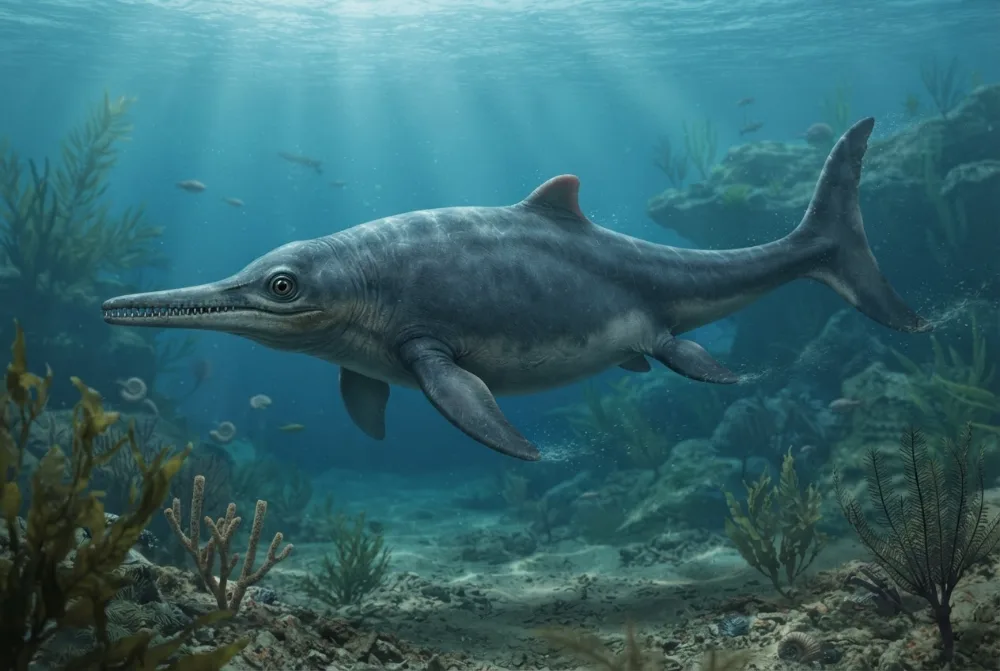
Arthropterygius was a large, fish-shaped marine reptile that swam in the oceans during the late Jurassic period. It had a long snout and strong flippers, and it was a fast hunter of fish and squid.13
Yabayeho ryari?
Yanganaga ite?
Yari ndende ite?
 ndende nk'imbwa 5 zikurikiranye🍌ndende nk'imineke 28 ikurikiranye🏊yashoboraga koga uburebure bwa pisine nini (50 m) mu masegonda 3,9
Arthropterygius yanganaga ite ugereranyije NAWE?
Ni imibare gusa ibarirwa muri mushakisha yawe. Nta kintu kibikwa cyangwa cyoherezwa ahandi.
Yihutaga ite?


Utuntu dushimishije
Arthropterygius had a special opening for the internal carotid artery on the back of its braincase, a feature unique among ichthyosaurs.2
Fossils of Arthropterygius have been found in both the Northern and Southern Hemispheres, showing it lived in warm and cold seas.12
One specimen from Svalbard, Norway, was about 3.8 to 4.3 metres (12 to 14 feet) long and was probably an adult.1
The name Arthropterygius means 'wing fin', referring to the shape of its flippers.1
Arthropterygius lived in shallow seas with methane seeps, where the seafloor was about 150 metres (490 feet) deep and had little oxygen.1
It belonged to a group called ophthalmosaurids, which were the last surviving ichthyosaurs before they went extinct.1
Ibibazo bibazwa cyane kuri Arthropterygius
?How big was Arthropterygius?
Arthropterygius was a relatively large ichthyosaur, with all species measuring between 3 and 5 metres (9.8 to 16.4 feet) long.1
?What did Arthropterygius eat?
It was a fast hunter of fish and squid, using its long snout and strong flippers to catch prey.1
?Was Arthropterygius a dinosaur?
No, Arthropterygius was an ichthyosaur, a type of marine reptile that lived in the oceans, not a dinosaur.1
?Where did Arthropterygius live?
Fossils of Arthropterygius have been found in Canada, Norway, Russia, and Argentina, showing it lived in both warm and cold seas across the Northern and Southern Hemispheres.1
Ku bazobereye muri dinozore
- Izina rya siyansi
- Arthropterygius
- Yiswe na
- Maxwell 20103
- Itsinda
- Iktiyozore
- Umuryango / ishami
- Ophthalmosauridae3
- Ishyirwa mu byiciro
- Ichthyosauria > Ichthyosauromorpha3
- Imyaka y'amabuye
- imyaka miliyoni 162 kugeza 143 (Oxfordian / Tithonian)3
- Inzego z'amabuye
- Ringnes, Agardhfjellet, Vaca Muerta3
- Ibihugu
- Kanada, Noruveje, Arijantine, Uburusiya3
- Ibisigazwa byanditswe
- 8 muri The Paleobiology Database3
- Ivumburwa
- The first fossils of Arthropterygius were found on Melville Island, Canada, and were originally named Ophthalmosaurus chrisorum in 1993. In 2010, scientist Erin Maxwell gave them a new genus name, Arthropterygius.13
- Biracyagibwaho impaka
- Scientists are not sure if Arthropterygius lived into the earliest Cretaceous period, or if it went extinct at the end of the Jurassic.1
Aho amakuru yakuwe
- Arthropterygius (en.wikipedia.org)
- Original article The genus Arthropterygius Maxwell (Ichthyosauria: Ophthalmosauridae) in the Late Jurassic of the Neuquén Basin, Argentina ☆ (sciencedirect.com)
- Arthropterygius in The Paleobiology Database (CC BY 4.0): imyaka, ahantu, inzego z'amabuye, ishyirwa mu byiciro.
Buri kintu kiri kuri uru rupapuro gifite nimero yerekana aho cyakuwe. Niba hari icyo twibeshye, tubabarire, turi abakunzi ba dinozore, ntituri ikinyamakuru cya siyansi. Tubwire kuri [email protected] tuzagikosora.
 Rex arashonje! Dino Wiki ni umushinga wa papa umwe yakoreye umuhungu we ukunda dinozore, ni ubuntu, nta matangazo kandi nta bigukurikirana. Abantu bakuru bashobora guha Rex akantu ko kurya kugira ngo Dino Wiki ikomeze kuboneka kuri interineti.Gaburira Rex
 Ichthyosaurus
 Platypterygius
 Stenopterygius
 Khudiakovia
 Ophthalmosaurus
 Chonespondylus
 Brachiosaurus
 Diplodocus
 Allosaurus
 Brontosaurus
 Compsognathus
 Camarasaurus