 Uri dinozore iyihe? Umukino w'ibibazo
 Intambara ya dinozore
 Isiganwa rya dinozore
 Imikino mito ya dinozore
 Alubumu ya sitikeri
 Intonde za TOP za dinozore
 Ntungura!
Brachypterygius
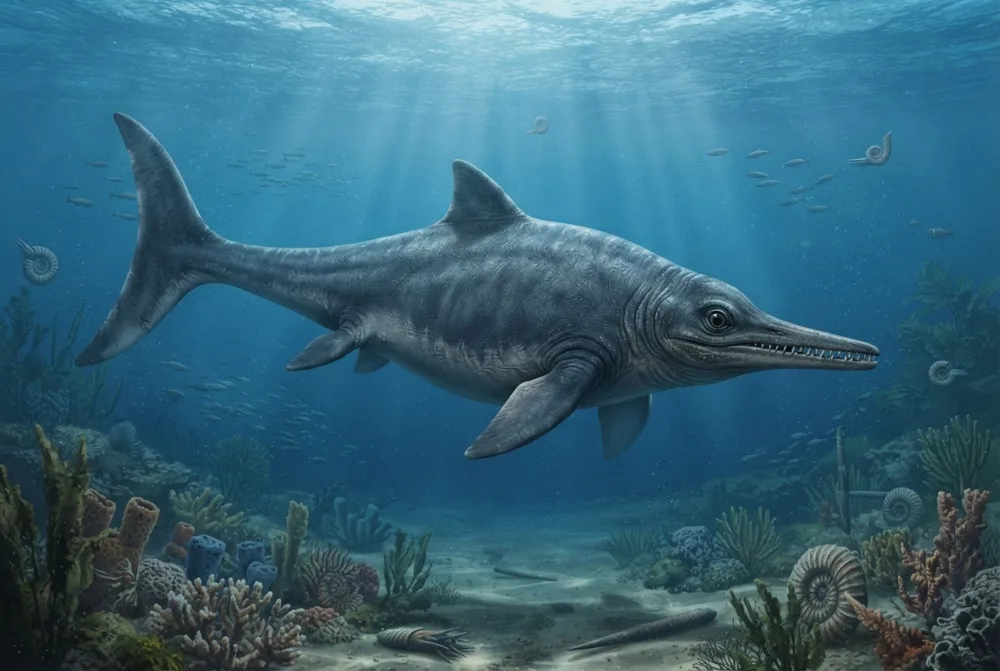
Brachypterygius was a fast-swimming marine reptile that lived in the Late Jurassic seas. It looked a bit like a dolphin but was a reptile, not a fish or a dinosaur. Its short, wide front flippers helped it steer through the water.1
Yabayeho ryari?
Yanganaga ite?
Yari ndende ite?
 ndende nk'imbwa 4 zikurikiranye🍌ndende nk'imineke 22 ikurikiranye🏊yashoboraga koga uburebure bwa pisine nini (50 m) mu masegonda 3,8
Brachypterygius yanganaga ite ugereranyije NAWE?
Ni imibare gusa ibarirwa muri mushakisha yawe. Nta kintu kibikwa cyangwa cyoherezwa ahandi.
Yihutaga ite?


Utuntu dushimishije
Brachypterygius had a short, wide front flipper with up to six fingers, and some fingers had as many as 16 bones.1
Its skull was between 0.5 and 1.2 metres long, about the size of a big dog's head.1
The first fossil of Brachypterygius was just a single right front flipper, found in England.1
Brachypterygius lived during the Kimmeridgian and Tithonian ages, about 154 to 143 million years ago.3
It is closely related to other ichthyosaurs like Platypterygius and Caypullisaurus.1
Scientists once thought Brachypterygius was the same as another ichthyosaur called Grendelius, but now many think they are different.1
Ibibazo bibazwa cyane kuri Brachypterygius
?How big was Brachypterygius?
Brachypterygius was a medium sized ichthyosaur, with a body length up to 4 metres (13 ft) and a skull length of 0.5 to 1.2 metres (1.6 to 3.9 ft).1
?Was Brachypterygius a dinosaur?
No, Brachypterygius was an ichthyosaur, a marine reptile that lived in the sea. It was not a dinosaur, even though it lived at the same time as dinosaurs.1
?What did Brachypterygius eat?
Scientists think Brachypterygius hunted in sunlit waters for slower prey like fish that swam in shoals. Its teeth were larger and more robust than those of some other ichthyosaurs.2
Ku bazobereye muri dinozore
- Izina rya siyansi
- Brachypterygius
- Yiswe na
- Huene 19223
- Itsinda
- Iktiyozore
- Umuryango / ishami
- Ophthalmosauridae3
- Ishyirwa mu byiciro
- Ichthyosauria > Ichthyosauromorpha3
- Imyaka y'amabuye
- imyaka miliyoni 155 kugeza 143 (Kimmeridgian / Tithonian)3
- Inzego z'amabuye
- Kimmeridge Clay, Agardhfjellet3
- Ibihugu
- Ubwongereza, Uburusiya, Noruveje3
- Ibisigazwa byanditswe
- 6 muri The Paleobiology Database3
- Izwi kandi ku izina rya
- Ochevia, Otschevia (amazina ya kera ubu abarwa nk'inyamaswa imwe)3
- Ivumburwa
- The first fossil, a right front flipper, was described as Ichthyosaurus extremus by Boulenger in 1904. In 1922, Friedrich von Huene gave it the new name Brachypterygius because of its short, wide flipper.1
- Biracyagibwaho impaka
- Scientists still debate whether the species Grendelius mordax is the same as Brachypterygius extremus or a separate animal.1
Aho amakuru yakuwe
- Brachypterygius (en.wikipedia.org)
- Brachypterygius (prehistoric-wildlife.com)
- Brachypterygius in The Paleobiology Database (CC BY 4.0): imyaka, ahantu, inzego z'amabuye, ishyirwa mu byiciro.
Buri kintu kiri kuri uru rupapuro gifite nimero yerekana aho cyakuwe. Niba hari icyo twibeshye, tubabarire, turi abakunzi ba dinozore, ntituri ikinyamakuru cya siyansi. Tubwire kuri [email protected] tuzagikosora.
 Rex arashonje! Dino Wiki ni umushinga wa papa umwe yakoreye umuhungu we ukunda dinozore, ni ubuntu, nta matangazo kandi nta bigukurikirana. Abantu bakuru bashobora guha Rex akantu ko kurya kugira ngo Dino Wiki ikomeze kuboneka kuri interineti.Gaburira Rex
 Ichthyosaurus
 Platypterygius
 Stenopterygius
 Khudiakovia
 Ophthalmosaurus
 Chonespondylus
 Brachiosaurus
 Diplodocus
 Allosaurus
 Brontosaurus
 Compsognathus
 Camarasaurus