 Uri dinozore iyihe? Umukino w'ibibazo
 Intambara ya dinozore
 Isiganwa rya dinozore
 Imikino mito ya dinozore
 Alubumu ya sitikeri
 Intonde za TOP za dinozore
 Ntungura!
Wukongopterus
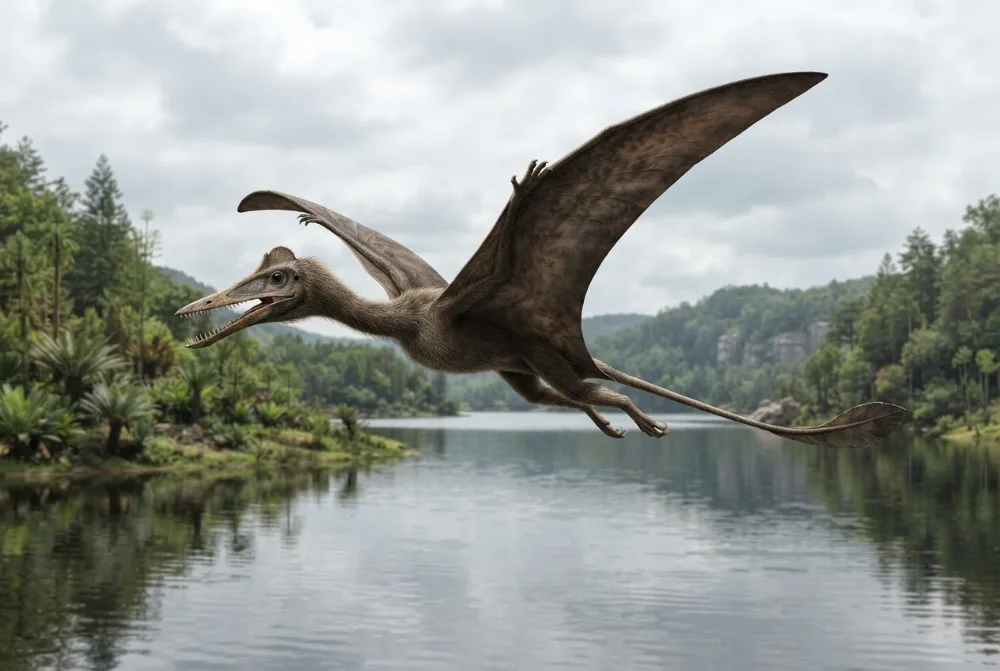
Wukongopterus was a small flying reptile that lived in what is now China. It had a long tail and a long neck, which made it look a bit like a dragon. It soared over ancient lakes and caught fish with its sharp teeth.1
Yabayeho ryari?
Yanganaga ite?
Amababa yayo yari arambuye angana iki?
Wukongopterus yanganaga ite ugereranyije NAWE?
Ni imibare gusa ibarirwa muri mushakisha yawe. Nta kintu kibikwa cyangwa cyoherezwa ahandi.
Yihutaga ite?


Utuntu dushimishije
Wukongopterus had a broken leg bone that healed while it was alive, showing it survived an injury.1
It had at least 16 short, peg-like teeth on each side of its upper jaw, perfect for catching slippery fish.1
Its neck bones were longer than those of any other known non-pterodactyloid pterosaur, which is a bit like a giraffe's neck among its relatives.1
The first two pairs of teeth in its upper jaw stuck out beyond its lower jaw, a unique feature not seen in other pterosaurs.1
It had a membrane between its hind legs, called a uropatagium, which helped it glide and steer in the air.1
Wukongopterus is one of the youngest long-tailed pterosaurs known, living near the end of the Jurassic period.1
Ibibazo bibazwa cyane kuri Wukongopterus
?How big was Wukongopterus?
It was small, with a wingspan of about 73 centimetres (29 inches).2
?What did Wukongopterus eat?
It ate fish, catching them with its sharp, peg-like teeth.2
?When did Wukongopterus live?
It lived during the Middle or Late Jurassic period, about 164 million years ago.2
?Is Wukongopterus a dinosaur?
No, it is a pterosaur, a flying reptile that is not a dinosaur.2
Gusenya ibinyoma
Ibivugwa: Some people think Wukongopterus was a dinosaur because it lived with dinosaurs.
Ukuri: It was actually a pterosaur, a flying reptile that is a close cousin of dinosaurs, but not a dinosaur itself.1
Ku bazobereye muri dinozore
- Izina rya siyansi
- Wukongopterus
- Yiswe na
- Wang et al. 20093
- Itsinda
- Ibikururanda biguruka
- Umuryango / ishami
- Monofenestrata3
- Ishyirwa mu byiciro
- Pterosauria3
- Imyaka y'amabuye
- imyaka miliyoni 168 kugeza 152 (Bathonian / Kimmeridgian)3
- Inzego z'amabuye
- Tiaojishan3
- Ibihugu
- Ubushinwa3
- Ibisigazwa byanditswe
- 1 muri The Paleobiology Database3
- Ivumburwa
- It was named by Wang and colleagues in 2009 based on an almost complete skeleton found in China. The fossil was discovered in rocks that may be from the Daohugou Bed, and it was given the species name lii.1
- Biracyagibwaho impaka
- Scientists are still debating exactly how old the rocks are where Wukongopterus was found, with some saying Late Jurassic and others Early Cretaceous.1
Aho amakuru yakuwe
- Brasil - An unusual long-tailed pterosaur with elongated neck from western Liaoning of China An unusual long-tailed pterosaur with elongated neck from western Liaoning of China (scielo.br)
- Wukongopterus (en.wikipedia.org)
- Wukongopterus in The Paleobiology Database (CC BY 4.0): imyaka, ahantu, inzego z'amabuye, ishyirwa mu byiciro.
Buri kintu kiri kuri uru rupapuro gifite nimero yerekana aho cyakuwe. Niba hari icyo twibeshye, tubabarire, turi abakunzi ba dinozore, ntituri ikinyamakuru cya siyansi. Tubwire kuri [email protected] tuzagikosora.
 Rex arashonje! Dino Wiki ni umushinga wa papa umwe yakoreye umuhungu we ukunda dinozore, ni ubuntu, nta matangazo kandi nta bigukurikirana. Abantu bakuru bashobora guha Rex akantu ko kurya kugira ngo Dino Wiki ikomeze kuboneka kuri interineti.Gaburira Rex
 Pteranodon
 Quetzalcoatlus
 Dorygnathus
 Rhamphorhynchus
 Anhanguera
 Pterodactylus
 Brachiosaurus
 Diplodocus
 Allosaurus
 Brontosaurus
 Compsognathus
 Camarasaurus