 Uri dhino ripi? Kwizi
 Hondo yemadhino
 Mujaho wemadhino
 Mitambo midiki yemadhino
 Arubhamu yemasitika
 Rondedzero dzeTOP dzemadhino
 Ndishamise!
Apatornis
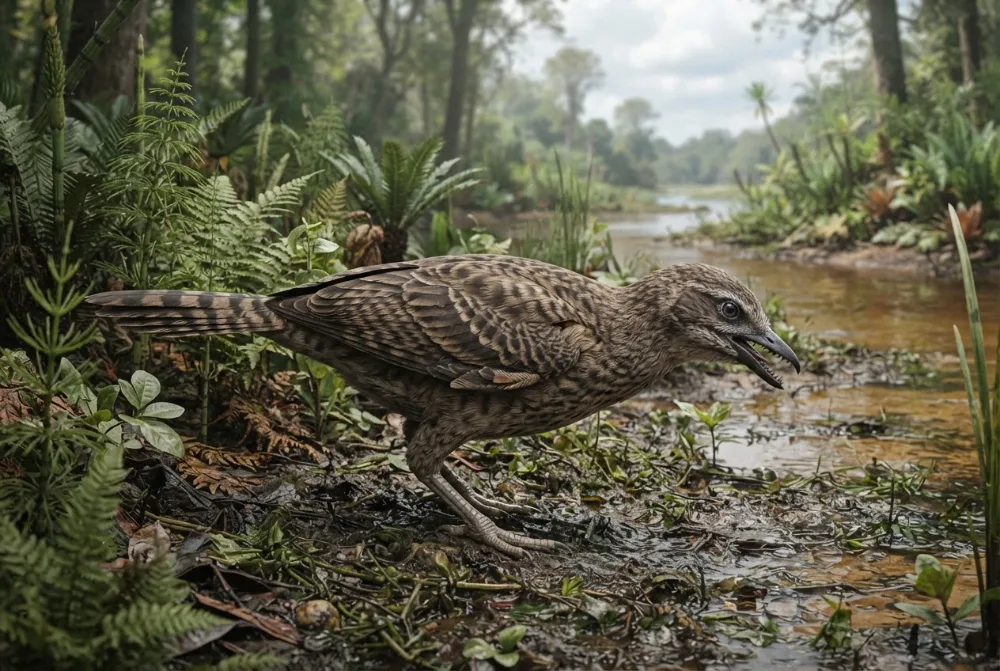
Apatornis was a small, toothed bird that lived in the Late Cretaceous period, about 83.5 million years ago. It was a fast, ground-dwelling hunter that probably chased after small prey. Even though it could fly, it spent much of its time on the ground.12
Rairarama rini?
Raiva hombe sei?
Raiva refu zvakadii?
Raiva rakakwirira zvakadii?
fungidziro
Apatornis raiva hombe sei kana richienzaniswa NEWE?
Masvomhu chete mubrowser yako. Hapana chinochengetwa kana kutumirwa kupi zvako.
Raimhanya zvakadii?


Zvinonakidza
Apatornis had at least one more rib attached to its hip vertebrae than its close relative Ichthyornis, and maybe more, because the whole hip bone wasn't preserved.1
Unlike Ichthyornis, Apatornis did not have ossified tendons covering the top of its sacral region, which is a unique feature.1
The only known fossil of Apatornis is a synsacrum, which is the fused vertebrae over the hips, and it was found in the Smoky Hill Chalk of Kansas.1
Apatornis was originally classified as a species of Ichthyornis, but scientists now think it's more closely related to modern birds.1
The type specimen of Apatornis was discovered by Othniel Charles Marsh in October 1872 at Butte Creek in Kansas.1
Apatornis lived during the Coniacian to Santonian stages, about 89.8 to 83.6 million years ago.2
Mibvunzo inonyanya kubvunzwa nezve Apatornis
?How big was Apatornis?
It was very small, about 18 to 20 centimetres long, which is roughly the size of a modern sparrow.1
?What did Apatornis eat?
It was a ground-dwelling carnivore that probably chased after small prey like insects or tiny vertebrates.2
?Could Apatornis fly?
Yes, it could fly, but it spent much of its time on the ground hunting for food.1
?Is Apatornis a dinosaur?
Yes, Apatornis is a genus of ornithuran dinosaurs, specifically a small, toothed bird from the Late Cretaceous.1
Mubvisi wengano
Ngano: Apatornis was a close relative of Ichthyornis.
Chokwadi: Scientists used to think so, but in 2004, Julia Clarke showed that Apatornis is actually more closely related to modern birds than to Ichthyornis.1
Zvevanyanzvi vemadhino
- Zita resainzi
- Apatornis
- Akaripa zita:
- Marsh 18732
- Boka
- Shiri dzekutanga
- Mhuri / boka
- Ornithurae2
- Kurongwa kwemhuka
- Theropoda > Avialae2
- Zera rematombo
- makore mamiriyoni 90 kusvika 84 (Coniacian / Santonian)2
- Mapoka ematombo
- Niobrara2
- Nyika
- Amerika2
- Zvinyorwa zvemafosiri
- 1 mu The Paleobiology Database2
- Kuwanikwa
- Apatornis was named by Othniel Charles Marsh in 1873. He found the first fossil, a synsacrum, in October 1872 at Butte Creek in Kansas, USA.1
- Zvichiri kupokanwa
- Scientists are still debating whether Apatornis is a valid genus or just a variation of Ichthyornis, because the only fossil is so incomplete.1
Kunobva chokwadi
- Apatornis (en.wikipedia.org)
- Apatornis in The Paleobiology Database (CC BY 4.0): zera, nzvimbo, mapoka ematombo, kurongwa kwemhuka.
Chokwadi chega chega papeji ino chine nhamba inoratidza kwachakabva. Kana takakanganisa chimwe chinhu, ruregerero, tiri vanoda madhino, kwete magazini yesainzi. Tiudze pa [email protected] tichazvigadzirisa.
 Rex ane nzara! Dino Wiki ipurojekiti yababa yemwanakomana wavo anoda madhino, mahara, pasina kushambadza uye pasina zvinokutevera. Vakuru vanogona kupa Rex chekudyadya kuti vabatsire kuchengeta saiti iri pamhepo.Fudza Rex
 Archaeopteryx
 Hesperornis
 Ichthyornis
 Baptornis
 Jurapteryx
 Gobipteryx
 Tyrannosaurus
 Triceratops
 Velociraptor
 Spinosaurus
 Ankylosaurus
 Parasaurolophus