 Uri dhino ripi? Kwizi
 Hondo yemadhino
 Mujaho wemadhino
 Mitambo midiki yemadhino
 Arubhamu yemasitika
 Rondedzero dzeTOP dzemadhino
 Ndishamise!
Rairarama rini?

Raiva hombe sei?
Raiva refu zvakadii?
Raiva rakakwirira zvakadii?
fungidziro
 kureba sekatsi dzemumba 1.5 kubva pamhino kusvika kumuswe🍌kureba semabhanana 4 akatevedzana🪑diki zvekugona kufamba pasi pechigaro🏊raigona kushambira kureba kwedziva guru rekushambira (50 m) mumasekonzi 22
Chupkaornis raiva hombe sei kana richienzaniswa NEWE?
Masvomhu chete mubrowser yako. Hapana chinochengetwa kana kutumirwa kupi zvako.
Raimhanya zvakadii?


Zvinonakidza
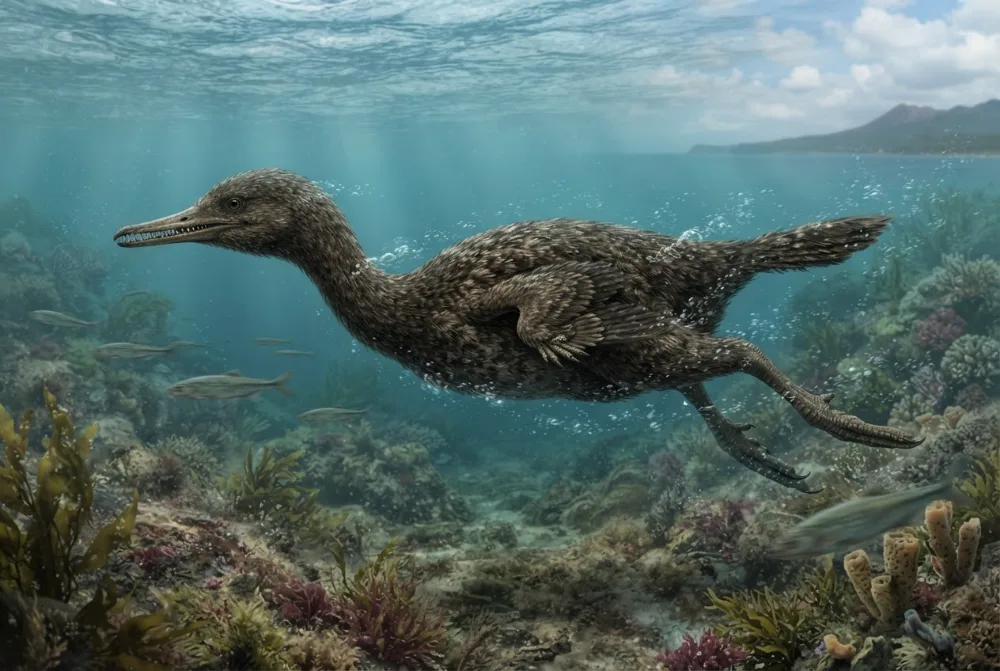
Chupkaornis is the oldest known hesperornithiform bird from Asia, living about 89 to 83 million years ago.2
Its name comes from the Ainu word 'chupka' meaning 'eastern', because it was found in East Asia, unlike its relative Hesperornis which means 'western bird'.1
Chupkaornis could not fly. Its wings were tiny, and it used its strong legs and feet to push itself through the water.2
The only known fossil of Chupkaornis includes nine bones: neck vertebrae, back vertebrae, part of the thigh bone, and part of the shin bone.1
It was discovered in 1996 by two amateur fossil collectors, Masatoshi and Yasuji Kera, and was named after them.1
Chupkaornis had special joints in its backbone that allowed it to bend its neck and body while diving.2
Mibvunzo inonyanya kubvunzwa nezve Chupkaornis
?How big was Chupkaornis?
Chupkaornis was about 70 to 80 centimetres (2.3 to 2.6 feet) long, roughly the size of a small penguin.1
?Could Chupkaornis fly?
No, Chupkaornis could not fly. It had very small wings and used its strong legs and webbed feet to swim underwater.12
?What did Chupkaornis eat?
Chupkaornis was a predatory diving bird that likely caught fish underwater with its sharp teeth.2
?When did Chupkaornis live?
Chupkaornis lived during the Late Cretaceous, about 89 to 83 million years ago.1
Zvevanyanzvi vemadhino
- Zita resainzi
- Chupkaornis
- Akaripa zita:
- Tanaka et al. 20184
- Boka
- Shiri dzekutanga
- Mhuri / boka
- Hesperornithiformes4
- Kurongwa kwemhuka
- Theropoda > Avialae4
- Zera rematombo
- makore mamiriyoni 90 kusvika 84 (Coniacian / Santonian)4
- Mapoka ematombo
- Kashima4
- Nyika
- Japan4
- Zvinyorwa zvemafosiri
- 1 mu The Paleobiology Database4
- Kuwanikwa
- Chupkaornis was discovered in August 1996 by Masatoshi and Yasuji Kera in Hokkaido, Japan. It was named and described by Tomonori Tanaka and colleagues in 2018.13
- Zvichiri kupokanwa
- Scientists are not sure exactly how large Chupkaornis was, because only a few bones have been found.1
Kunobva chokwadi
- Chupkaornis (en.wikipedia.org)
- The oldest Asian hesperornithiform from the Upper Cretaceous of Japan, and the phylogenetic reassessment of Hesperornithiformes (perot-m.imgix.net)
- PBDB Taxon (paleobiodb.org)
- Chupkaornis in The Paleobiology Database (CC BY 4.0): zera, nzvimbo, mapoka ematombo, kurongwa kwemhuka.
Chokwadi chega chega papeji ino chine nhamba inoratidza kwachakabva. Kana takakanganisa chimwe chinhu, ruregerero, tiri vanoda madhino, kwete magazini yesainzi. Tiudze pa [email protected] tichazvigadzirisa.
 Rex ane nzara! Dino Wiki ipurojekiti yababa yemwanakomana wavo anoda madhino, mahara, pasina kushambadza uye pasina zvinokutevera. Vakuru vanogona kupa Rex chekudyadya kuti vabatsire kuchengeta saiti iri pamhepo.Fudza Rex
 Archaeopteryx
 Hesperornis
 Ichthyornis
 Baptornis
 Jurapteryx
 Gobipteryx
 Tyrannosaurus
 Triceratops
 Velociraptor
 Spinosaurus
 Ankylosaurus
 Parasaurolophus