 Uri dhino ripi? Kwizi
 Hondo yemadhino
 Mujaho wemadhino
 Mitambo midiki yemadhino
 Arubhamu yemasitika
 Rondedzero dzeTOP dzemadhino
 Ndishamise!
Rairarama rini?

Raimhanya zvakadii?


Zvinonakidza
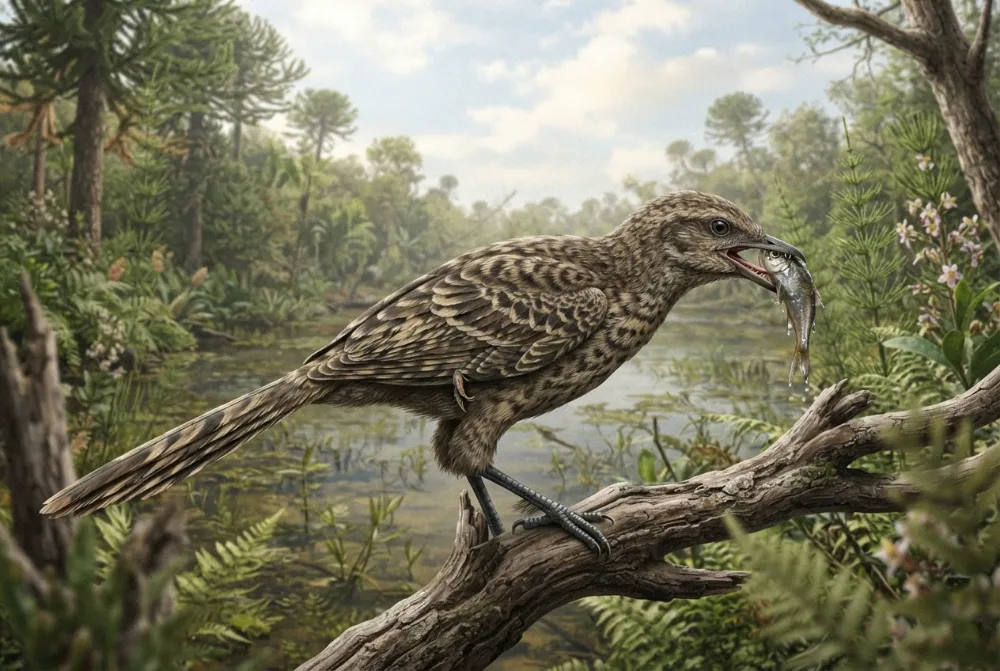
Cratoavis is one of the earliest known fossil birds from South America, living about 117 million years ago.2
Its fossil includes feathers attached to the wings and around the body, showing what it looked like.1
Fish bones from at least two small fish called Dastilbe crandalli were found inside the bird's digestive tract.2
This is the first direct evidence of what any Mesozoic bird from the Southern Hemisphere ate.2
Cratoavis had a short beak, but it still caught and ate fish.2
Mibvunzo inonyanya kubvunzwa nezve Cratoavis
?How big was Cratoavis?
It was a very small bird, about the size of a sparrow. The fossil shows it had a short beak and long tail feathers.13
?What did Cratoavis eat?
It ate fish. Fish bones from at least two small fish called Dastilbe crandalli were found inside its digestive tract.21
Zvevanyanzvi vemadhino
- Zita resainzi
- Cratoavis
- Akaripa zita:
- Carvalho et al. 20154
- Boka
- Shiri dzekutanga
- Mhuri / boka
- Euenantiornithes4
- Kurongwa kwemhuka
- Theropoda > Avialae4
- Zera rematombo
- makore mamiriyoni 120 kusvika 113 (Aptian)4
- Mapoka ematombo
- Crato4
- Nyika
- Brazil4
- Zvinyorwa zvemafosiri
- 1 mu The Paleobiology Database4
- Kuwanikwa
- Cratoavis was named in 2015 by Carvalho and colleagues. The fossil was found in the Crato Formation in Brazil.41
- Zvichiri kupokanwa
- Scientists are not sure exactly how big Cratoavis was, because only one fossil has been found.1
Kunobva chokwadi
- Cratoavis (en.wikipedia.org)
- Evidence of piscivorous diet in an enantiornithine bird from the Lower Cretaceous of Brazil (igeo.ufrj.br)
- Brasil - A new genus and species of enantiornithine bird from the Early Cretaceous of Brazil A new genus and species of enantiornithine bird from the Early Cretaceous of Brazil (scielo.br)
- Cratoavis in The Paleobiology Database (CC BY 4.0): zera, nzvimbo, mapoka ematombo, kurongwa kwemhuka.
Chokwadi chega chega papeji ino chine nhamba inoratidza kwachakabva. Kana takakanganisa chimwe chinhu, ruregerero, tiri vanoda madhino, kwete magazini yesainzi. Tiudze pa [email protected] tichazvigadzirisa.
 Rex ane nzara! Dino Wiki ipurojekiti yababa yemwanakomana wavo anoda madhino, mahara, pasina kushambadza uye pasina zvinokutevera. Vakuru vanogona kupa Rex chekudyadya kuti vabatsire kuchengeta saiti iri pamhepo.Fudza Rex
 Archaeopteryx
 Hesperornis
 Ichthyornis
 Baptornis
 Jurapteryx
 Gobipteryx
 Stegosaurus
 Iguanodon
 Giganotosaurus
 Microraptor
 Deinonychus
 Baryonyx