 Uri dhino ripi? Kwizi
 Hondo yemadhino
 Mujaho wemadhino
 Mitambo midiki yemadhino
 Arubhamu yemasitika
 Rondedzero dzeTOP dzemadhino
 Ndishamise!
Rairarama rini?

Raiva hombe sei?
Raiva refu zvakadii?
Rairema zvakadii?
Eoalulavis raiva hombe sei kana richienzaniswa NEWE?
Masvomhu chete mubrowser yako. Hapana chinochengetwa kana kutumirwa kupi zvako.
Raimhanya zvakadii?


Zvinonakidza
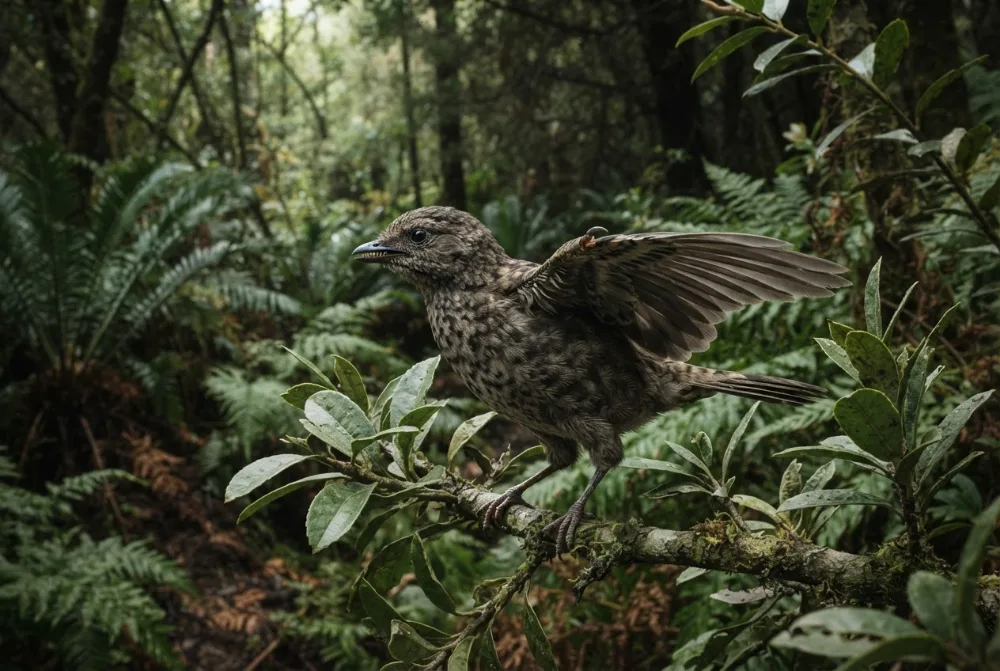
Eoalulavis was about the size of a European goldfinch, weighing only about 45 grams (1.6 ounces).1
Its wingspan, including feathers, was only about 26 centimeters (10 inches), similar to a modern kingfisher.1
The name Eoalulavis means 'dawn alula bird' because it is one of the earliest birds known to have an alula, or 'bastard wing'.1
Scientists found the remains of its last meal inside the fossil: concentrated pieces of crustacean shells.1
Eoalulavis had a very thin, spear-shaped breastbone, unlike the wide breastbones of most early birds.1
It likely flew in a bounding style, flapping hard then tucking its wings to dive, like modern songbirds and woodpeckers.1
The fossil was preserved with feathers and soft tissues because it was buried quickly in a lake with special conditions.1
Mibvunzo inonyanya kubvunzwa nezve Eoalulavis
?What did Eoalulavis eat?
It ate small crustaceans. Scientists found pieces of crustacean shells in its fossilized belly, its last meal.1
?How big was Eoalulavis?
It was tiny, about the size of a European goldfinch. It weighed about 45 grams and had a wingspan of about 26 centimeters.1
?Could Eoalulavis fly well?
Yes, it was a good flier. It had an alula for slow, sharp turns and likely used bounding flight, flapping hard then diving with wings folded, like modern songbirds.1
?Is Eoalulavis a dinosaur?
Yes, it is a bird, and birds are a type of dinosaur called avialan dinosaurs. It lived about 125 million years ago.1
Zvevanyanzvi vemadhino
- Zita resainzi
- Eoalulavis
- Akaripa zita:
- Sanz et al. 19962
- Boka
- Shiri dzekutanga
- Mhuri / boka
- Enantiornithes2
- Kurongwa kwemhuka
- Theropoda > Avialae2
- Zera rematombo
- makore mamiriyoni 126 kusvika 121 (Barremian)2
- Mapoka ematombo
- La Huérguina2
- Nyika
- Spain2
- Zvinyorwa zvemafosiri
- 1 mu The Paleobiology Database2
- Kuwanikwa
- Eoalulavis was named in 1996 by Sanz and colleagues based on a single fossil skeleton found at Las Hoyas in Spain.12
- Zvichiri kupokanwa
- Scientists are not sure what its hind legs looked like because no leg bones have been found.1
Kunobva chokwadi
- Eoalulavis (en.wikipedia.org)
- Eoalulavis in The Paleobiology Database (CC BY 4.0): zera, nzvimbo, mapoka ematombo, kurongwa kwemhuka.
Chokwadi chega chega papeji ino chine nhamba inoratidza kwachakabva. Kana takakanganisa chimwe chinhu, ruregerero, tiri vanoda madhino, kwete magazini yesainzi. Tiudze pa [email protected] tichazvigadzirisa.
 Rex ane nzara! Dino Wiki ipurojekiti yababa yemwanakomana wavo anoda madhino, mahara, pasina kushambadza uye pasina zvinokutevera. Vakuru vanogona kupa Rex chekudyadya kuti vabatsire kuchengeta saiti iri pamhepo.Fudza Rex
 Archaeopteryx
 Hesperornis
 Ichthyornis
 Baptornis
 Jurapteryx
 Gobipteryx
 Stegosaurus
 Iguanodon
 Giganotosaurus
 Microraptor
 Deinonychus
 Baryonyx