 Uri dhino ripi? Kwizi
 Hondo yemadhino
 Mujaho wemadhino
 Mitambo midiki yemadhino
 Arubhamu yemasitika
 Rondedzero dzeTOP dzemadhino
 Ndishamise!
Fortipesavis
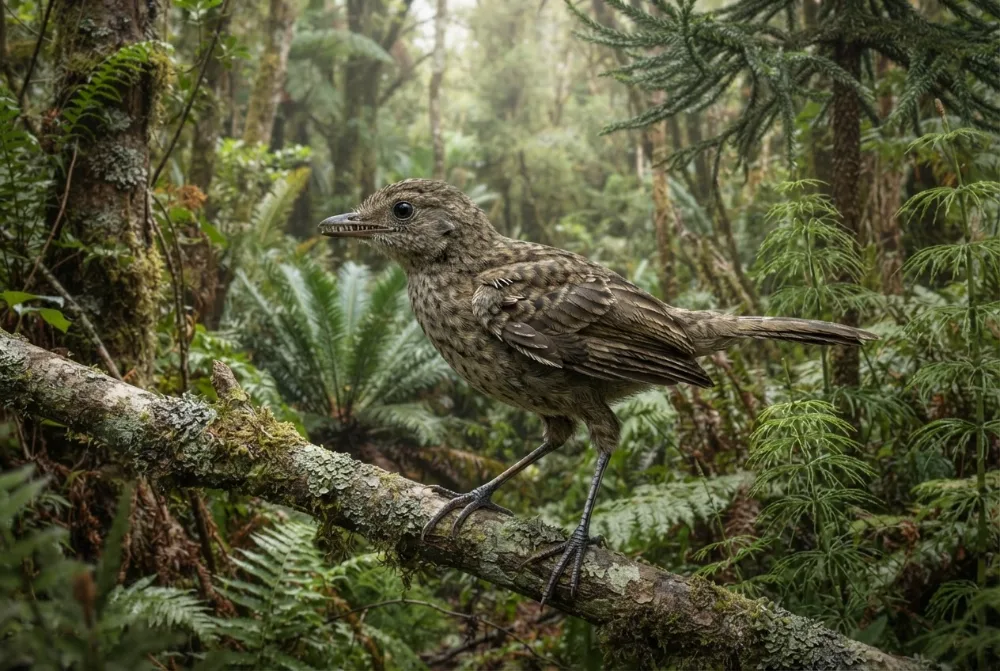
Fortipesavis was a tiny bird that lived about 98 million years ago. It had a very strong and wide fourth toe, which helped it grip onto thin, wobbly branches like a kingfisher. Its foot was so unusual that scientists named it the 'strong-footed bird'.12
Rairarama rini?
Raimhanya zvakadii?


Zvinonakidza
Fortipesavis is known only from a partial left foot preserved in amber, which is a piece of fossilized tree resin.1
Its fourth toe was almost twice as wide as its second toe, a feature not seen in any other bird, living or extinct.12
The foot of Fortipesavis had thick, padded toes with deep grooves between them, which helped it grip tightly onto branches.2
This bird lived in a mangrove forest environment, where it probably perched on thin, swaying branches while hunting for insects.12
The fossil of Fortipesavis was found in a piece of amber that weighs only 2.68 grams and is about the size of a large coin.1
Scientists used micro-CT scanning to study the foot inside the amber without damaging the fossil.1
Zvevanyanzvi vemadhino
- Zita resainzi
- Fortipesavis
- Akaripa zita:
- Clark and O’Connor 20214
- Boka
- Shiri dzekutanga
- Mhuri / boka
- Enantiornithes4
- Kurongwa kwemhuka
- Theropoda > Avialae4
- Zera rematombo
- makore mamiriyoni 100 kusvika 94 (Cenomanian)4
- Nyika
- Myanmar4
- Zvinyorwa zvemafosiri
- 1 mu The Paleobiology Database4
- Kuwanikwa
- Fortipesavis was named in 2021 by Alexander Clark and Jingmai O'Connor based on a foot preserved in amber from Myanmar. The fossil was first described in 2019 by Lida Xing and colleagues.13
- Zvichiri kupokanwa
- Scientists are not sure whether Fortipesavis ate insects or fish, because its foot is similar to both modern kingfishers (which eat fish) and bee-eaters (which eat insects).2
Kunobva chokwadi
- Fortipesavis (en.wikipedia.org)
- Frontiers | Exploring the Ecomorphology of Two Cretaceous Enantiornithines With Unique Pedal Morphology (frontiersin.org)
- PBDB Taxon (paleobiodb.org)
- Fortipesavis in The Paleobiology Database (CC BY 4.0): zera, nzvimbo, mapoka ematombo, kurongwa kwemhuka.
Chokwadi chega chega papeji ino chine nhamba inoratidza kwachakabva. Kana takakanganisa chimwe chinhu, ruregerero, tiri vanoda madhino, kwete magazini yesainzi. Tiudze pa [email protected] tichazvigadzirisa.
 Rex ane nzara! Dino Wiki ipurojekiti yababa yemwanakomana wavo anoda madhino, mahara, pasina kushambadza uye pasina zvinokutevera. Vakuru vanogona kupa Rex chekudyadya kuti vabatsire kuchengeta saiti iri pamhepo.Fudza Rex
 Archaeopteryx
 Hesperornis
 Ichthyornis
 Baptornis
 Jurapteryx
 Gobipteryx
 Tyrannosaurus
 Triceratops
 Velociraptor
 Spinosaurus
 Ankylosaurus
 Parasaurolophus