 Uri dhino ripi? Kwizi
 Hondo yemadhino
 Mujaho wemadhino
 Mitambo midiki yemadhino
 Arubhamu yemasitika
 Rondedzero dzeTOP dzemadhino
 Ndishamise!
Rairarama rini?

Raiva hombe sei?
Raiva refu zvakadii?
Raiva rakakwirira zvakadii?
fungidziro
Rairema zvakadii?
 kureba seimbwa 6 kubva pamhino kusvika kumuswe🍌kureba semabhanana 33 akatevedzana🍉kurema semanwiwa 74🧸kurema sevana vekireshi 19🎒kurema sevana vechikoro 12🏃raigona kumhanya mamita 100 mumasekonzi 9 (munhu anomhanya kupfuura vose anoda 9.6)
Jeyawati raiva hombe sei kana richienzaniswa NEWE?
Masvomhu chete mubrowser yako. Hapana chinochengetwa kana kutumirwa kupi zvako.
Raimhanya zvakadii?


Zvinonakidza
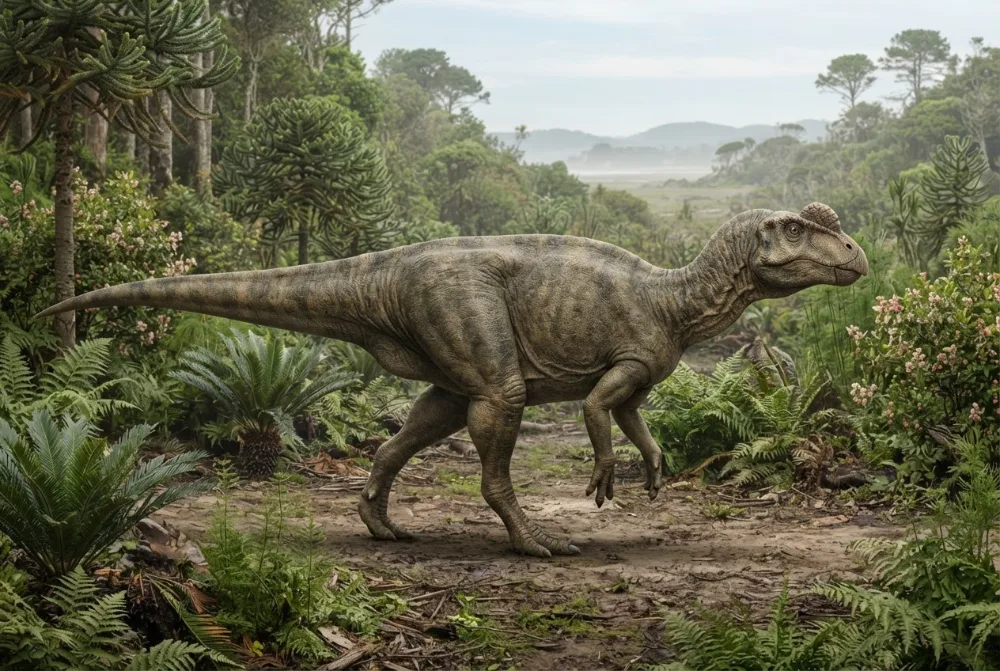
Jeyawati's full scientific name is Jeyawati rugoculus, which means 'wrinkle eye' because of the rough texture on its skull bone near the eye.12
It was a hadrosauroid, a cousin of the duck-billed dinosaurs, but it lived earlier than most of them.1
The only known fossil of Jeyawati was found in rocks that are about 90 million years old, from the Turonian stage of the Late Cretaceous.51
Jeyawati was more advanced than some early hadrosauroids like Eolambia, but not as advanced as later ones like Bactrosaurus.1
The name Jeyawati comes from the Zuni language, spoken by Native American people in New Mexico.1
Mibvunzo inonyanya kubvunzwa nezve Jeyawati
?How big was Jeyawati?
Nobody knows for sure because only a partial skeleton has been found. Based on its relatives, it was probably a medium-sized dinosaur, but no exact length or weight is given in the sources.14
?What did Jeyawati eat?
Jeyawati was a plant-eater. It likely ate ferns and conifer trees that grew in its swampy forest home 91 million years ago.4
?Could Jeyawati walk on two legs?
Yes, scientists think it could. It probably walked on all fours but was also able to rear up on its hind legs.4
Zvevanyanzvi vemadhino
- Zita resainzi
- Jeyawati
- Akaripa zita:
- McDonald et al. 20105
- Boka
- Vanodya miriwo vane miromo
- Mhuri / boka
- Hadrosauroidea5
- Kurongwa kwemhuka
- Ornithischia > Ornithopoda > Iguanodontia5
- Zera rematombo
- makore mamiriyoni 94 kusvika 90 (Turonian)5
- Mapoka ematombo
- Moreno Hill5
- Nyika
- Amerika5
- Zvinyorwa zvemafosiri
- 1 mu The Paleobiology Database5
- Kuwanikwa
- Jeyawati was named in 2010 by Andrew T. McDonald, Douglas G. Wolfe, and James I. Kirkland. The fossil was found in the Moreno Hill Formation in New Mexico.15
- Zvichiri kupokanwa
- Scientists are still debating exactly where Jeyawati fits on the family tree of hadrosauroids, with some studies placing it close to Eolambia and others near Eotrachodon.1
Kunobva chokwadi
- Jeyawati (en.wikipedia.org)
- Holdings: A New Basal Hadrosauroid (Dinosauria: Ornithopoda) from the Turonian of New Mexico :: Descubridor de recursos de la Universidad Veracruzana (ebusca.uv.mx)
- Jeyawati rugoculus | Dinosaur Database by DinoAnimals.com (dinoanimals.com)
- “Grinding Mouth, Wrinkle Eye”: Penn Graduate Student Describes New Species of Plant-Eating Dinosaur (penntoday.upenn.edu)
- Jeyawati in The Paleobiology Database (CC BY 4.0): zera, nzvimbo, mapoka ematombo, kurongwa kwemhuka.
Chokwadi chega chega papeji ino chine nhamba inoratidza kwachakabva. Kana takakanganisa chimwe chinhu, ruregerero, tiri vanoda madhino, kwete magazini yesainzi. Tiudze pa [email protected] tichazvigadzirisa.
 Rex ane nzara! Dino Wiki ipurojekiti yababa yemwanakomana wavo anoda madhino, mahara, pasina kushambadza uye pasina zvinokutevera. Vakuru vanogona kupa Rex chekudyadya kuti vabatsire kuchengeta saiti iri pamhepo.Fudza Rex
 Iguanodon
 Tenontosaurus
 Thescelosaurus
 Zalmoxes
 Camptosaurus
 Rhabdodon
 Tyrannosaurus
 Triceratops
 Velociraptor
 Spinosaurus
 Ankylosaurus
 Parasaurolophus