 Uri dhino ripi? Kwizi
 Hondo yemadhino
 Mujaho wemadhino
 Mitambo midiki yemadhino
 Arubhamu yemasitika
 Rondedzero dzeTOP dzemadhino
 Ndishamise!
Rairarama rini?

Raiva hombe sei?
Mapapiro aro aiva akapamhama zvakadii?
Parvavis raiva hombe sei kana richienzaniswa NEWE?
Masvomhu chete mubrowser yako. Hapana chinochengetwa kana kutumirwa kupi zvako.
Raimhanya zvakadii?


Zvinonakidza
When Parvavis was discovered, it was the smallest known enantiornithine bird, even smaller than Iberomesornis.1
The fossil of Parvavis includes parts of the skull, spine, tail, and even impressions of its feathers in the rock.1
Scientists studied the bone structure and found that Parvavis was nearly full-grown when it died, but it was still surprisingly tiny.12
Parvavis had a special feature: the bottom joint of its second metatarsal (a foot bone) was wider than the joints of its other metatarsals.1
The claw on the fourth toe of Parvavis was reduced, meaning it was smaller than the other toe claws.1
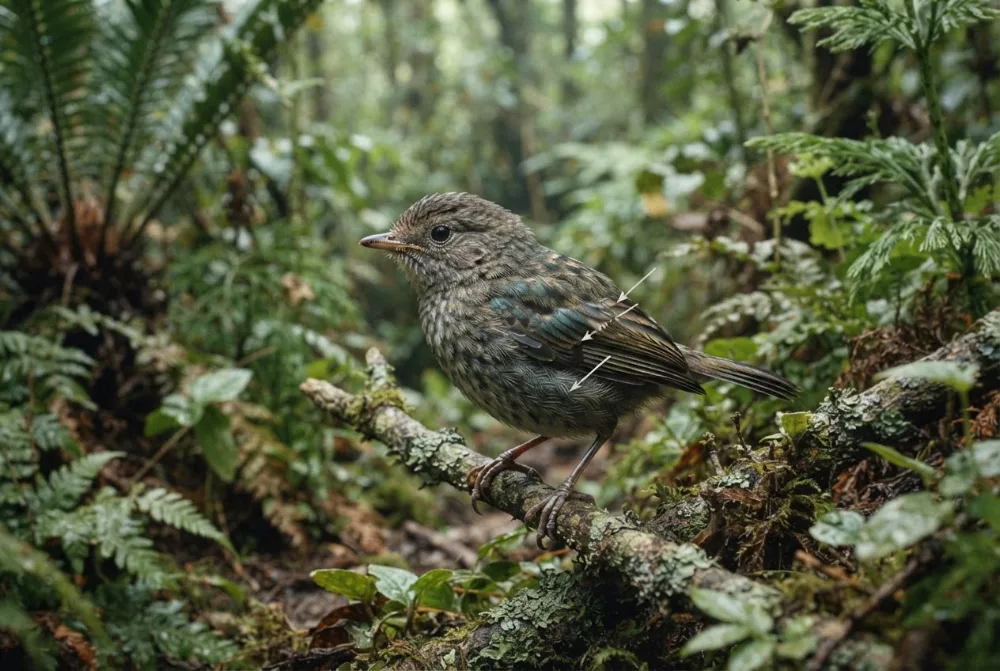
Zvevanyanzvi vemadhino
- Zita resainzi
- Parvavis
- Akaripa zita:
- Wang et al. 20143
- Boka
- Shiri dzekutanga
- Mhuri / boka
- Enantiornithes3
- Kurongwa kwemhuka
- Theropoda > Avialae3
- Zera rematombo
- makore mamiriyoni 94 kusvika 84 (Turonian / Santonian)3
- Mapoka ematombo
- Jiangdihe3
- Nyika
- China3
- Zvinyorwa zvemafosiri
- 1 mu The Paleobiology Database3
- Kuwanikwa
- The skeleton of Parvavis was found in 2010 near Luojumei Village in Yunnan, China. It was named and described in 2014 by Wang Min, Zhou Zhonghe, and Xu Guanghui.1
- Zvichiri kupokanwa
- Scientists are still debating exactly where Parvavis fits on the enantiornithine family tree. Some analyses place it in a relatively basal position, meaning it may have been an early branch of this group.1
Kunobva chokwadi
- Parvavis (en.wikipedia.org)
- The first enantiornithine bird from the Upper Cretaceous of China (tandfonline.com)
- Parvavis in The Paleobiology Database (CC BY 4.0): zera, nzvimbo, mapoka ematombo, kurongwa kwemhuka.
Chokwadi chega chega papeji ino chine nhamba inoratidza kwachakabva. Kana takakanganisa chimwe chinhu, ruregerero, tiri vanoda madhino, kwete magazini yesainzi. Tiudze pa [email protected] tichazvigadzirisa.
 Rex ane nzara! Dino Wiki ipurojekiti yababa yemwanakomana wavo anoda madhino, mahara, pasina kushambadza uye pasina zvinokutevera. Vakuru vanogona kupa Rex chekudyadya kuti vabatsire kuchengeta saiti iri pamhepo.Fudza Rex
 Archaeopteryx
 Hesperornis
 Ichthyornis
 Baptornis
 Jurapteryx
 Gobipteryx
 Tyrannosaurus
 Triceratops
 Velociraptor
 Spinosaurus
 Ankylosaurus
 Parasaurolophus