 Uri dhino ripi? Kwizi
 Hondo yemadhino
 Mujaho wemadhino
 Mitambo midiki yemadhino
 Arubhamu yemasitika
 Rondedzero dzeTOP dzemadhino
 Ndishamise!
Protopteryx
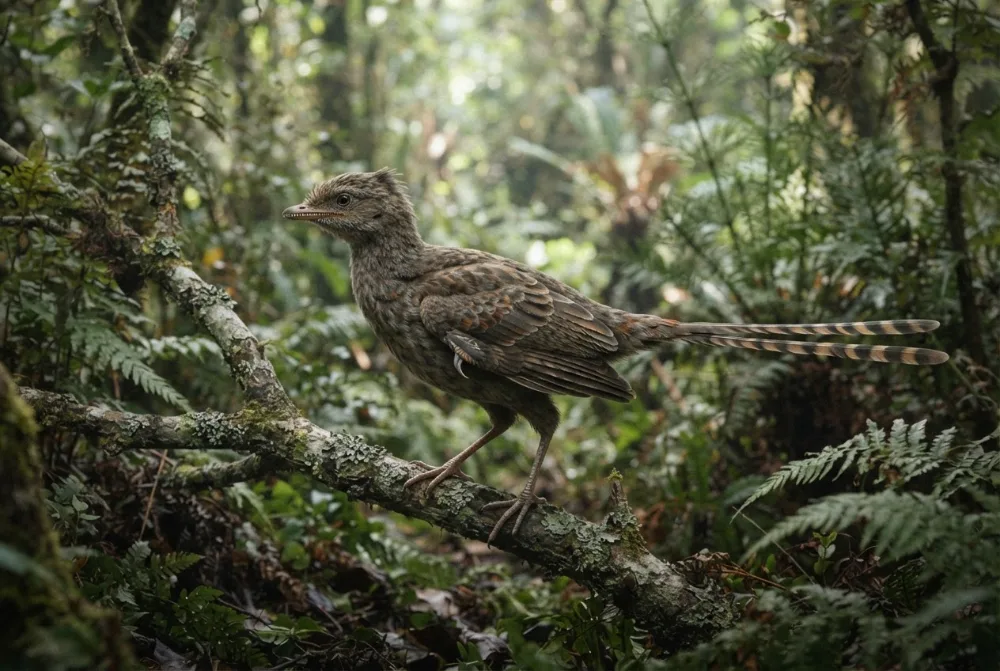
Protopteryx was a tiny early bird that lived about 131 million years ago in what is now China. It had two long, ribbon-like tail feathers that were different from any modern bird's feathers. This little bird could fly and probably ate small animals like insects.14
Rairarama rini?
Raiva hombe sei?
Raiva refu zvakadii?
Raiva rakakwirira zvakadii?
fungidziro
Rairema zvakadii?
Protopteryx raiva hombe sei kana richienzaniswa NEWE?
Masvomhu chete mubrowser yako. Hapana chinochengetwa kana kutumirwa kupi zvako.
Raimhanya zvakadii?


Zvinonakidza
Protopteryx is one of the oldest and most primitive members of the group Enantiornithes, which were early birds that lived alongside dinosaurs.1
Its two central tail feathers were scalelike without barbs near the body, only having barbs at the tips. This is similar to the tail feathers of the modern red bird-of-paradise.12
Protopteryx was about the size of a modern starling, with a body length of only 10 centimetres (3.9 inches) not counting its long tail feathers.1
Its body was covered in three types of feathers: down feathers, flight feathers, and the long ribbon-like tail feathers.1
The down feathers of Protopteryx had flat, frayed tips instead of the hairlike barbs seen in modern birds.1
Protopteryx had a triosseal canal, a feature in the shoulder that helped with flight, and this is one of the earliest examples in birds.2
Mibvunzo inonyanya kubvunzwa nezve Protopteryx
?How big was Protopteryx?
About 10 centimetres long, not counting its long tail feathers. It was roughly the size of a modern starling.1
?What did Protopteryx eat?
It probably ate small animals like insects. Its teeth are similar to those of Archaeopteryx, which suggests a similar diet.1
?Could Protopteryx fly?
Yes, it was adapted for flying. It had a triosseal canal in its shoulder and asymmetric wing feathers, just like modern flying birds.1
?Why did Protopteryx have long tail feathers?
The long, ribbon-like tail feathers were probably used for display, not for flying. They only had barbs at the tips, similar to the red bird-of-paradise today.1
Zvevanyanzvi vemadhino
- Zita resainzi
- Protopteryx
- Akaripa zita:
- Zhang and Zhou 20004
- Boka
- Shiri dzekutanga
- Mhuri / boka
- Enantiornithes4
- Kurongwa kwemhuka
- Theropoda > Avialae4
- Zera rematombo
- makore mamiriyoni 133 kusvika 121 (Hauterivian / Barremian)4
- Mapoka ematombo
- Huajiying4
- Nyika
- China4
- Zvinyorwa zvemafosiri
- 2 mu The Paleobiology Database4
- Kuwanikwa
- Protopteryx was named by Chinese paleontologists Fucheng Zhang and Zhonghe Zhou in 2000 based on a fossil found in the Yixian Formation of Hebei Province, China.14
- Zvichiri kupokanwa
- Scientists are still debating whether the long, ribbon-like tail feathers of Protopteryx were used for display, thermoregulation, or sensing the environment.1
Kunobva chokwadi
- Protopteryx (en.wikipedia.org)
- A Primitive Enantiornithine Bird and the Origin of Feathers (science.org)
- Anatomy and Flight Performance of the Early Enantiornithine Bird Protopteryx fengningensis : Information from New Specimens of the Early Cretaceous Huajiying Formation of China (anatomypubs.onlinelibrary.wiley.com)
- Protopteryx in The Paleobiology Database (CC BY 4.0): zera, nzvimbo, mapoka ematombo, kurongwa kwemhuka.
Chokwadi chega chega papeji ino chine nhamba inoratidza kwachakabva. Kana takakanganisa chimwe chinhu, ruregerero, tiri vanoda madhino, kwete magazini yesainzi. Tiudze pa [email protected] tichazvigadzirisa.
 Rex ane nzara! Dino Wiki ipurojekiti yababa yemwanakomana wavo anoda madhino, mahara, pasina kushambadza uye pasina zvinokutevera. Vakuru vanogona kupa Rex chekudyadya kuti vabatsire kuchengeta saiti iri pamhepo.Fudza Rex
 Archaeopteryx
 Hesperornis
 Ichthyornis
 Baptornis
 Jurapteryx
 Gobipteryx
 Stegosaurus
 Iguanodon
 Giganotosaurus
 Microraptor
 Deinonychus
 Baryonyx