 Kwisi: O dinosaure efe?
 Ntwa ya didinosaure
 Peiso ya didinosaure
 Dipapadi tse nyane tsa didinosaure
 Albamo ya ditikara
 Manane a TOP a didinosaure
 Nkgethele!
Apatornis
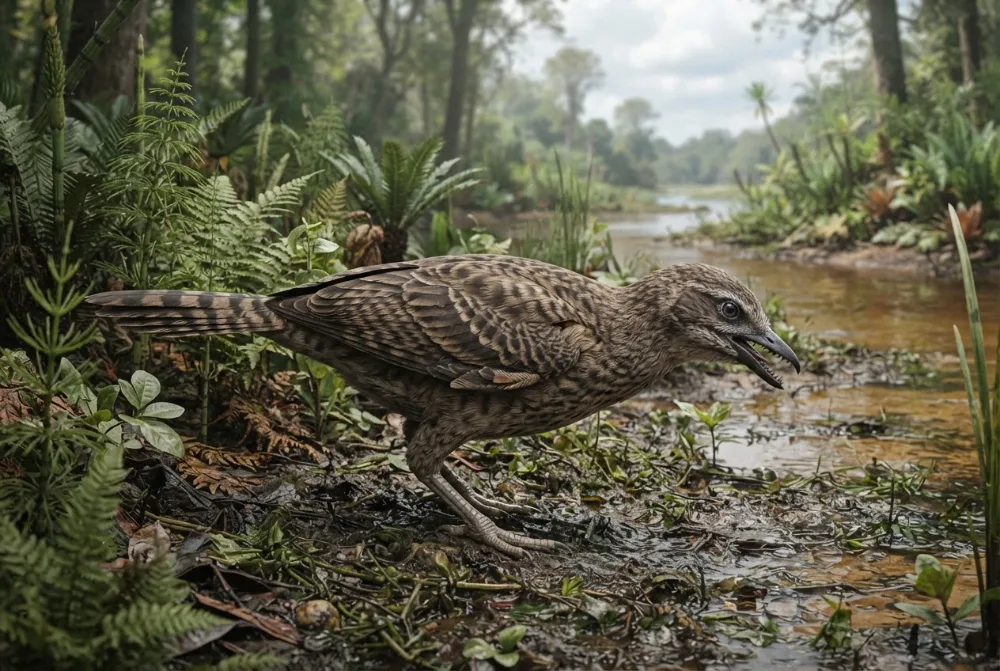
Apatornis was a small, toothed bird that lived in the Late Cretaceous period, about 83.5 million years ago. It was a fast, ground-dwelling hunter that probably chased after small prey. Even though it could fly, it spent much of its time on the ground.12
E phetse neng?
E ne e le kgolo hakae?
E ne e le telele hakae?
E ne e phahame hakae?
kakanyo
Apatornis e ne e le kgolo hakae ha e bapiswa le WENA?
Ke dipalo feela ho browser ya hao. Ha ho letho le bolokwang kapa le romelwang kae kapa kae.
E ne e le lebelo hakae?


Dintlha tse monate
Apatornis had at least one more rib attached to its hip vertebrae than its close relative Ichthyornis, and maybe more, because the whole hip bone wasn't preserved.1
Unlike Ichthyornis, Apatornis did not have ossified tendons covering the top of its sacral region, which is a unique feature.1
The only known fossil of Apatornis is a synsacrum, which is the fused vertebrae over the hips, and it was found in the Smoky Hill Chalk of Kansas.1
Apatornis was originally classified as a species of Ichthyornis, but scientists now think it's more closely related to modern birds.1
The type specimen of Apatornis was discovered by Othniel Charles Marsh in October 1872 at Butte Creek in Kansas.1
Apatornis lived during the Coniacian to Santonian stages, about 89.8 to 83.6 million years ago.2
Dipotso tse botswang haholo ka Apatornis
?How big was Apatornis?
It was very small, about 18 to 20 centimetres long, which is roughly the size of a modern sparrow.1
?What did Apatornis eat?
It was a ground-dwelling carnivore that probably chased after small prey like insects or tiny vertebrates.2
?Could Apatornis fly?
Yes, it could fly, but it spent much of its time on the ground hunting for food.1
?Is Apatornis a dinosaur?
Yes, Apatornis is a genus of ornithuran dinosaurs, specifically a small, toothed bird from the Late Cretaceous.1
Mosenyi wa ditshomo
Tshomo: Apatornis was a close relative of Ichthyornis.
Nnete: Scientists used to think so, but in 2004, Julia Clarke showed that Apatornis is actually more closely related to modern birds than to Ichthyornis.1
Bakeng sa ditsebi tsa didinosaure
- Lebitso la saense
- Apatornis
- E rehilwe ke
- Marsh 18732
- Sehlopha
- Dinonyana tsa pele
- Lelapa / leloko
- Ornithurae2
- Tlhophiso
- Theropoda > Avialae2
- Dilemo tsa mafika
- dilemo tse dimilione tse 90 ho isa ho 84 (Coniacian / Santonian)2
- Dibopeho tsa mafika
- Niobrara2
- Dinaha
- Amerika2
- Direkoto tsa difosili
- 1 ho The Paleobiology Database2
- Ho sibollwa
- Apatornis was named by Othniel Charles Marsh in 1873. He found the first fossil, a synsacrum, in October 1872 at Butte Creek in Kansas, USA.1
- E sa ntse e phehwa kgang
- Scientists are still debating whether Apatornis is a valid genus or just a variation of Ichthyornis, because the only fossil is so incomplete.1
Moo dintlha di tswang teng
- Apatornis (en.wikipedia.org)
- Apatornis in The Paleobiology Database (CC BY 4.0): dilemo, dibaka, dibopeho tsa mafika, tlhophiso.
Ntlha e nngwe le e nngwe leqepheng lena e na le nomoro e supang mohlodi wa yona. Haeba re fositse ho hong, re kopa tshwarelo, re balatedi ba didinosaure, ha re koranta ya saense. Re bolelle ho [email protected] mme re tla e lokisa.
 Rex o lapile! Dino Wiki ke projeke ya ntate bakeng sa mora wa hae ya ratang didinosaure, ke mahala, ha ho dipapatso, ha ho disebedi. Batho ba baholo ba ka fepa Rex seneke ho thusa hore e dule e le inthaneteng.Fepa Rex
 Archaeopteryx
 Hesperornis
 Ichthyornis
 Baptornis
 Jurapteryx
 Gobipteryx
 Tyrannosaurus
 Triceratops
 Velociraptor
 Spinosaurus
 Ankylosaurus
 Parasaurolophus