 Kwisi: O dinosaure efe?
 Ntwa ya didinosaure
 Peiso ya didinosaure
 Dipapadi tse nyane tsa didinosaure
 Albamo ya ditikara
 Manane a TOP a didinosaure
 Nkgethele!
E phetse neng?

E ne e le kgolo hakae?
E ne e le telele hakae?
E ne e phahame hakae?
kakanyo
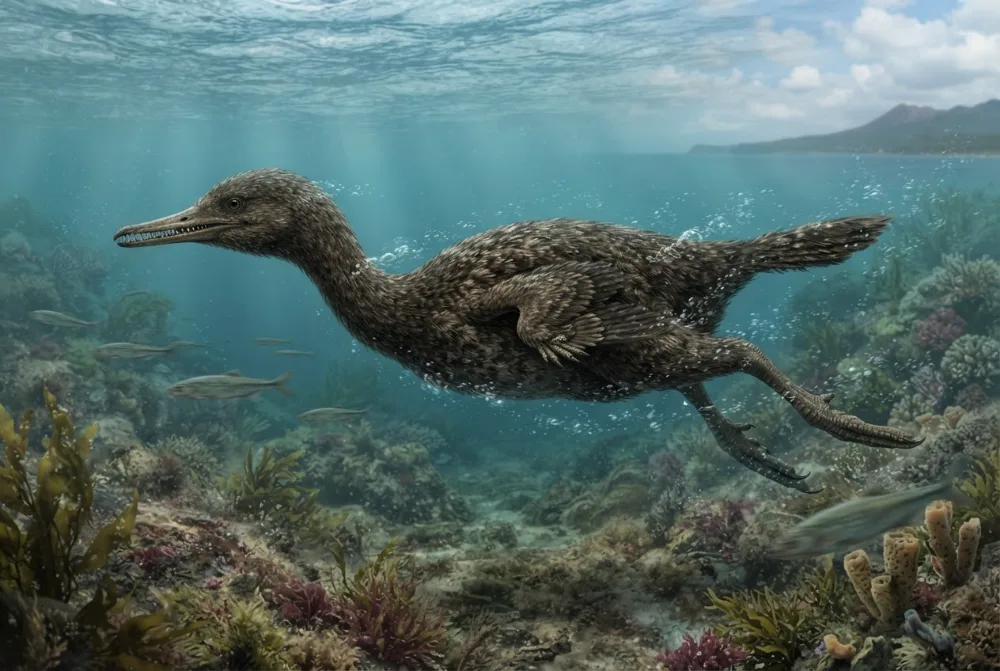
 telele jwaloka dikatse tsa lapeng tse 1.5 ho tloha nkong ho isa mohatleng🍌telele jwaloka dibanana tse 4 di behilwe ka mola🪑e nyane hoo e ka tsamayang ka tlasa setulo🏊e ne e ka sesa bolelele ba letamo le leholo la ho sesa (50 m) ka metsotswana e 22
Chupkaornis e ne e le kgolo hakae ha e bapiswa le WENA?
Ke dipalo feela ho browser ya hao. Ha ho letho le bolokwang kapa le romelwang kae kapa kae.
E ne e le lebelo hakae?


Dintlha tse monate
Chupkaornis is the oldest known hesperornithiform bird from Asia, living about 89 to 83 million years ago.2
Its name comes from the Ainu word 'chupka' meaning 'eastern', because it was found in East Asia, unlike its relative Hesperornis which means 'western bird'.1
Chupkaornis could not fly. Its wings were tiny, and it used its strong legs and feet to push itself through the water.2
The only known fossil of Chupkaornis includes nine bones: neck vertebrae, back vertebrae, part of the thigh bone, and part of the shin bone.1
It was discovered in 1996 by two amateur fossil collectors, Masatoshi and Yasuji Kera, and was named after them.1
Chupkaornis had special joints in its backbone that allowed it to bend its neck and body while diving.2
Dipotso tse botswang haholo ka Chupkaornis
?How big was Chupkaornis?
Chupkaornis was about 70 to 80 centimetres (2.3 to 2.6 feet) long, roughly the size of a small penguin.1
?Could Chupkaornis fly?
No, Chupkaornis could not fly. It had very small wings and used its strong legs and webbed feet to swim underwater.12
?What did Chupkaornis eat?
Chupkaornis was a predatory diving bird that likely caught fish underwater with its sharp teeth.2
?When did Chupkaornis live?
Chupkaornis lived during the Late Cretaceous, about 89 to 83 million years ago.1
Bakeng sa ditsebi tsa didinosaure
- Lebitso la saense
- Chupkaornis
- E rehilwe ke
- Tanaka et al. 20184
- Sehlopha
- Dinonyana tsa pele
- Lelapa / leloko
- Hesperornithiformes4
- Tlhophiso
- Theropoda > Avialae4
- Dilemo tsa mafika
- dilemo tse dimilione tse 90 ho isa ho 84 (Coniacian / Santonian)4
- Dibopeho tsa mafika
- Kashima4
- Dinaha
- Japane4
- Direkoto tsa difosili
- 1 ho The Paleobiology Database4
- Ho sibollwa
- Chupkaornis was discovered in August 1996 by Masatoshi and Yasuji Kera in Hokkaido, Japan. It was named and described by Tomonori Tanaka and colleagues in 2018.13
- E sa ntse e phehwa kgang
- Scientists are not sure exactly how large Chupkaornis was, because only a few bones have been found.1
Moo dintlha di tswang teng
- Chupkaornis (en.wikipedia.org)
- The oldest Asian hesperornithiform from the Upper Cretaceous of Japan, and the phylogenetic reassessment of Hesperornithiformes (perot-m.imgix.net)
- PBDB Taxon (paleobiodb.org)
- Chupkaornis in The Paleobiology Database (CC BY 4.0): dilemo, dibaka, dibopeho tsa mafika, tlhophiso.
Ntlha e nngwe le e nngwe leqepheng lena e na le nomoro e supang mohlodi wa yona. Haeba re fositse ho hong, re kopa tshwarelo, re balatedi ba didinosaure, ha re koranta ya saense. Re bolelle ho [email protected] mme re tla e lokisa.
 Rex o lapile! Dino Wiki ke projeke ya ntate bakeng sa mora wa hae ya ratang didinosaure, ke mahala, ha ho dipapatso, ha ho disebedi. Batho ba baholo ba ka fepa Rex seneke ho thusa hore e dule e le inthaneteng.Fepa Rex
 Archaeopteryx
 Hesperornis
 Ichthyornis
 Baptornis
 Jurapteryx
 Gobipteryx
 Tyrannosaurus
 Triceratops
 Velociraptor
 Spinosaurus
 Ankylosaurus
 Parasaurolophus