 Kwisi: O dinosaure efe?
 Ntwa ya didinosaure
 Peiso ya didinosaure
 Dipapadi tse nyane tsa didinosaure
 Albamo ya ditikara
 Manane a TOP a didinosaure
 Nkgethele!
Elektorornis
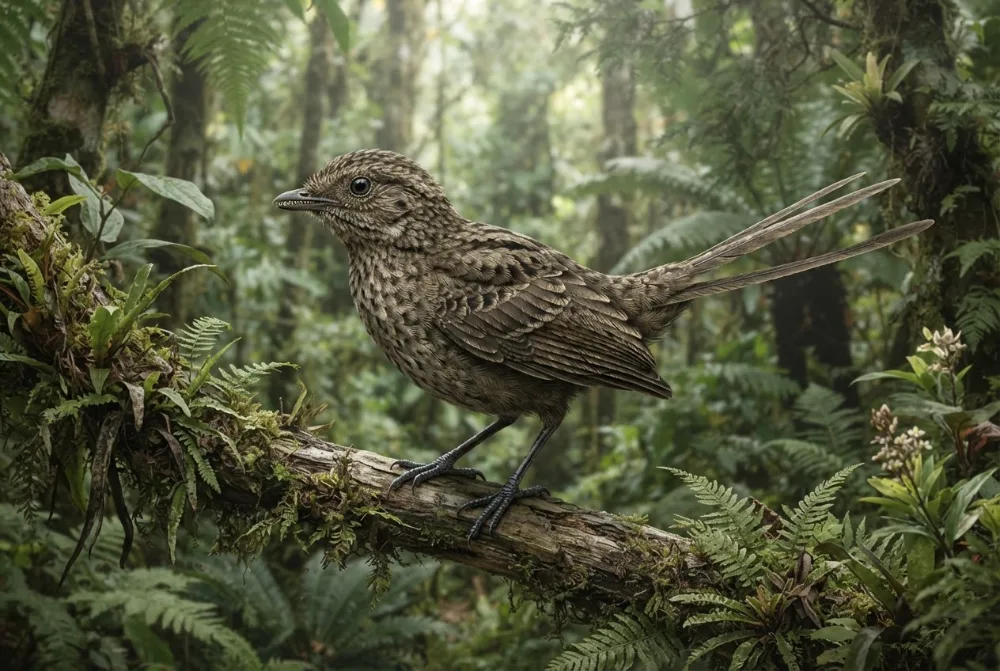
Elektorornis was a tiny bird that lived about 99 million years ago. It had a super long middle toe, much longer than its other toes. Scientists think it used that long toe to poke into tree bark and find tasty bugs to eat.12
E phetse neng?
E ne e le lebelo hakae?


Dintlha tse monate
Elektorornis is the first bird species ever described from fossils found in Burmese amber.1
Its third toe was 20% longer than its whole foot bone (tarsometatarsus). No other known bird, alive or extinct, has such a long toe compared to its foot.2
This bird was smaller than a sparrow. It was an enantiornithine, a group of early birds that lived alongside dinosaurs.12
The only known fossil of Elektorornis is a partial right leg and some wing feathers, all preserved in a piece of amber.12
Elektorornis had big, curved claws and a long hallux (back toe) that helped it grip branches. It was an arboreal bird, meaning it lived in trees.2
Scientists think Elektorornis may have had a toothless beak to pry into wood, like a woodpecker, to reach insects.1
Bakeng sa ditsebi tsa didinosaure
- Lebitso la saense
- Elektorornis
- E rehilwe ke
- Xing et al. 20193
- Sehlopha
- Dinonyana tsa pele
- Lelapa / leloko
- Enantiornithes3
- Tlhophiso
- Theropoda > Avialae3
- Dilemo tsa mafika
- dilemo tse dimilione tse 100 ho isa ho 94 (Cenomanian)3
- Dinaha
- Myanmar3
- Direkoto tsa difosili
- 1 ho The Paleobiology Database3
- Ho sibollwa
- Elektorornis chenguangi was named in 2019 by Lida Xing and colleagues. The fossil was found in Burmese amber at the Angbamo locality in Myanmar. The species name honors Chen Guang, a curator at the Hupoge Amber Museum.21
- E sa ntse e phehwa kgang
- Scientists are not sure exactly how Elektorornis used its extra-long middle toe. It might have been for probing tree bark for insects, or for better climbing, or both.2
Moo dintlha di tswang teng
- Elektorornis (en.wikipedia.org)
- A New Enantiornithine Bird with Unusual Pedal Proportions Found in Amber: Current Biology (cell.com)
- Elektorornis in The Paleobiology Database (CC BY 4.0): dilemo, dibaka, dibopeho tsa mafika, tlhophiso.
Ntlha e nngwe le e nngwe leqepheng lena e na le nomoro e supang mohlodi wa yona. Haeba re fositse ho hong, re kopa tshwarelo, re balatedi ba didinosaure, ha re koranta ya saense. Re bolelle ho [email protected] mme re tla e lokisa.
 Rex o lapile! Dino Wiki ke projeke ya ntate bakeng sa mora wa hae ya ratang didinosaure, ke mahala, ha ho dipapatso, ha ho disebedi. Batho ba baholo ba ka fepa Rex seneke ho thusa hore e dule e le inthaneteng.Fepa Rex
 Archaeopteryx
 Hesperornis
 Ichthyornis
 Baptornis
 Jurapteryx
 Gobipteryx
 Tyrannosaurus
 Triceratops
 Velociraptor
 Spinosaurus
 Ankylosaurus
 Parasaurolophus