 Kwisi: O dinosaure efe?
 Ntwa ya didinosaure
 Peiso ya didinosaure
 Dipapadi tse nyane tsa didinosaure
 Albamo ya ditikara
 Manane a TOP a didinosaure
 Nkgethele!
E phetse neng?

E ne e le lebelo hakae?


Dintlha tse monate
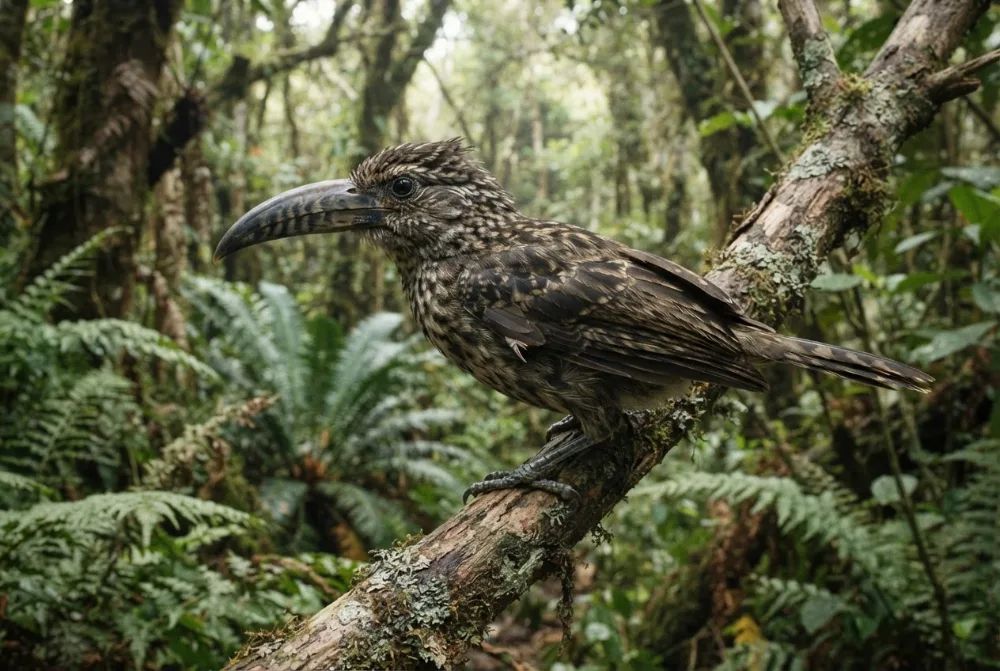
Falcatakely had a beak that looked like a toucan's, but it was not a close relative of toucans. Its beak shape evolved separately.1
The upper jaw of Falcatakely was made mostly of a large, toothless maxilla bone, with a small premaxilla that held teeth.1
Falcatakely is one of the few Mesozoic birds known to have a deep, long beak. Most early birds had simple, short snouts.1
This bird belonged to a group called Enantiornithes, which were the most common birds during the Cretaceous period.3
The only known fossil of Falcatakely was found in the Maevarano Formation in Madagascar, a site famous for other unusual animals like the giant frog Beelzebufo.3
Falcatakely shows that some ancient birds evolved large beaks before modern birds appeared, challenging old ideas about beak evolution.1
Dipotso tse botswang haholo ka Falcatakely
?How big was Falcatakely?
About the size of a crow. Its beak was about 9 centimetres (3.5 inches) long.2
?Did Falcatakely have teeth?
Yes, it had teeth in the tip of its upper jaw, which is unusual for a bird.2
?Is Falcatakely a dinosaur?
Yes, it is a bird, and birds are a type of dinosaur called avialan dinosaurs.2
?When did Falcatakely live?
It lived about 68 to 70 million years ago, during the Late Cretaceous period.2
Bakeng sa ditsebi tsa didinosaure
- Lebitso la saense
- Falcatakely
- E rehilwe ke
- O'Connor et al. 20203
- Sehlopha
- Dinonyana tsa pele
- Lelapa / leloko
- Enantiornithes3
- Tlhophiso
- Theropoda > Avialae3
- Dilemo tsa mafika
- dilemo tse dimilione tse 72 ho isa ho 66 (Maastrichtian)3
- Dibopeho tsa mafika
- Maevarano3
- Dinaha
- Madagaskara3
- Direkoto tsa difosili
- 1 ho The Paleobiology Database3
- Ho sibollwa
- Falcatakely was named in 2020 by Patrick O'Connor and colleagues based on a fossil skull found in Madagascar.31
- E sa ntse e phehwa kgang
- Scientists are still debating exactly how Falcatakely used its unusual beak, since it had teeth in the front but a large toothless beak behind.1
Moo dintlha di tswang teng
- Late Cretaceous bird from Madagascar reveals unique development of beaks | Nature (nature.com)
- Falcatakely (en.wikipedia.org)
- Falcatakely in The Paleobiology Database (CC BY 4.0): dilemo, dibaka, dibopeho tsa mafika, tlhophiso.
Ntlha e nngwe le e nngwe leqepheng lena e na le nomoro e supang mohlodi wa yona. Haeba re fositse ho hong, re kopa tshwarelo, re balatedi ba didinosaure, ha re koranta ya saense. Re bolelle ho [email protected] mme re tla e lokisa.
 Rex o lapile! Dino Wiki ke projeke ya ntate bakeng sa mora wa hae ya ratang didinosaure, ke mahala, ha ho dipapatso, ha ho disebedi. Batho ba baholo ba ka fepa Rex seneke ho thusa hore e dule e le inthaneteng.Fepa Rex
 Archaeopteryx
 Hesperornis
 Ichthyornis
 Baptornis
 Jurapteryx
 Gobipteryx
 Tyrannosaurus
 Triceratops
 Velociraptor
 Spinosaurus
 Ankylosaurus
 Parasaurolophus