 Ban dino nga? Kiis
 Xeexu dino
 Rawante dino
 Fo yu ndaw yu dino
 Albomu sitikeer
 Limu TOP yu dino
 Bett ma!
Amanasaurus
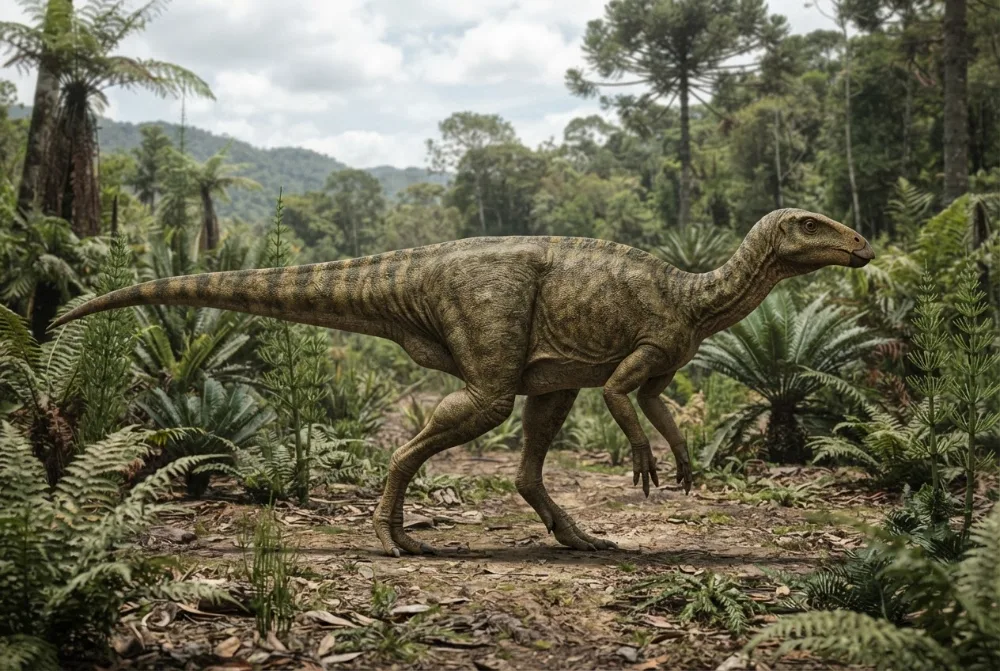
Amanasaurus was a plant-eating dinosaur that lived about 233 million years ago in what is now Brazil. It had a beak-like mouth and walked on four legs, munching on ferns and other plants. This dinosaur was about the size of a large dog, making it one of the bigger plant-eaters of its time.26
Kañ la dundoon?
Naka la réyoon?
Naka la guddoon?
Naka la kawewoon?
jortu
Naka la diisoon?
 gudd ni 2,5 muusu kër, bakkan ba geen🍌gudd ni 7 banaana yu ñu topp-toppalelu tollu ci diisaayu muusu kër🍌diis ni 29 banaana🪑tuuti ba mën a dox ci suufu siis🏃mënoon na daw 100 meetar ci 14 segond (nit ki gën a gaaw dafay soxla 9,6)
Naka la Amanasaurus réyoon, bu ñu ko méngalee ak YAW?
Ay kalkil rekk ci sa navigatëer. Dara du ñu denc, dara du ñu yónne fenn.
Naka la gaawoon?


Xibaar yu neex
Amanasaurus lived during a time called the Carnian pluvial episode, a wet period when it rained a lot. Its name 'rain lizard' comes from that.12
Scientists know Amanasaurus from just two leg bones: a top part of a right thigh bone and a bottom part of a left thigh bone. These bones were found in the same spot.21
Amanasaurus was about the same size as the earliest dinosaurs that lived alongside it. This surprised scientists, who thought silesaurids were always smaller.2
The thigh bone of Amanasaurus had a special groove called a cleft between the top of the anterior trochanter and the shaft. This is the oldest such feature seen in any silesaurid.2
Laaj yi ñu gën a laaj ci Amanasaurus
?How big was Amanasaurus?
About 1.3 metres (4.3 feet) long, based on the larger leg bone found. That is roughly the size of a large dog.4
?Was Amanasaurus a dinosaur?
Scientists disagree. Some say it was a very early ornithischian dinosaur, while others say it was a close cousin of dinosaurs. Either way, it is a dinosauriform, meaning it is closely related to dinosaurs.51
?What did Amanasaurus eat?
It was a plant-eater. It used its beak-like mouth to munch on ferns and other plants that grew during the rainy Carnian period.4
Ngir ñi xam dino lool
- Turu xam-xam
- Amanasaurus
- Ku ko tudde
- Müller and Garcia 20236
- Kurél
- Dino yu lekk gàncax te am gémmiñu picc
- Njaboot / klad
- Silesauridae6
- Klasifikasiyoŋ
- Ornithischia6
- Màggaayu doj yi
- 237 ba 227 milyoŋ at (Carnian)6
- Réew yi
- Beresil6
- Fosil yu ñu gis
- 1 ci The Paleobiology Database6
- Gisees
- Amanasaurus was named in 2023 by paleontologists Rodrigo T. Müller and Maurício S. Garcia. They studied two fossil leg bones found at the Pivetta site in Brazil.62
- Ñu ngi koy werante ba tey
- Scientists are not sure if Amanasaurus was a true dinosaur or a very close relative. Some studies place it inside Ornithischia, while others put it just outside Dinosauria.21
Fa xibaar yi jóge
- Amanasaurus (en.wikipedia.org)
- A new silesaurid from Carnian beds of Brazil fills a gap in the radiation of avian line archosaurs (nature.com)
- Amanasaurus nesbitti | Dinosaur Database by DinoAnimals.com (dinoanimals.com)
- Paleontólogos da UFSM descobrem nova espécie pré-histórica que preenche lacuna na evolução dos dinossauros – UFSM (ufsm.br)
- A new silesaurid from Carnian beds of Brazil fills a gap in the radiation of avian line archosaurs | Scientific Reports (nature.com)
- Amanasaurus in The Paleobiology Database (CC BY 4.0): at, béréb yi, formasiyoŋi doj, klasifikasiyoŋ.
Bépp xibaar ci xët wii am na lim bu wone fa mu jóge. Su nu juumee, baal nu, nun ñu bëgg dino lanu, du ab sërnaalu xam-xam. Wax nu ko ci [email protected] nu defar ko.
 Rex xiif na! Dino Wiki, mbiru ab baay la ngir doomam ju góor ju bëgg dinosoor, ci neen te amul kaamuñaate, amul tracker. Mag ñi mën nañu jox Rex tuuti ñam ngir dimbali ko mu des ci internet.Dundal Rex
 Iguanodon
 Tenontosaurus
 Thescelosaurus
 Zalmoxes
 Camptosaurus
 Rhabdodon
 Nothosaurus
 Massospondylus
 Plateosaurus
 Coelophysis
 Podokesaurus
 Simosaurus