 Ban dino nga? Kiis
 Xeexu dino
 Rawante dino
 Fo yu ndaw yu dino
 Albomu sitikeer
 Limu TOP yu dino
 Bett ma!
Rhamphinion
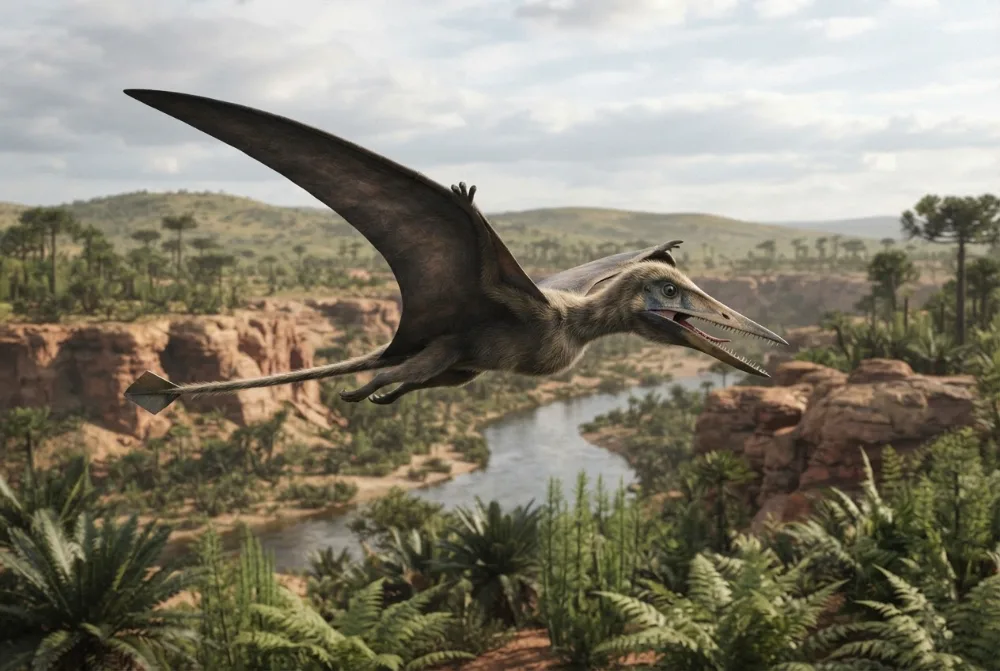
Rhamphinion was an early flying reptile that soared over what is now Arizona during the Early Jurassic. It was one of the first pterosaurs ever found in the Americas, but we only know it from a few pieces of its skull.12
Kañ la dundoon?
Naka la gaawoon?


Xibaar yu neex
Rhamphinion lived about 196 to 183 million years ago, during the Early Jurassic.1
The only known fossils are three pieces of skull: an occipital bone, part of a left jugal (cheek bone), and two teeth with a possible jaw fragment.12
Its name comes from Greek words meaning 'beak nape', because the fossils come from the back of the skull.1
When it was discovered in 1978, Rhamphinion was the oldest pterosaur known from the Western Hemisphere.1
The fossils were found by an expedition led by Farish A. Jenkins Jr., and the species name jenkinsi honors him.1
A nearly complete wing bone (fourth metacarpal) found nearby might belong to Rhamphinion, but scientists are not sure.1
Laaj yi ñu gën a laaj ci Rhamphinion
?Is Rhamphinion a dinosaur?
No, Rhamphinion is a pterosaur, a flying reptile that is not a dinosaur.1
?How big was Rhamphinion?
Nobody knows for sure because only a few skull pieces have been found, but it was a small pterosaur.1
?What did Rhamphinion eat?
Scientists are not certain, but as a basal pterosaur it likely ate small animals like insects or fish.1
?When did Rhamphinion live?
Rhamphinion lived during the Early Jurassic, about 196 to 183 million years ago.1
Ngir ñi xam dino lool
- Turu xam-xam
- Rhamphinion
- Ku ko tudde
- Padian 19843
- Kurél
- Reptil yuy naaw
- Njaboot / klad
- Rhamphorhynchoidea3
- Klasifikasiyoŋ
- Pterosauria3
- Màggaayu doj yi
- 200 ba 184 milyoŋ at (Sinemurian / Pliensbachian)3
- Formasiyoŋi doj
- Kayenta3
- Réew yi
- Amerig3
- Fosil yu ñu gis
- 1 ci The Paleobiology Database3
- Gisees
- Rhamphinion was named in 1984 by Kevin Padian based on skull fragments collected in 1978 from the Kayenta Formation of Arizona. The fossils were found by an expedition from Harvard's Museum of Comparative Zoology and the Museum of Northern Arizona.12
- Ñu ngi koy werante ba tey
- Scientists are not sure exactly where Rhamphinion fits in the pterosaur family tree because the fossils are so fragmentary. It might be related to Dimorphodon, but its classification remains uncertain.1
Fa xibaar yi jóge
- Rhamphinion (en.wikipedia.org)
- Pterosaur remains from the Kayenta Formation (?Early Jurassic) of Arizona | The Palaeontological Association (palass.org)
- Rhamphinion in The Paleobiology Database (CC BY 4.0): at, béréb yi, formasiyoŋi doj, klasifikasiyoŋ.
Bépp xibaar ci xët wii am na lim bu wone fa mu jóge. Su nu juumee, baal nu, nun ñu bëgg dino lanu, du ab sërnaalu xam-xam. Wax nu ko ci [email protected] nu defar ko.
 Rex xiif na! Dino Wiki, mbiru ab baay la ngir doomam ju góor ju bëgg dinosoor, ci neen te amul kaamuñaate, amul tracker. Mag ñi mën nañu jox Rex tuuti ñam ngir dimbali ko mu des ci internet.Dundal Rex
 Pteranodon
 Quetzalcoatlus
 Dorygnathus
 Rhamphorhynchus
 Anhanguera
 Pterodactylus
 Dilophosaurus
 Stenopterygius
 Lufengosaurus
 Scutellosaurus
 Yunnanosaurus
 Sinosaurus