 Ban dino nga? Kiis
 Xeexu dino
 Rawante dino
 Fo yu ndaw yu dino
 Albomu sitikeer
 Limu TOP yu dino
 Bett ma!
Sacisaurus
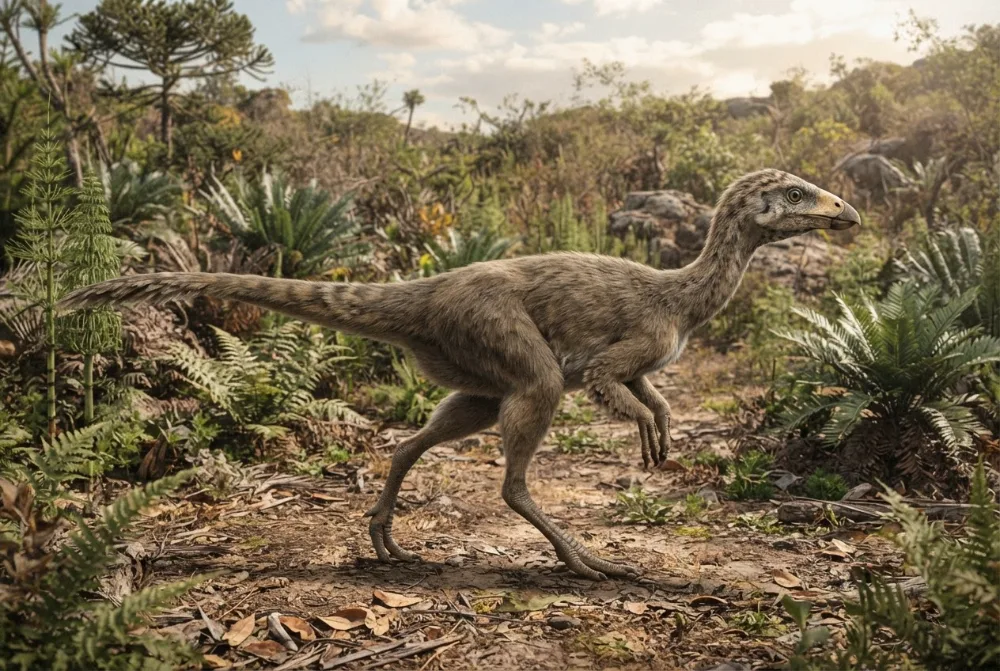
Sacisaurus was a small, fast plant-eater that lived in Brazil about 225 million years ago. It had a beak-like jaw and leaf-shaped teeth for munching on tough plants. This dinosaur got its name because scientists found 35 right thigh bones but only one left one, just like the one-legged Saci from Brazilian stories.1
Kañ la dundoon?
Naka la réyoon?
Naka la guddoon?
Naka la kawewoon?
 gudd ni 2 muusu kër, bakkan ba geen🍌gudd ni 6 banaana yu ñu topp-toppale🪑tuuti ba mën a dox ci suufu siis🏃mënoon na daw 100 meetar ci 13 segond (nit ki gën a gaaw dafay soxla 9,6)
Naka la Sacisaurus réyoon, bu ñu ko méngalee ak YAW?
Ay kalkil rekk ci sa navigatëer. Dara du ñu denc, dara du ñu yónne fenn.
Naka la gaawoon?


Xibaar yu neex
Sacisaurus was a small dinosaur, only about 1.1 metres (3.6 feet) long and 35 centimetres (1.15 feet) tall at the hips.1
Its biggest teeth were just 3 millimetres (0.12 inches) long, perfect for nibbling plants.1
Sacisaurus had long, strong legs that made it a fast runner, able to dart away from predators.1
The tip of its lower jaw had a beak-like bone that looks like the predentary bone found in ornithischian dinosaurs.1
Scientists found 35 right thigh bones but only one left thigh bone, which is why they named it after the one-legged Saci.1
Sacisaurus lived during the Late Triassic period, about 225 million years ago, in what is now southern Brazil.1
Laaj yi ñu gën a laaj ci Sacisaurus
?Is Sacisaurus a dinosaur?
Scientists are not sure. It is a silesaurid dinosauriform, which means it is a close relative of dinosaurs, but it is not classified as a dinosaur.13
?What did Sacisaurus eat?
Sacisaurus was an herbivore, meaning it ate plants. It had leaf-shaped teeth with large denticles and a beak-like jaw tip to help it chew tough plants.12
?How fast could Sacisaurus run?
Nobody knows the exact speed, but its long, strong legs and elongate hindlimbs suggest it was a fast runner with good cursorial ability.12
?Why is it called Sacisaurus?
It is named after Saci, a one-legged creature from Brazilian folklore, because scientists found 35 right thigh bones but only one left thigh bone among the fossils.1
Ku tas léeb yu dul dëgg
Léeb: Some people think Sacisaurus was a true dinosaur.
Dëgg: Most scientists now place Sacisaurus in Silesauridae, a group of dinosaur-like reptiles that are close relatives but not true dinosaurs. A few studies suggest it might be a very early ornithischian dinosaur, but this is debated.12
Ngir ñi xam dino lool
- Turu xam-xam
- Sacisaurus
- Ku ko tudde
- Ferigolo and Langer 20073
- Kurél
- Dino yu lekk gàncax te am gémmiñu picc
- Njaboot / klad
- Silesauridae3
- Klasifikasiyoŋ
- Ornithischia3
- Màggaayu doj yi
- 227 ba 206 milyoŋ at (Norian)3
- Formasiyoŋi doj
- Caturrita3
- Réew yi
- Beresil3
- Fosil yu ñu gis
- 1 ci The Paleobiology Database3
- Gisees
- Sacisaurus was discovered in 2001 near Agudo, Brazil, by a team led by paleontologist Jorge Ferigolo. The species was officially named in 2006 in the journal Historical Biology.1
- Ñu ngi koy werante ba tey
- Scientists still debate whether Sacisaurus was a non-dinosaur dinosauromorph or one of the earliest ornithischian dinosaurs.12
Fa xibaar yi jóge
- Sacisaurus (en.wikipedia.org)
- Brazil): anatomy and affinities agudoensis (Caturrita Formation; Rio Grande do Sul, (paleolab.com.br)
- Sacisaurus in The Paleobiology Database (CC BY 4.0): at, béréb yi, formasiyoŋi doj, klasifikasiyoŋ.
Bépp xibaar ci xët wii am na lim bu wone fa mu jóge. Su nu juumee, baal nu, nun ñu bëgg dino lanu, du ab sërnaalu xam-xam. Wax nu ko ci [email protected] nu defar ko.
 Rex xiif na! Dino Wiki, mbiru ab baay la ngir doomam ju góor ju bëgg dinosoor, ci neen te amul kaamuñaate, amul tracker. Mag ñi mën nañu jox Rex tuuti ñam ngir dimbali ko mu des ci internet.Dundal Rex
 Iguanodon
 Tenontosaurus
 Thescelosaurus
 Zalmoxes
 Camptosaurus
 Rhabdodon
 Nothosaurus
 Massospondylus
 Plateosaurus
 Coelophysis
 Podokesaurus
 Simosaurus