 Uyiyiphi idayinaso? Ikwizi
 Idabi leedayinaso
 Ugqatso lweedayinaso
 Imidlalo emincinci yeedayinaso
 I-albhamu yezitikha
 Iilisti ze-TOP zeedayinaso
 Ndothuse!
Anurognathus
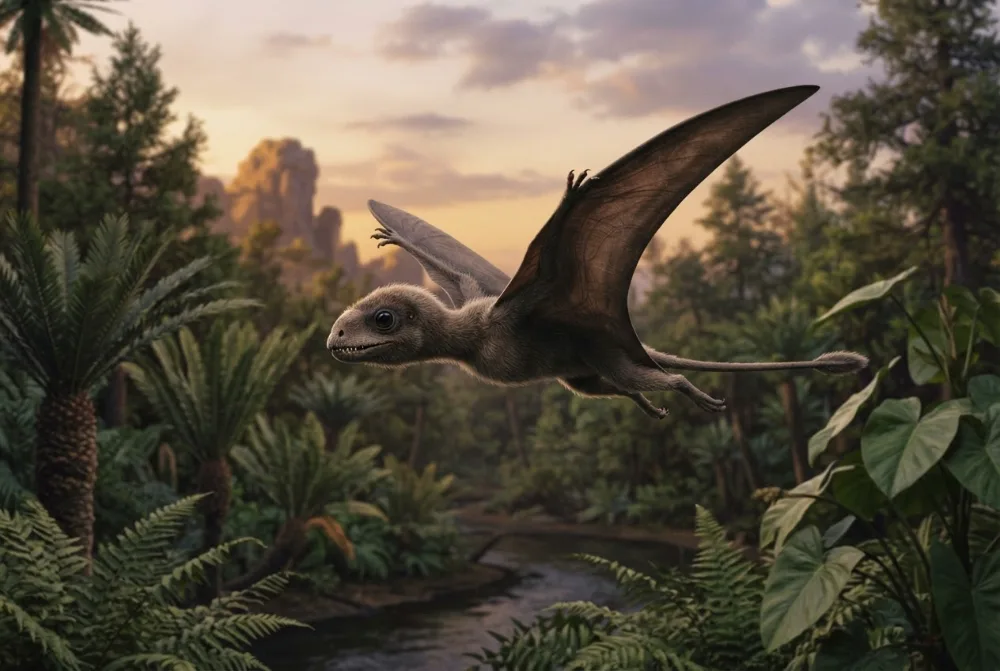
Anurognathus was a tiny pterosaur that lived in the Late Jurassic. It had a very short, wide head and big eyes, like a little flying frog. It probably hunted insects at dusk.12
Yaphila nini?
Yayinkulu kangakanani?
Yayinde kangakanani?
Yayinzima kangakanani?
Anurognathus wayemkhulu kangakanani xa ethelekiswa NAWE?
Yimathematika nje kwibhrawuza yakho. Akukho nto igcinwayo okanye ithunyelwe naphi na.
Yayikhawuleza kangakanani?


Iinyani ezimnandi
Anurognathus had a very short tail, unlike most early pterosaurs. This made it more maneuverable when hunting insects.1
Its skull was wider than it was long, and its eyes were huge. This helped it see well in dim light.12
Anurognathus weighed only about 40 grams (1.4 ounces), as light as a small bird.1
Scientists think Anurognathus had bristles around its mouth, like a fringe, to help catch insects.12
Only two fossils of Anurognathus have been found, both in Germany. One is a juvenile.1
Eyona mibuzo ibuzwa kakhulu: Anurognathus
?How big was Anurognathus?
Anurognathus was tiny, with a wingspan of about 35 cm (14 in) and a weight of only 40 grams (1.4 oz), as light as a small bird.1
?What did Anurognathus eat?
It ate insects. Its pin-like teeth and small mouth were perfect for catching tiny bugs about 11 mm long.1
?Could Anurognathus fly?
Yes, it was a pterosaur and could fly. It had short, broad wings and probably flew slowly and maneuvered well to catch insects at dusk.1
?Did Anurognathus have feathers?
No, it did not have feathers. It had a fuzzy coat of hair-like fibers called pycnofibers, and possibly bristles around its mouth.1
?When did Anurognathus live?
Anurognathus lived during the Late Jurassic period, about 150 to 148 million years ago.1
?Why did Anurognathus have big eyes?
Its huge eyes helped it see well in dim light, so it could hunt insects at dusk or in the dark.1
?Is Anurognathus a dinosaur?
No, Anurognathus is a pterosaur, a flying reptile that is not a dinosaur.1
?How many fossils of Anurognathus have been found?
Only two fossils have been found, both in Germany. One is a juvenile, and the other is a subadult.1
Inyaniso ngeentsomi
Intsomi: Some people think Anurognathus was a dinosaur.
Inyaniso: Anurognathus was a pterosaur, a flying reptile that is not a dinosaur.4
Kwiingcali zeedayinaso
- Igama lenzululwazi
- Anurognathus
- Inikwe igama ngu:
- Döderlein 19234
- Iqela
- Izirhubuluzi ezibhabhayo
- Usapho / iclade
- Anurognathidae4
- Ukuhlelwa
- Pterosauria4
- Ubudala bamatye
- 149 ukuya ku-145 izigidi zeminyaka (Tithonian)4
- Izakhiwo zamatye
- Solnhofener Plattenkalk4
- Amazwe
- iJamani4
- Iirekhodi zeefosili
- 1 kwi-Paleobiology Database4
- Ukufunyanwa
- Anurognathus was named by Ludwig Döderlein in 1923. He bought the first fossil from a collector in 1922. It was found in the Solnhofen limestone of Germany.1
- Kusaxoxwa ngayo
- Scientists still debate whether Anurognathus was a fast flyer that surprised its prey, or a slow, maneuverable hunter like a nightjar.1
Apho iinyani zivela khona
- Anurognathus (en.wikipedia.org)
- A second specimen of the pterosaurAnurognathus ammoni | PalZ | Springer Nature Link (link.springer.com)
- PaleoCodex :: Anurognathus (paleocodex.com)
- Anurognathus in The Paleobiology Database (CC BY 4.0): ubudala, iindawo, izakhiwo zamatye, ukuhlelwa.
Yonke inyani ekweli phepha inenombolo ebonisa umthombo wayo. Ukuba siphosisile, uxolo, sithanda iidayinaso, asiyojenali yenzululwazi. Sixelele apha: [email protected], siya kuyilungisa.
 URex ulambile! I-Dino Wiki yiprojekthi katata ukwenzela unyana wakhe othanda iidayinaso, isimahla, ayinazintengiso, ayinazilandeli. Abantu abadala banokuphakela uRex isidlwana ukuze incede ihlale kwi-intanethi.Phakela uRex
 Pteranodon
 Quetzalcoatlus
 Dorygnathus
 Rhamphorhynchus
 Anhanguera
 Pterodactylus
 Brachiosaurus
 Diplodocus
 Allosaurus
 Brontosaurus
 Compsognathus
 Camarasaurus