 Uyiyiphi idayinaso? Ikwizi
 Idabi leedayinaso
 Ugqatso lweedayinaso
 Imidlalo emincinci yeedayinaso
 I-albhamu yezitikha
 Iilisti ze-TOP zeedayinaso
 Ndothuse!
Archaeornithomimus
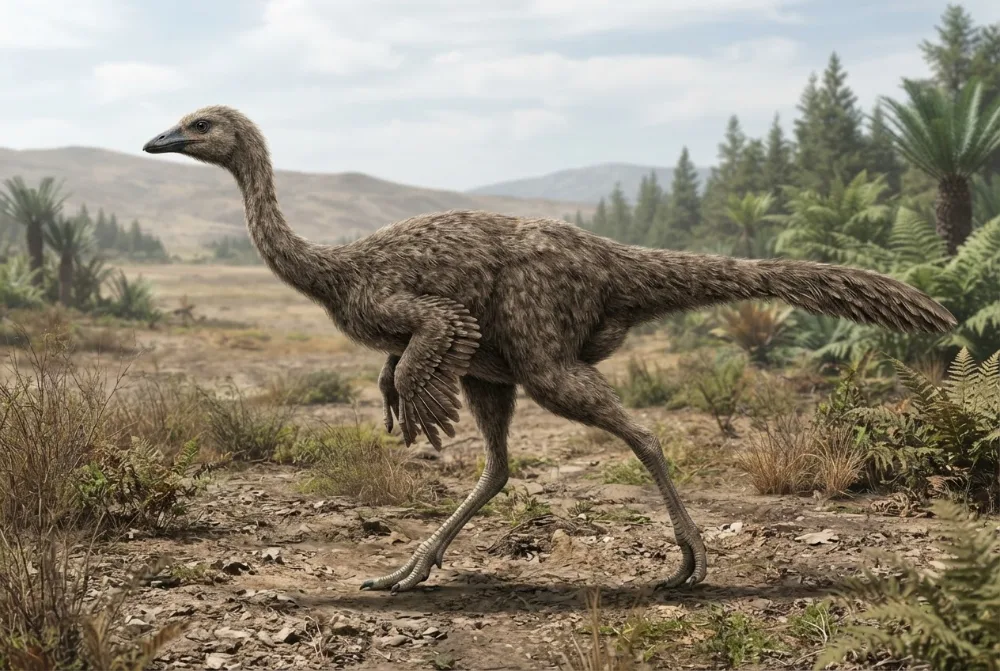
Archaeornithomimus was a fast, ostrich-like dinosaur that lived in Asia during the Late Cretaceous. It had a beak, long legs, and probably feathers. It could run quickly to escape predators or chase small prey.1
Yaphila nini?
Yayinkulu kangakanani?
Yayinde kangakanani?
Yayiphakame kangakanani?
uqikelelo
Yayinzima kangakanani?
 inde njengezinja ezingama-3, impumlo ukuya emsileni🍌inde njengeebhanana ezingama-19 zilandelelana🍉inzima njengamavatala angama-14🧸inzima njengabantwana basenkulisa abangama-4🎒inzima njengabantwana besikolo abangama-2🏃ibinokubaleka iimitha ezili-100 ngemizuzwana engama-5.5 (oyena mntu ukhawulezayo udinga i-9,6)
Archaeornithomimus wayemkhulu kangakanani xa ethelekiswa NAWE?
Yimathematika nje kwibhrawuza yakho. Akukho nto igcinwayo okanye ithunyelwe naphi na.
Yayikhawuleza kangakanani?


Iinyani ezimnandi
Its neck bones had air spaces inside, like modern birds, which made its neck lighter.1
Scientists think it had feathers that looked like those of an ostrich.1
It lived alongside the giant dinosaur Gigantoraptor and the predator Alectrosaurus.1
No stress fractures were found in its foot bones, meaning it probably didn't run too hard or too often.1
Its third toe bone was not pinched at the top, so its foot was not built for extreme speed like some other ornithomimids.1
The first fossils were found by an expedition led by Roy Chapman Andrews in 1923.1
Eyona mibuzo ibuzwa kakhulu: Archaeornithomimus
?How big was Archaeornithomimus?
About 3.4 metres (11 feet) long and weighed over 71.5 kilograms (158 pounds).1
?What did Archaeornithomimus eat?
It was an omnivore with a horny beak, eating small mammals, plants, fruit, eggs, and even hatchlings of other dinosaurs.1
?Did Archaeornithomimus have feathers?
Yes, scientists think it had feathers that looked like those of an ostrich.1
?When did Archaeornithomimus live?
It lived during the Late Cretaceous period, about 96 million years ago.1
?Where was Archaeornithomimus found?
Its fossils were found in the Iren Dabasu Formation of Inner Mongolia, China.1
?Was Archaeornithomimus a dinosaur?
Yes, it was a theropod dinosaur, specifically an ornithomimosaurian.1
Kwiingcali zeedayinaso
- Igama lenzululwazi
- Archaeornithomimus
- Inikwe igama ngu:
- Russell 19724
- Iqela
- Iidayinaso-nciniba
- Usapho / iclade
- Ornithomimidae4
- Ukuhlelwa
- Theropoda > Ornithomimosauria4
- Ubudala bamatye
- 90 ukuya ku-72 izigidi zeminyaka (Coniacian / Campanian)4
- Izakhiwo zamatye
- Iren Dabasu, Dabrazhin4
- Amazwe
- iTshayina, iKazakhstan4
- Iirekhodi zeefosili
- 3 kwi-Paleobiology Database4
- Ukufunyanwa
- The first fossils were found in 1923 in Inner Mongolia by an American Museum of Natural History expedition. In 1933, Charles Gilmore named them Ornithomimus asiaticus. In 1972, Dale Russell gave them their own genus, Archaeornithomimus.1
- Kusaxoxwa ngayo
- Scientists are not sure whether Archaeornithomimus was a true ornithomimid or a more primitive ornithomimosaur. Some studies place it inside the family, others outside.1
Apho iinyani zivela khona
- Archaeornithomimus (en.wikipedia.org)
- Archaeornithomimus | Natural History Museum (nhm.ac.uk)
- PBDB Taxon (paleobiodb.org)
- Archaeornithomimus in The Paleobiology Database (CC BY 4.0): ubudala, iindawo, izakhiwo zamatye, ukuhlelwa.
Yonke inyani ekweli phepha inenombolo ebonisa umthombo wayo. Ukuba siphosisile, uxolo, sithanda iidayinaso, asiyojenali yenzululwazi. Sixelele apha: [email protected], siya kuyilungisa.
 URex ulambile! I-Dino Wiki yiprojekthi katata ukwenzela unyana wakhe othanda iidayinaso, isimahla, ayinazintengiso, ayinazilandeli. Abantu abadala banokuphakela uRex isidlwana ukuze incede ihlale kwi-intanethi.Phakela uRex
 Gallimimus
 Ornithomimus
 Struthiomimus
 Deinocheirus
 Dromiceiomimus
 Anserimimus
 Tyrannosaurus
 Triceratops
 Velociraptor
 Spinosaurus
 Ankylosaurus
 Parasaurolophus