 Uyiyiphi idayinaso? Ikwizi
 Idabi leedayinaso
 Ugqatso lweedayinaso
 Imidlalo emincinci yeedayinaso
 I-albhamu yezitikha
 Iilisti ze-TOP zeedayinaso
 Ndothuse!
Yaphila nini?

Yayinkulu kangakanani?
Yayinde kangakanani?
Yayiphakame kangakanani?
Yayinzima kangakanani?
 inde njengezinja ezingama-5, impumlo ukuya emsileni🍌inde njengeebhanana ezingama-27 zilandelelana🍉inzima njengamavatala angama-70🧸inzima njengabantwana basenkulisa abangama-18🎒inzima njengabantwana besikolo abangama-11🏃ibinokubaleka iimitha ezili-100 ngemizuzwana engama-5.1 (oyena mntu ukhawulezayo udinga i-9,6)
Struthiomimus wayemkhulu kangakanani xa ethelekiswa NAWE?
Yimathematika nje kwibhrawuza yakho. Akukho nto igcinwayo okanye ithunyelwe naphi na.
Yayikhawuleza kangakanani?


Iinyani ezimnandi
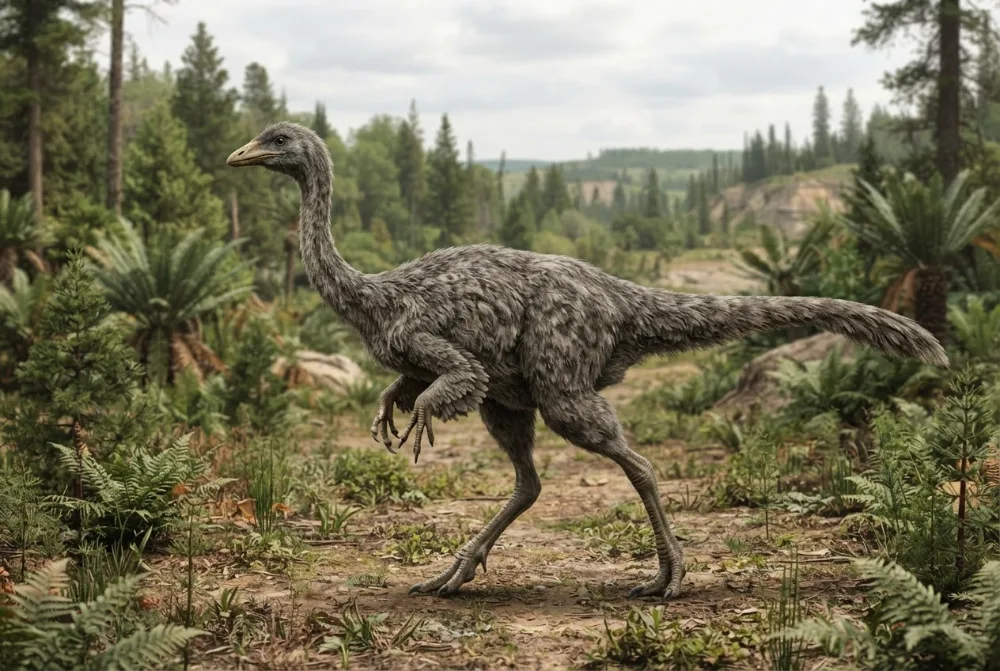
Struthiomimus looked a bit like a featherless ostrich with a long tail.1
Its neck made up about 40% of the length of its body in front of the hips.2
It had three fingers on each hand that were roughly the same length, which is unusual for a theropod.2
Its tail was relatively stiff and probably helped it keep balance while running.2
Some scientists think its hands worked like a hook or clamp to pull branches close, but others think they supported wing feathers.2
Eyona mibuzo ibuzwa kakhulu: Struthiomimus
?How big was Struthiomimus?
About 4.3 metres (14 feet) long, 1.4 metres (4.5 feet) tall at the hips, and weighed around 150 kilograms (330 pounds). A larger specimen weighed about 234 kilograms (515 pounds).21
?How fast could Struthiomimus run?
It could run between 50 and 80 km/h (31 to 50 mph), using its long legs to escape predators like tyrannosaurs.2
?What did Struthiomimus eat?
It was probably an omnivore, eating both plants and small animals like insects, mammals, and reptiles. Its toothless beak was good for cropping plants and maybe filtering food from water.21
?Did Struthiomimus have feathers?
Yes, it likely had feathers all over its body. Its arm bones show adaptations that may have supported wing feathers.2
?Where did Struthiomimus live?
It lived in western North America, in what is now Canada and the United States, during the Late Cretaceous period.21
?Why is it called Struthiomimus?
Its name means 'ostrich mimic' because it looked a lot like a modern ostrich, with long legs, a long neck, and a toothless beak.21
?Was Struthiomimus bigger than a human?
Yes, it was about 4.3 metres long and stood about 1.4 metres tall at the hips, which is taller than most people.2
Inyaniso ngeentsomi
Intsomi: Struthiomimus was a fierce meat-eater like other theropods.
Inyaniso: It had no teeth and a beak, and most scientists think it ate both plants and small animals, not just meat.2
Kwiingcali zeedayinaso
- Igama lenzululwazi
- Struthiomimus
- Inikwe igama ngu:
- Osborn 19163
- Iqela
- Iidayinaso-nciniba
- Usapho / iclade
- Ornithomimidae3
- Ukuhlelwa
- Theropoda > Ornithomimosauria3
- Ubudala bamatye
- 84 ukuya ku-66 izigidi zeminyaka (Campanian / Maastrichtian)3
- Izakhiwo zamatye
- Oldman, Kirtland, Dinosaur Park3
- Amazwe
- iKhanada, iUSA3
- Iirekhodi zeefosili
- 18 kwi-Paleobiology Database3
- Ukufunyanwa
- Lawrence Lambe found the first remains in 1901 and named them Ornithomimus altus. In 1914, Barnum Brown found a nearly complete skeleton in Alberta, and Henry Fairfield Osborn named it Struthiomimus in 1917.2
- Kusaxoxwa ngayo
- Scientists still debate what Struthiomimus ate. Some think it was a plant-eater, others think it was a meat-eater, and some even suggest it filtered food from water.2
Apho iinyani zivela khona
- Struthiomimus | Natural History Museum (nhm.ac.uk)
- Struthiomimus (en.wikipedia.org)
- Struthiomimus in The Paleobiology Database (CC BY 4.0): ubudala, iindawo, izakhiwo zamatye, ukuhlelwa.
Yonke inyani ekweli phepha inenombolo ebonisa umthombo wayo. Ukuba siphosisile, uxolo, sithanda iidayinaso, asiyojenali yenzululwazi. Sixelele apha: [email protected], siya kuyilungisa.
 URex ulambile! I-Dino Wiki yiprojekthi katata ukwenzela unyana wakhe othanda iidayinaso, isimahla, ayinazintengiso, ayinazilandeli. Abantu abadala banokuphakela uRex isidlwana ukuze incede ihlale kwi-intanethi.Phakela uRex
 Gallimimus
 Ornithomimus
 Deinocheirus
 Dromiceiomimus
 Archaeornithomimus
 Anserimimus
 Tyrannosaurus
 Triceratops
 Velociraptor
 Spinosaurus
 Ankylosaurus
 Parasaurolophus