 Uyiyiphi idayinaso? Ikwizi
 Idabi leedayinaso
 Ugqatso lweedayinaso
 Imidlalo emincinci yeedayinaso
 I-albhamu yezitikha
 Iilisti ze-TOP zeedayinaso
 Ndothuse!
Yaphila nini?

Yayinkulu kangakanani?
Yayinde kangakanani?
Yayiphakame kangakanani?
Yayinzima kangakanani?
 inde njengeemoto ezingama-2 zipakwe zilandelelana🍌inde njengeebhanana ezingama-56 zilandelelana
 inzima njengeendlovu ezingama-1.5🍉inzima njengamavatala angama-2000🎒inzima njengamagumbi okufundela apheleleyo abantwana angama-12🐻❄️inzima njengeebhere ezimhlophe ezingama-22🏃ibinokubaleka iimitha ezili-100 ngemizuzwana engama-15 (oyena mntu ukhawulezayo udinga i-9,6)
Deinocheirus wayemkhulu kangakanani xa ethelekiswa NAWE?
Yimathematika nje kwibhrawuza yakho. Akukho nto igcinwayo okanye ithunyelwe naphi na.
Yayikhawuleza kangakanani?


Iinyani ezimnandi
For a long time, scientists only had a pair of arm bones with huge claws to study Deinocheirus. They did not know what the rest of the dinosaur looked like until 2014.1
Deinocheirus had a large hump on its back, supported by its backbone. This made it look a bit like a camel.1
Its hands were huge and had long, sharp claws. The name Deinocheirus means 'terrible hand'.1
Deinocheirus lived during the Late Cretaceous period, about 70 to 66 million years ago.1
It was an omnivore, meaning it ate both plants and meat. Scientists think it used its beak to eat plants and small animals.15
Deinocheirus belonged to a group of dinosaurs called ornithomimosaurs, which are often called 'ostrich dinosaurs' because they looked a bit like ostriches.5
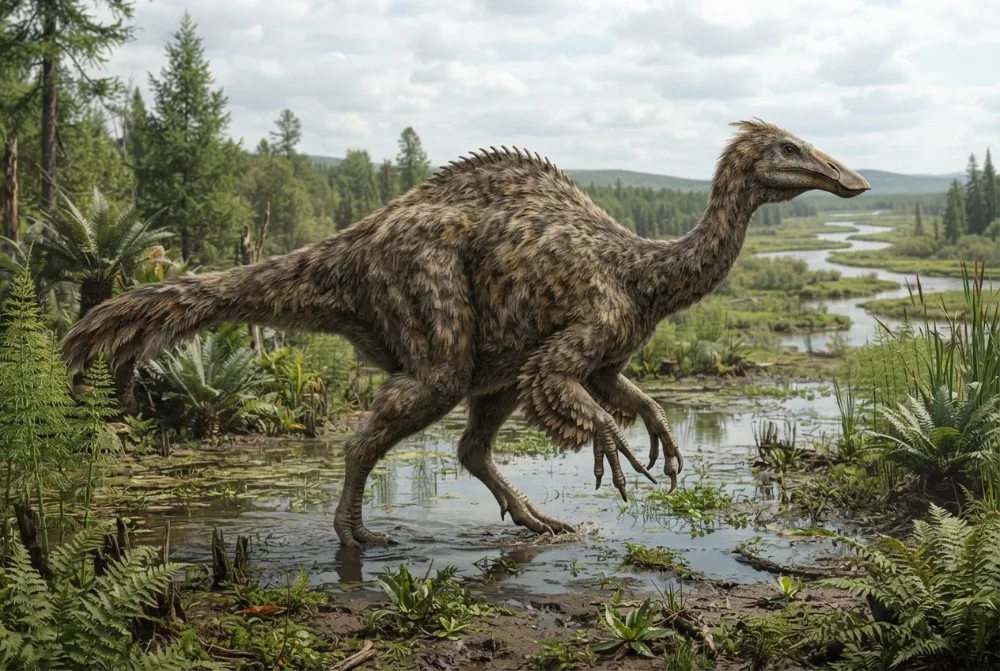
Eyona mibuzo ibuzwa kakhulu: Deinocheirus
?How big was Deinocheirus?
It was about 11 metres (36 feet) long and weighed around 6.5 tonnes (7.2 short tons). That is as long as a big bus.4
?What did Deinocheirus eat?
It was an omnivore, meaning it ate both plants and meat. It had a duck-like beak for cropping soft plants, and fish scales found with one specimen show it also ate fish.4
?Did Deinocheirus have feathers?
Yes, it probably had a fan of feathers on its tail. The tail ended in pygostyle-like vertebrae, which is a sign of feathers.4
?Why did Deinocheirus have such big claws?
Its huge, blunt claws were probably used for digging and gathering plants. The name Deinocheirus means 'terrible hand' because of those big claws.4
?Was Deinocheirus a dinosaur?
Yes, it was a dinosaur. It belonged to a group called ornithomimosaurs, which are often called 'ostrich dinosaurs'.41
?When did Deinocheirus live?
It lived during the Late Cretaceous period, about 70 to 66 million years ago.1
?Could Deinocheirus run fast?
No, it was not built for speed. It had short legs and a bulky body, so it moved slowly.4
?What hunted Deinocheirus?
Bite marks on its bones show that the tyrannosaurid Tarbosaurus probably attacked or scavenged it.4
Kwiingcali zeedayinaso
- Igama lenzululwazi
- Deinocheirus
- Inikwe igama ngu:
- Kielan-Jaworowska 19695
- Iqela
- Iidayinaso-nciniba
- Usapho / iclade
- Deinocheiridae5
- Ukuhlelwa
- Theropoda > Ornithomimosauria5
- Ubudala bamatye
- 100 ukuya ku-66 izigidi zeminyaka (Cenomanian / Maastrichtian)5
- Izakhiwo zamatye
- Nemegt, Baynshire5
- Amazwe
- iMongolia5
- Iirekhodi zeefosili
- 5 kwi-Paleobiology Database5
- Ukufunyanwa
- Deinocheirus was named by Polish paleontologist Zofia Kielan-Jaworowska in 1969. The first fossils were found in the Gobi Desert in Mongolia.51
Apho iinyani zivela khona
- Deinocheirus | Natural History Museum (nhm.ac.uk)
- PBDB Taxon (paleobiodb.org)
- Deinocheirus — size, diet & habitat | DinoLifePedia (dinolifepedia.com)
- Deinocheirus (en.wikipedia.org)
- Deinocheirus in The Paleobiology Database (CC BY 4.0): ubudala, iindawo, izakhiwo zamatye, ukuhlelwa.
Yonke inyani ekweli phepha inenombolo ebonisa umthombo wayo. Ukuba siphosisile, uxolo, sithanda iidayinaso, asiyojenali yenzululwazi. Sixelele apha: [email protected], siya kuyilungisa.
 URex ulambile! I-Dino Wiki yiprojekthi katata ukwenzela unyana wakhe othanda iidayinaso, isimahla, ayinazintengiso, ayinazilandeli. Abantu abadala banokuphakela uRex isidlwana ukuze incede ihlale kwi-intanethi.Phakela uRex
 Gallimimus
 Ornithomimus
 Struthiomimus
 Dromiceiomimus
 Archaeornithomimus
 Anserimimus
 Tyrannosaurus
 Triceratops
 Velociraptor
 Spinosaurus
 Ankylosaurus
 Parasaurolophus